

April Wang Attends Heidelberg Laureate Forum
Wang was among 200 young researchers selected to attend the annual networking conference designed to encourage intellectual discourse and collaboration
Northwestern computer science student April Wang aims to develop algorithms and software to enable practical scientific applications in quantum computing, including solving complex problems in physics and chemistry.
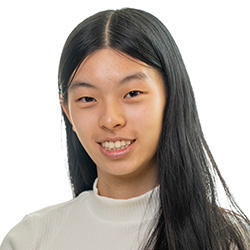 So, when she attended the Heidelberg Laureate Forum (HLF) last month, Wang was particularly excited to meet Charles H. Bennett and Gilles Brassard, joint recipients of the 2025 Association for Computing Machinery (ACM) A.M. Turing Award for their essential role in establishing the foundations of quantum information science and transforming secure communication and computing.
“Their BB84 quantum key establishment protocol was the first quantum cryptography protocol ever developed and is still the first quantum protocol taught in many QIS courses,” Wang said. “It was surreal to talk to them, and I enjoyed both their presentation on the history of QIS and learning about their recent interests, like Bennett’s studies on bacteria.”
Wang is a fourth-year student majoring in integrated science and computer science at Northwestern’s Weinberg College of Arts and Sciences, and pursuing a minor in physics. She plans to pursue a PhD in quantum computing to continue the research she’s explored with Professor Nikos Hardavellas and the Parallel Architecture Group at Northwestern (PARAG@N).
Held September 13-18 at Heidelberg University in Germany, the annual HLF networking conference is designed to encourage intellectual discourse and collaboration. Two hundred select young researchers in mathematics and computer science from around the world interact with the disciplines’ foremost luminaries in a mix of scientific and social activities.
At HLF, Wang learned as much from her peers as from the HLF laureates. A four-hour boat tour along the Neckar River was a venue for several memorable conversations.
“Everyone I met had a unique perspective shaped by their distinct experiences and, with people at different career stages working on a range of topics, there was a lot to discuss,” Wang said.
Wang also found a panel discussion on AI in mathematical research impactful. Moderator Tony Feng (Google DeepMind and University of California, Berkeley), Michael Harris (Columbia University and Université Paris Cité) and Geordie Williamson (University of Sydney) discussed topics including AI’s current capabilities, how AI is reshaping mathematicians’ workflows, and the evolving role of humans and AI in the future of mathematics and computer science.
“The panel was a great format for presenting contrasting opinions on the salient subject of AI,” Wang said. “It continued to prompt discussions afterwards, and I came away with new perspectives that have since informed my own approach to AI use.”