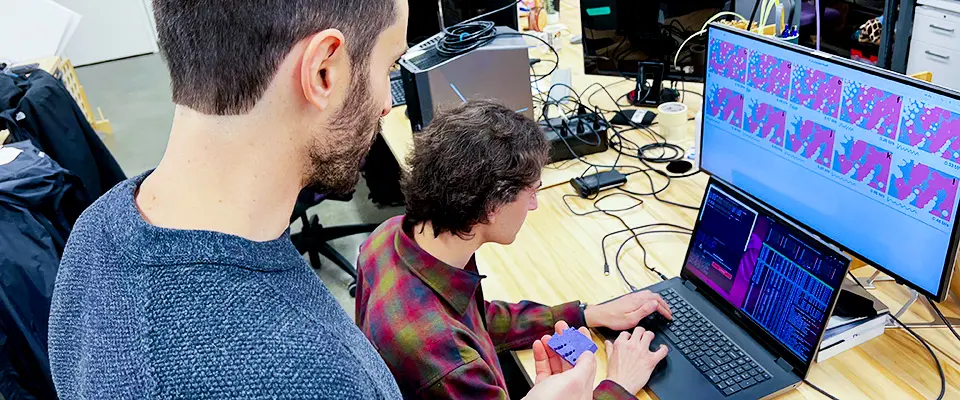
Two people in lab working at desk with computers

Major in Artificial Intelligence

Why major in artificial intelligence?

Graduates with AI expertise are in demand across industries, from tech companies and startups to healthcare, government, nonprofits, and graduate programs. As organizations race to build smarter systems, researchers continue to expand what machines can learn, create, do, and decide.

Designed for a rapidly evolving technological landscape, the AI major prepares students to become both skilled builders and critical thinkers. You’ll gain a practical understanding of how intelligent systems are designed, deployed, and used responsibly.

Through rigorous training in machine learning, natural language processing, AI systems, algorithms, and mathematical foundations, you’ll learn to develop efficient, reliable, and scalable solutions. The curriculum emphasizes programming fluency and collaboration across technical environments, while foregrounding the human and societal dimensions of AI—privacy, sustainability, and ethical impact.

Interested in fields from robotics and medicine to economics, philosophy, or political science? Pair your passion with AI to accelerate discovery and explore new frontiers.

Major in AI. Shape what’s next.


Imagine Yourself

  • Designing intelligent systems that learn from data, adapt over time, and make decisions in complex, real-world environments
  • Turning messy, high-dimensional data into models that can recognize patterns, generate insights, and power new capabilities
  • Building AI-driven tools—such as recommendation systems, language models, or computer vision applications—that millions of people could rely on every day
  • Developing robust, trustworthy AI systems that are reliable, secure, and aligned with human values
  • Collaborating with researchers and practitioners across fields—from medicine and engineering to the social sciences, humanities, and the arts—to reimagine discovery and creativity through AI

Apply Now

Study Options

Study AI in an engineering context or double major with another program

Earn a BS in Engineering with a Major in AI

For students enrolled in the McCormick School of Engineering

Students complete 48 units, including McCormick core requirements and AI major coursework. After building a foundation in computer science and introductory machine learning and AI, students advance through coursework spanning at least five of six AI breadth areas: Advanced Machine Learning and Natural Language Processing; Theoretical Foundations; Symbolic AI; AI Systems; Systems that Interact with Humans; and Systems that Navigate the World. A required societal impact component teaches students how to consider new technologies through an ethical framework. Electives allow students to explore the full breadth of AI offerings or focus on a particular area of interest.

Note: Students majoring in AI are not eligible to minor in computer science or AI.

Pursue AI as a Second Major

For students enrolled in McCormick or any other Northwestern school

Pair the AI major with another subject area that excites you. Consider AI + applied math, biomedical engineering, chemical and biological engineering, civil engineering, cognitive science, economics, environmental engineering, industrial engineering, materials science, mechanical engineering, neuroscience, philosophy, or political science.

Students must complete 6 core courses plus 1 societal impact, 5 breadth, and 6 technical elective courses.

Note: Students in other Northwestern schools may add AI as a second major while remaining enrolled in their current school.

Students pursuing a BA or BS in computer science are not eligible to add AI as a second major.

Declare or Transition to the AI Major

Northwestern students can declare the AI major as a new major, change in major, or addition as a second major. Students who plan to declare or shift to the AI major, or have any questions about the program, should complete this interest form.

Complementary Minors

The following minors may be of interest to students majoring in AI:

Minor in Entrepreneurship

The Minor in Entrepreneurship is designed for students who are interested in pursuing a practical education in how to start a business or how to make innovation a cornerstone of their career paths.

Biotechnology and Biochemical Engineering Minor

The Biotechnology and Biochemical Engineering Minor trains McCormick students interested in industries that create and manufacture bio-based fuels and industrial chemicals, pharmaceuticals, biomaterials, and agents for gene and cell therapies.

Learn about the Biotechnology and Biochemical Engineering Minor

Minor in Transportation and Logistics

Northwestern University Transportation Center’s Minor in Transportation and Logistics equips students with an in-depth understanding of the economics, engineering and operations in transportation and logistics systems, and the impact of these systems on public policy.

Faculty

Learn from faculty who are actively shaping the future of AI

Our award-winning faculty’s research spans machine learning, cognitive modeling, language understanding and generation, planning and reasoning, robotics and human-robot interaction, computational journalism, creativity and education, and how AI intersects with law and society. In addition to tenure-track faculty, you’ll work with 18 full-time teaching professors who are deeply invested in student learning and discovery. 

The Student Experience

Beyond the classroom

Enhance your education even further through our many opportunities to network and broaden your worldview.

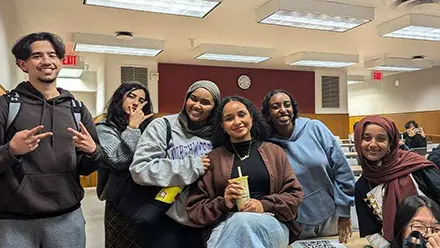
Students networking

Network with your peers in our student groups

Choose from numerous student groups centered around various interests such as AI, web development, or coding projects.

Students can also compete to solve problems and innovate in our collaborative, creative, and fast-paced convivial WildHacks competition, Northwestern’s largest annual hackathon. 

Visit Student Groups
Grace hopper students on stairs

Receive support and build your network

The Peer Mentor Program is designed to ensure that students receive individual attention and real-time feedback. During regular “office hours,” mentors answer their student’s questions and provide instruction on course material. The program rewards mentors by fostering community with students and peers while also strengthening their competitiveness for careers or graduate programs.

Explore the Mentor Program
Study abroad students

Broaden your perspective by studying abroad

Northwestern encourages students in all of its undergraduate schools to study abroad. Study Abroad Office staff and advisers will work closely with you to help you connect your academic and personal goals to an international credit-bearing experience.

Explore Study Abroad

Career Paths

Where do we go from here?

Our graduates may pursue careers related to engineering, technology, business, medicine, politics, and finance, while others go on to graduate programs at top universities.

While at Northwestern, our students benefit from professional development opportunities that prepare them for the next step in their careers. The Northwestern Tech Career Fair is a great opportunity for students to learn, network, and possibly be recruited across various industries. Students also have access to internships and extensive career placement resources via both Northwestern Engineering Career Development and Northwestern Career Advancement.

Graduates of this program can explore a wide range of opportunities in roles such as:

Model Designer

Model Designer

Software development

Research Engineer

Software development

Machine Learning Engineer

Software development

Software Engineer

Product engineer

Product Engineer

Data scientist

Data Scientist

Visit Northwestern

We encourage you to visit our campus and learn about Northwestern Engineering first hand.