

Alum Spotlight: Lukas Gross (’20)
As a member of OpenAI’s technical staff, Gross has worked on a variety of projects across the company, most recently developing tools that help lawyers focus on their most consequential work
Lukas Gross (’20) came to Northwestern to study biology, but pivoted to computer science, graduating with a combined bachelor’s and master’s degree in computer science from Northwestern Engineering.
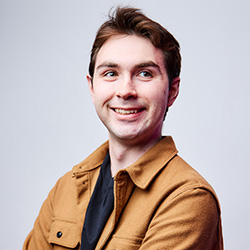 Advised by Professor Simone Campanoni, Gross was an undergraduate researcher in Northwestern’s Rethinks Compiler Abstractions for New Applications (ARCANA) Lab, where he worked on loop-distribution and dependency-queue forwarding passes for NOELLE, an LLVM-based framework designed to enable automatic program parallelization.
After four years as a software engineer at financial services platform Stripe, Gross joined OpenAI in 2024 as a member of its technical staff.
Looking back on your time at Northwestern, was there a faculty member or project that had a profound impact?
My high school didn’t offer computer science, so Professor Sara Sood’s Fundamentals of Computer Programming I (COMP_SCI 111) was my first exposure to the field. I took it on a whim because it happened to fit into my schedule, but it quickly became my favorite class that quarter. For the final project, we built a simple Snake game, with extra credit for writing a basic “AI” tool to play it. I remember telling Sara in office hours how much fun I’d had programming even my very simple if statement decision-making system. She encouraged me to keep taking computer science courses and consider the major. I’m so glad I took her advice.
Which AI/ML courses did you take at Northwestern, and what did you take away from the learning experience?
I took Intro to Artificial Intelligence (COMP_SCI 348), Machine Learning (COMP_SCI 349), Optimization Techniques for Machine Learning and Deep Learning (ELEC_ENG 395, 495), Artificial Intelligence Programming (COMP_SCI 325), and Professor Ian Horswill’s AI for Hybrid, Participatory Narrative (Special Topics in Computer Science (COMP_SCI 295/396). In retrospect, it’s interesting how much ground we covered, from symbolic AI to neural networks to storytelling. That breadth gave me a sense of how many different approaches fit under the label “AI.” And while it was not explicitly an AI class, I’m especially grateful for Professor Nikos Hardavellas’s Programming Massively Parallel Processors with CUDA (COMP_SCI 368/468). It taught me how GPUs actually work and gave me a foundation for understanding a lot of the technical details at OpenAI.
What types of tools and systems are you working on today?
I’ve worked on a lot of different projects at OpenAI across our API, models, and ChatGPT. Today, I work on tools that help lawyers bring AI into their practice, including researching case law, analyzing contracts, and working with their firms’ own documents and expertise. I’m particularly excited to be working on Astra for Law, a configuration of our leading model that is optimized for legal research and other legal tasks.
What’s the one piece of advice you’d give a current CS student?
Let yourself explore! I came to Northwestern planning to become a biologist, but I fell in love with computer science. Along the way, I discovered subfields like compilers that captured my imagination. I ended up doing research with Professor Simone Campanoni on automatic parallelization in compilers, and somehow the right topic can make drawing directed graphs on whiteboards fun (I promise!). One of my favorite classes at Northwestern was a legal studies class I took the spring of my senior year, and I wish I had taken it earlier so I could have considered a minor. You never know what will capture your imagination—or where it might eventually take you.