

PhD Student Spotlight: Payal Mohapatra
Mohapatra’s goal is to design robust deep learning frameworks capable of adapting to practical sensing scenarios in healthcare, continuous sensing, and audio domains
Northwestern Engineering’s Payal Mohapatra is fascinated by emerging sensing technologies.
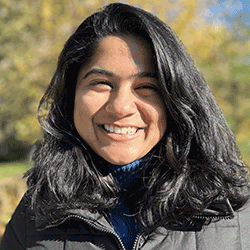 She aims to tackle the challenges associated with analyzing time series data in sensing applications like smartwatches, smart glasses, and fitness trackers. This data is often noisy and difficult to interpret due to its complexity.
Using methods inspired by machine learning, signal processing, and embedded systems, Mohapatra designs algorithms to extract more latent information about human behavior from multimodal sensor data. She has built data modeling frameworks to predict fatigue in manufacturing workers and detect speech disfluency. During an internship at Meta Reality Labs, Mohapatra worked on non-visual, sensing-based human behavior modeling in the context of seated conversations.
Her goal is to design a unified deep-learning architecture capable of adapting to practical sensing scenarios, including varying conditions of stationarity, irregular sampling, and missing data due to sensor malfunctions or out-of-distribution data from sensor upgrades.
A PhD candidate in computer engineering and member of the Design Automation of Intelligent Systems Lab, Mohapatra is advised by Qi Zhu, professor of electrical and computer engineering and (by courtesy) computer science at the McCormick School of Engineering. Prior to joining Northwestern, Mohapatra was an integrated circuit design engineer at Analog Devices Inc., and earned a master’s degree in electrical engineering from the Indian Institute of Technology Madras.
We asked Mohapatra about her experience as a PhD student at Northwestern, important lessons learned, and her advice for prospective PhD students.
Why did you decide to pursue a PhD in computer engineering at McCormick?
I applied for my PhD after gaining industry experience in integrated circuit design for consumer electronics at Analog Devices Inc., where I realized that the signal conditioning and on-device architectures I was designing would greatly benefit from stronger algorithmic foundations. My goal was to train as a systems architect for intelligent solutions and develop my skillset in machine learning and signal processing to better inform my lower-level designs of application-specific integrated circuits.
Although I initially planned to focus my PhD on hardware-software co-design, I stumbled upon many interesting problems and found myself drawn deeper into the algorithmic side. My adviser Qi Zhu and the computer engineering department at McCormick foster an environment where you can be fiercely creative but with clarity. If you can lay out and defend your investigation approach and justify why the problem you're chasing is meaningful, you generally receive support, and that is one of the most liberating experiences a young researcher can ask for. In my case, my adviser's roadmap and mine aligned well, and I've learned that working with kind, supportive researchers is one of the rarest privileges in academia.
What are three words you'd use to describe the Northwestern Computer Engineering community?
Creative, supportive, and collaborative.
What are some examples of collaborative or interdisciplinary experiences at Northwestern that have been notably impactful to your research?
One of my most interdisciplinary experiences was working on a near-real-time fatigue prediction sensor system for manufacturing workers. The collaboration engaged four engineering departments — biomedical engineering, electrical and computer engineering, materials science, and mechanical engineering — and five institutions, including Northwestern, Boeing Research & Technology, Deere and Company, and the University at Buffalo.
We built factory floor prototypes supported by Professor Jian Cao's and Professor Ping Guo's groups and used flexible band-aid-like devices that monitor vital signs from the Rogers Research Group. I was in a unique position to design data ingestion and analysis pipelines as well as study protocols to collect data.
We deployed these systems at Boeing and John Deere to provide real-time feedback about fatigue to workers. Learning from messy, real-world data and seeing the immediate impact was incredibly demanding but equally rewarding. The project's success depended on everyone's contribution, providing me with a unique opportunity to learn about challenges in various fields and improve communication practices for effectively conveying technical bottlenecks across disciplines.
What's next? What are your short- and long-term plans/goals in terms of your career path?
Currently, I am seeking research positions in industry or postdoctoral positions. Ultimately, I aim to conduct research that develops the next generation of sensing devices and collaborate with bright, energetic individuals who share a vision of making wearable technology more intelligent and accessible.
What hobbies/activities do you enjoy? What’s your favorite part about living in Evanston/Chicago?
I love painting and reading. I feel fortunate to live close to the beach, which is perfect for impromptu picnics. I also like to run, and Evanston offers an ideal setting — the Northwestern University Lakefill Path is perfect for long runs alongside the lake.
What’s your favorite restaurant in Evanston/Chicago and why?
This is the hardest question — I can't pick just one! Belgian Chocolatier Piron on Main Street has some of the absolute best quality chocolates, and their hot chocolate during the fall is the perfect pick-me-up. Coralie's has a patisserie on campus, making it a very convenient treat for those hard days (try the almond croissant)! I also frequent K-Brothers Coffee, Dave's Italian Kitchen, late-night ramen at Pho Ever Ramen, and Cupitol's big breakfast.
What advice do you have for prospective Northwestern Computer Engineering PhD students?
The PhD journey is tough — no sugarcoating that — so embrace it. A PhD program is one of those rare times where you can completely reinvent yourself and explore ideas that genuinely fascinate you. Coming in with humility and curiosity helps, and you'll be surprised by how much you can grow. Having worked in industry first, the creative freedom I’ve found is unparalleled — you get to chase problems you care about without the usual constraints.
Comparison is the thief of joy. PhD journeys are hyper-unique, so everyone's timeline and path looks different.
Don't skimp on productivity enhancers. Invest in ergonomic equipment and good coffee — these compound over four-plus years. Equally important: cultivate genuine friendships. The PhD journey can be isolating — you're working on a niche problem that only you fully understand, and your vision won't be apparent to others until all the pieces come together. While this isolation creates space for genuine intellectual transformation, having a few steady friendships serves as essential guideposts, keeping you grounded through the long journey.