

PhD Student Charles Cui Attends Heidelberg Laureate Forum
Cui was among 200 young researchers selected to attend the annual networking conference designed to encourage intellectual discourse and collaboration
As the saying goes, never meet your heroes. But when you have an opportunity to meet 28 of them in a week, it’s hard to resist.
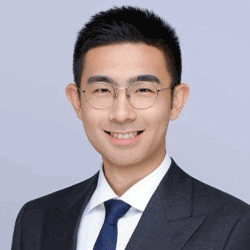 Northwestern Engineering’s Charles Cui (MS ’23) did exactly that at the Heidelberg Laureate Forum (HLF), held September 13-19 at Heidelberg University in Germany.
At the annual networking conference designed to encourage intellectual discourse and collaboration, 200 select young researchers in mathematics and computer science from around the world interact with the disciplines’ foremost luminaries in a mix of scientific and social activities.
The laureates — from Google’s chief scientist Jeffrey A. Dean to internet founder Vinton Gray Cerf to theoretical computer science pioneer Avi Wigderson — are recipients of the most prestigious awards in mathematics and computer science, including the Abel Prize, Association for Computing Machinery (ACM) A.M. Turing Award, ACM Prize in Computing, Fields Medal, International Mathematical Union (IMU) Abacus Medal and Nevanlinna Prize.
Cui is a PhD candidate in computer science and a member of the Midwest Uncertainty Collective, advised by Matthew Kay, associate professor of computer science at the McCormick School of Engineering and associate professor of communication studies in Northwestern’s School of Communication.
Cui’s work centers on building AI tools that enhance creativity, efficiency, and impact for educators and data professionals.
We caught up with Cui to learn more about his experience at the HLF.
Why did you apply to the Heidelberg Laureate Forum?
I learned about the HLF program from my teammate at the Data Science for Social Good fellowship program in 2022. I didn’t believe that the intellectual giants of my field would actually show up at this event and interact with a group of undergrad and grad students, but they did. It still feels surreal to me.
Which of the laureates at HLF 2025 were you particularly excited to meet?
I was genuinely excited to meet all of them, but I was a bit awe-struck by Jeff Dean and Avi Wigderson.
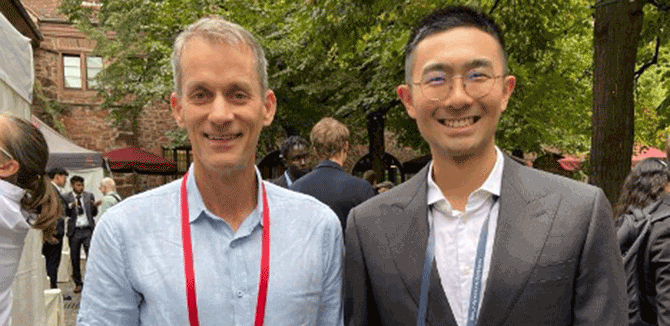
Jeff Dean is the engineering mastermind who designed and implemented the core infrastructures of some of the most influential products at Google. On my first day in Heidelberg, I walked up to him at an outdoor dinner event and told him that he’s my intellectual hero. We chatted for about 15 minutes, from what great engineers look like in the era of AI to how he picked which grad school to go to.
On the third day, the researchers and laureates went on a boat tour, and I got to talk to Avi Widgerson and his wife for half an hour. Avi is the only winner of both the Turing Award and the Abel Prize, which many consider the Nobel Prize in computer science and mathematics, respectively. I learned about Avi’s path from a curious student to making groundbreaking discoveries, his advice for young researchers, and how he met his wife, who is also brilliant and kind. It was so special to get to know them as people and hear them talk about their life stories.
What is a research problem/project you are currently tackling?
I am working on expanding the capabilities of a generative AI Edtech system called Ripplet, a web-based AI-powered assessment authoring tool co-designed with 13 mathematics, computer science, natural sciences, and social studies teachers. More than 30 educators across ten schools nationwide are already testing the tool — and many more are eager to put it to work.
In collaboration with Professor Steve Franconeri, I’m also leading a team of developers to build a digital game called Point Taken, which facilitates structured conversations around controversial topics. Our vision of this game is to help people become better communicators and critical thinkers in today’s increasingly polarized world, where civic discourse is diminished. I believe in the mission of this game and the positive role AI and computer science can play in advancing this mission.
You were among 30 researchers selected to present their research during the HLF flash talks and poster session. What insights or constructive feedback did you gain from the laureates and your peers?
I presented my work on Ripplet and met with a lot of people during the poster session who are interested in using the tool. It felt amazing to get so much interest and recognition from both the laureates and my peers.
Two days before we went on stage, the presenters attended a four-hour workshop focused on practical techniques — posture, gestures, pace, and so on — for public speaking to an audience of hundreds. We got to practice and critique each other, which was very helpful.
Which HLF program elements or opportunities did you find most impactful?
We listened to talks by the laureates and attended master classes on such a variety of topics and expertise from every corner of mathematics and computer science. As PhD students, we specialize and acquire expertise in a niche area, and we usually meet people who work on similar topics when we attend conferences. HLF was a reminder that the space of interesting research in mathematics and computer science is vast, and people who make significant contributions often have an incredible range. It was an absolute intellectual feast for me.
What lessons learned or insights did you gain from the experience that your peers in Northwestern Computer Science may also benefit from?
- Solve important problems. Tackling big challenges creates lasting impact. They’re often difficult, and it’s normal to feel pressure to produce results quickly. But if a problem truly matters, even partial solutions are valuable. Sometimes it also takes conviction and time to persuade others of its importance. Contrarian beliefs — pursuing what you think is right when most disagree — can be transformative.
- Know what to build. Builders with product sense and system design skills are hard to replace, even in the era of AI. The only way to develop these skills is to build many systems and work with people who know what you don’t.
- Gauge your audience and adapt. Even within the similar fields of mathematics and computer science, we often speak very different languages. To engage your listeners, you need to gauge their background (range + listening) and adjust your pitch (improvisation). Good communicators spark curiosity and explain their work in ways that meet the listeners where they are. Everyone should have both a 30-second and a two-minute pitch that anyone can understand.