

News & EventsDepartment Events & Announcements
Events
-
May1
EVENT DETAILS
less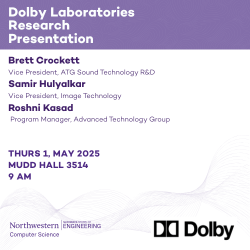
Please join us in Mudd 3514 at 9 AM for a research presentation brought to you by Dolby Laboratories.
TIME Thursday, May 1, 2025 at 9:00 AM - 10:15 AM
LOCATION 3514, Mudd Hall ( formerly Seeley G. Mudd Library) map it
CONTACT Dru Redmond drucilla.redmond@northwestern.edu EMAIL
CALENDAR Department of Computer Science (CS)
-
Jun1
EVENT DETAILS
lessEmbodied AI promises agents that perceive, reason, and act in the physical world, yet realizing such agents demands more than algorithmic novelty. Progress at the frontier increasingly depends on the co-design of three tightly coupled layers: the methods that learn behavior, the simulation infrastructure that supplies the data and experience to learn from, and the systems that bridge learned policies to physical hardware. This dissertation argues that the next generation of embodied-AI researchers must be full-stack roboticists, fluent across all three layers, and presents my previous works that together trace this thesis.
TIME Monday, June 1, 2026 at 10:30 AM - 11:30 AM
LOCATION Mudd 3514, Mudd Hall ( formerly Seeley G. Mudd Library) map it
CONTACT Jensen Smith jensen.smith@northwestern.edu EMAIL
CALENDAR Department of Computer Science (CS)
-
Jun3
EVENT DETAILS
lessModern hardware is parallel and is increasingly relying on parallel programming to achieve
both performance and energy efficiency. However, today’s parallel programming places a disproportionate burden on developers, requiring them to design and fine-tune parallel execution strategies across diverse hardware platforms and varying program inputs. I postulate that optimizing compilers can relieve developers from this burden by automatically reasoning about parallel execution strategies while also enforcing correctness properties. Achieving high parallel performance across modern hardware requires selecting an effective parallel execution plan, including how and where parallelism should be expressed and implemented. To automate this selection process, I introduce the Parallel-Semantics Program Dependence Graph (PS-PDG), a compiler abstraction
that captures developer-encoded parallel semantics alongside compiler-derived analysis. PS-PDG
enables compilers to override suboptimal execution plans with superior alternatives. While static
execution-plan selection is effective for regular workloads, irregular and input-sensitive applica
tions require runtime adaptation of parallel granularity. To address this challenge, I introduce the
Heartbeat Compiler (HBC), a compilation system that automatically translates high-level fork
join parallelism into binaries capable of dynamically controlling task granularity through heartbeat
scheduling to eliminate the need for manual task-size tuning. Beyond performance, parallel C++
applications also face severe memory-safety risks arising from operations on data collections, in
cluding iterator invalidation. These bugs are difficult for existing tools to detect precisely and
become even harder to diagnose under nondeterministic thread interleavings. To address this chal
lenge, I introduce Ledger, a data collection-oriented static analyzer that provides high-precision
detection of invalidation vulnerabilities in programs that operate on complex data collections.TIME Wednesday, June 3, 2026 at 2:00 PM - 4:00 PM
LOCATION mudd 3501, Mudd Hall ( formerly Seeley G. Mudd Library) map it
CONTACT Jensen Smith jensen.smith@northwestern.edu EMAIL
CALENDAR Department of Computer Science (CS)
-
Jun5
EVENT DETAILS
lessThere is growing momentum—from industry, government, and academia—to use AI for automating cybersecurity tasks. Yet practitioners remain skeptical: while 87% of security leaders expect AI to enhance their roles, only 9% believe it will replace significant parts of them. This gap stems from two fundamental barriers: limited capability and lack of trust. In this talk, I present my research on addressing these barriers through explainable AI. I first introduce StateMask, a method that automatically identifies critical decision steps in AI agent trajectories, enabling security professionals to understand why an AI-generated patch succeeded or failed. A user study with 41 experienced developers shows that 89% find our explanations aligned with their reasoning. I then present GPO, which leverages these explanations to synthesize high-quality training data without expensive expert annotation, thereby improving model capability. GPO-trained open-source models achieve performance competitive with leading commercial models on vulnerability patching, and its extension, EntroPO, ranks 1st on SWE-Bench Lite among all open-weight models. I conclude by discussing future directions toward building AI systems that are robust to imperfect data, trusted by security professionals, and capable of tackling real-world cybersecurity challenges.
TIME Friday, June 5, 2026 at 9:00 AM - 11:00 AM
CONTACT Jensen Smith jensen.smith@northwestern.edu EMAIL
CALENDAR Department of Computer Science (CS)
-
Jun15
EVENT DETAILS
lessMcCormick School of Engineering PhD Hooding and Master's Degree Recognition Ceremony. The most up to date information can be found on our graduation webpage.
TIME Monday, June 15, 2026 at 9:00 AM - 11:00 AM
CONTACT Andi Joppie andi.joppie@northwestern.edu EMAIL
CALENDAR McCormick School of Engineering and Applied Science
-
Jun15
EVENT DETAILS
lessMcCormick School of Engineering Undergraduate Convocation. The most up to date information can be found on our graduation webpage.
TIME Monday, June 15, 2026 at 2:00 PM - 4:00 PM
CONTACT Andi Joppie andi.joppie@northwestern.edu EMAIL
CALENDAR McCormick School of Engineering and Applied Science