

PhD Grad Spotlight: Glenn Fernandes
Fernandes earned a PhD in computer science
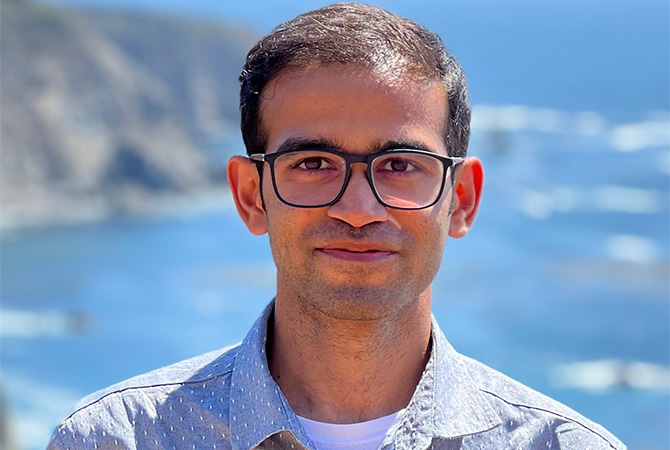
Glenn Fernandes (MS ’22, PhD ‘26) builds wearable AI-enhanced systems to detect and analyze everyday behaviors and health risk factors, from eating to smoking to sun exposure. Integrating multi-modal sensors—including cameras, accelerometers, motion sensors, and thermal sensors—Fernandes aims to design more privacy-aware, energy-efficient, and interpretable systems useful in the clinic and laboratory as well as by individual consumers.
Fernandes earned a PhD in computer science from Northwestern Engineering. A member of the multidisciplinary Health-Aware Bits (HABits) Lab, he was advised by Professor Nabil Alshurafa.
We caught up with Fernandes to learn more about his experience earning a doctoral degree, impactful interdisciplinary experiences, problem-solving inspiration, and his advice for students.
Why did you decide to pursue a PhD in computer science at McCormick?
I was interested in building technologies that could move beyond the lab and have a meaningful impact on people’s everyday lives. My background spans electronics engineering, biology, and computer science, so I was especially drawn to research questions that sit at the intersection of sensing, health, and AI. McCormick felt like the right place for that kind of work because of its strong engineering culture and its encouragement of interdisciplinary research.
I was also excited by the opportunity to work with Professor Nabil Alshurafa and the HABits Lab, where the focus is not only on building technically strong sensing systems, but also on understanding real human behavior in realistic settings. That combination of rigorous computer science, real-world deployment, and health impact was exactly what I was looking for in a PhD program.
Whose research—inside or outside your immediate area—most shaped how you approach problems? Are there papers, books, or conversations that you keep returning to?
Professor Alshurafa’s research and mentorship taught me to think carefully about the full system—from sensing and machine learning to usability, deployment, privacy, and clinical relevance. In the HABits Lab, I learned that a technically impressive model is only one part of the solution—the system also has to work in messy real-world conditions and be meaningful to users.
I have also been shaped by work from the broader ubiquitous computing and human-computer interaction communities, especially research that addresses how technology can support people unobtrusively in everyday life. Earlier in my career, my work with Pattie Maes in the Fluid Interfaces group at the MIT Media Lab also influenced how I think about wearable systems as tools for augmenting human behavior and supporting behavior change. Conversations with clinicians, behavioral scientists, and study participants have also been just as important as papers in shaping how I define meaningful research problems.
Interdisciplinary research is at the core of the work in the HABits Lab. What are some specific examples of collaborative or interdisciplinary experiences at Northwestern that were notably impactful to your research?
One of the most impactful parts of my PhD was learning how to build computer science systems in close conversation with health, behavioral science, and human-centered design. In the HABits Lab, the research questions were rarely just technical. We were not only asking, “Can we build a model that detects behavior?” but also, “Is this behavior clinically meaningful? Would a person be comfortable wearing this system? Would the data be useful to researchers or clinicians? Can the system work in everyday life?”
A strong example of this was my work on HabitSense, a neck-worn multimodal wearable platform for detecting hand-to-mouth behaviors such as eating and smoking in real-world settings. The project required collaboration across multiple areas: hardware and embedded systems to design the wearable device, machine learning to detect behaviors from RGB, thermal, and motion data, behavioral health to define the behaviors and use cases, and human-centered design to think through privacy, comfort, battery life, and acceptability.
Another important example was PRIMO, an explainable AI interface designed to help clinicians understand model predictions. This project required translating machine learning outputs into explanations that aligned with how clinicians reason about patient behavior. Working at that intersection taught me that interpretability is not just a technical feature; it is a communication problem, a design problem, and a trust problem. The system had to make sense not only to AI researchers, but also to the clinicians who might rely on it.
Impactful AI and sensing systems cannot be designed from one discipline alone. The strongest systems emerge when technical design is informed by the people, contexts, and real-world constraints that surround the problem.
What advice do you have for current or prospective Northwestern Computer Science PhD students?
Think of the PhD as a process of becoming the owner of a research vision. A few principles helped me along the way:
1. Choose problems you can keep caring about. A PhD is long, uncertain, and often nonlinear. Curiosity is what carries you through the difficult parts, so it is important to work on questions that feel meaningful to you beyond just the next paper deadline.
2. Own the project. My adviser was there to advise me, challenge me, and help me see further—but the project ultimately had to become mine.
3. Let the work evolve. Some of the most meaningful directions in my PhD came from unexpected challenges: a system not working in the real world, feedback from collaborators, or realizing that a technically elegant solution was not enough. Being open to those moments often leads to stronger and more impactful research.
4. Build your community early. Research can feel individual, but a PhD is not meant to be done alone. Advisors, labmates, collaborators, mentors, and friends all shape the experience. Some of the best ideas come from conversations that happen outside formal meetings.
5. Share before it feels perfect. Do not wait until your work feels completely polished before presenting it, asking for feedback, or explaining it to people outside your area. Learning to communicate your research clearly is part of becoming a strong researcher, and early feedback often makes the work much better.
Beyond research, what experiences during your PhD—teaching, mentoring, internships, conferences, or life outside the lab—were most meaningful to you, and why?
One especially rewarding teaching experience was serving as an instructor for Northwestern’s Computing Everywhere workshops. These sessions were meaningful because they allowed me to make computing accessible and applied, while also connecting students to real-world problems in health, sensing, and machine learning.
Mentoring students was another highlight of my PhD. One particularly meaningful experience was collaborating with Meixi Lu, a student in the Master of Science in Artificial Intelligence program, on a multi-modal AI project at HABits Lab. Our work was accepted and presented at AAAI, where we won the Three-Minute Presentation Contest.
My internships also shaped my PhD experience in important ways. I completed two internships at Dolby Laboratories in the Advanced Technology Group, where I gained valuable industry research experience and learned how advanced sensing, audio, and machine learning technologies are developed in a product-oriented environment. Later, my research scientist internship at Meta Reality Labs Research gave me the opportunity to work on wearable AI and multimodal sensing. These experiences helped me understand how academic research can translate into real-world technology and impact.
What's next?
I am currently a research engineer at Meta Reality Labs in the Health and Wellbeing Technology group, where I work on next-generation wearable technologies. In the short term, I’m excited to continue working at the intersection of multimodal sensing, AI, and wearable computing, especially on systems that can understand human behavior in everyday contexts.
Long term, I hope to contribute to the development of AI technologies that are not only powerful, but also safe, responsible, privacy-preserving, and human-centered. As AI becomes increasingly integrated into everyday life, I believe there is an urgent need to build systems that people can trust and understand. My PhD research on privacy-aware sensing, explainable AI, and real-world wearable systems has shaped how I think about these challenges, and I hope to translate that work into technologies that support people intelligently while respecting privacy, context, and individual needs.