

Building Community Among Early-Career Researchers in Theoretical Computer Science
The Northwestern CS Theory Group and Toyota Technological Institute at Chicago co-hosted the Junior Theorists Workshop held Dec. 8-9
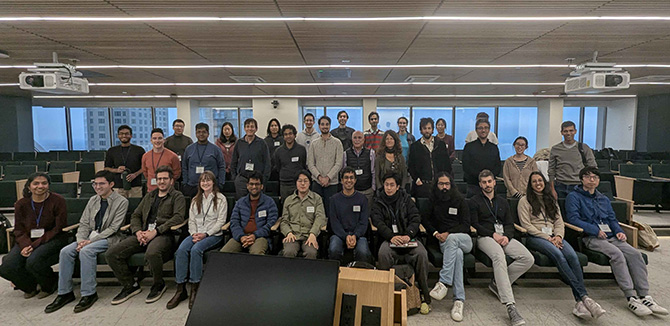
The Junior Theorists Workshop, held Dec. 8-9, was more than just a meeting of academic minds spanning a wide array of theoretical computer science topics—from algorithms and economic design to coding theory, distributed computing, and quantum complexity.
For Samir Khuller, Peter and Adrienne Barris Chair of Computer Science at Northwestern, one of the goals of the workshop was to highlight the University and showcase the department’s expertise. He described the event as part of a broader effort to highlight new research and connect Northwestern’s expanding CS footprint with the wider theory community.
“It gives our group a clearer picture as we are recruiting—a clearer picture of who's working in the field,” Khuller said. “The workshop also gives students an opportunity to network with each other and get a chance to know Northwestern CS as well.”
The workshop was jointly hosted by Northwestern and the Toyota Technological Institute at Chicago (TTIC), in partnership with the Institute for Data, Econometrics, Algorithms, and Learning; the NSF-Simons National Institute for Theory and Mathematics in Biology (NITMB); and the NSF-Simons AI Institute for the Sky (SkAI Institute). The event was supported by the ACM Special Interest Group on Algorithms and Computation Theory.
The workshop began in 2018 as a smaller, Northwestern-only event.
As the event grew, so did its collaborating sponsors and institutions. This year, the two-day event featured around 20 speakers, hailing from institutions including Northwestern, TTIC, Georgia Tech, the Massachusetts Institute of Technology, the University of Illinois Chicago, University of Illinois Urbana-Champaign, the University of Maryland, and the University of Waterloo.
New this year, a portion of the event took place downtown, using the SkAI Institute and NITMB’s space in 875 North Michigan Avenue. The venue improved access for attendees and reinforced Northwestern’s growing presence beyond Evanston, Khuller said.
“These kinds of workshops…are where a lot of the best new ideas and thinkers in theoretical computer science come together and mingle,” Columbia PhD student John Bostanci said.
The selection process is intentionally structured, Khuller said, with organizers sending nomination requests to faculty across dozens of universities.
The workshop also offers Northwestern CS a longer-term view of the field. Khuller noted that several faculty candidates had previously spoken at the Junior Theorists Workshop.
“It gives us a chance to get to know people early—and for them to get to know us,” Khuller said.
Khuller explained that the talks were accessible even to those not studying the same subfield, underscoring a commitment to forming new bonds across research disciplines.
Bostanci said, for example, that even though he was the only person working on quantum computing, he felt like many of the participants and students were interested in both learning about and exploring the topic.
Cornell PhD student Giannis Fikioris said workshops like this are “incredibly valuable” for researchers. He presented his novel model for sequential budgeted auctions that captures the temporal dependence of advertisements.
“First, it gives visibility of my research to a wide range of people,” Fikioiris said. “Second, it is a great opportunity to interact with researchers at the same career level as me…from niche fields different than mine.”
TTIC chief academic officer and interim president Avrim Blum praised the synergy cultivated by the event.
“The Chicago-area theoretical computer science community is very strong, and it's just great to have these opportunities that allow bringing together our folks from different institutions,” Blum said.
While some of the presentations looked at core questions in computer science and made progress on long-standing problems, he noted, others were able to build connections between computer science and other fields of study like economics.
For Khuller, its impact extends well beyond the talks themselves.
“These are people who are all going to be in the field together for a long time,” Khuller said. “Getting them in the same room really matters.”