

PhD Student Kexin Zhao Wins Best Student Paper Award at ACS 2025
Zhao and Professor Ken Forbus demonstrated the effectiveness of combining symbolic and neural methods for word sense disambiguation
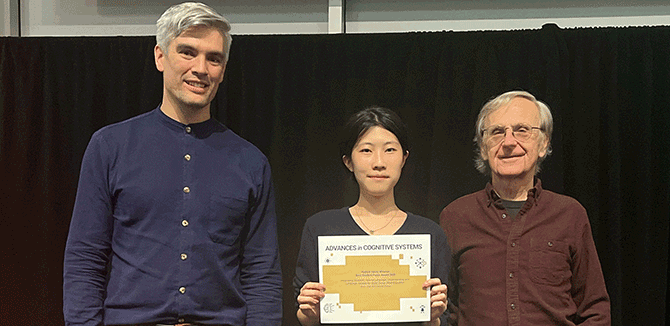 ACS 2025 program chair Christopher MacLellan, Kexin Zhao, Pat Langley (ISLE/Georgia Tech Research Institute)
Northwestern Engineering’s Kexin Zhao earned the Patrick Henry Winston Best Student Paper Award at the 2025 Conference on Advances in Cognitive Systems (ACS), held October 13-15 at the Georgia Institute of Technology Global Learning Center in Atlanta.
Zhao is a second-year PhD student in computer science and a member of the Qualitative Reasoning Group. Her research focuses on building AI systems that don’t simply mimic but deeply comprehend and generate human language.
ACS convenes researchers working to explain cognition and learning in computational terms and to reproduce a broad range of intelligent behaviors and human abilities in computational artifacts.
The winning paper, titled “Integrating Symbolic Natural Language Understanding and Language Models for Word Sense Disambiguation,” is coauthored by Zhao’s adviser, Ken Forbus, Walter P. Murphy Professor of Computer Science at the McCormick School of Engineering.
 “I am truly honored to receive this award, and it is especially encouraging that it comes from my very first oral presentation at a conference,” Zhao said. “This recognition affirms my research contributions and inspires me in the work ahead.”
In this work, Zhao and Forbus introduce a new paradigm for how AI understands and processes language — demonstrating the effectiveness of combining symbolic and neural methods for word sense disambiguation, that is, teaching computers to understand the exact meaning of a word in a specific context.
When humans read the sentence: “The traffic light turned yellow,” for example, we understand that the ambiguous term “turned” here means the light changed color. But, Zhao explained, this task is a two-dimensional challenge for AI systems. At a basic level, AI needs to identify the general category and determine whether “turned” is a movement, a change, or something else. Then, the AI needs to make subtle distinctions within that category, sorting out whether “turned” is an external or internal state change.
The team’s system — which achieved accuracy of more than 80 percent and consistent performance with both coarse and fine-grained disambiguation — combines linguistic flexibility with structured and interpretable outputs needed for advanced reasoning tasks.
“Our research opens up possibilities for deeper semantic understanding,” Zhao said. “When our method correctly identifies the general category, it is highly reliable at selecting the right specific meaning within that category. This establishes a stable foundation for more in-depth language understanding and reasoning.”
Zhao and Forbus’s method eliminates the need for large training datasets, enabling immediate application of the system to new domains without expensive and time-consuming supervised training.
As a next step, Zhao and Forbus plan to test their system on larger-scale experiments, including analyzing larger datasets and measuring the consistency between multiple annotators labeling the same data, called inter-annotator agreement. The team will also extend their symbolic–neural integration approach to other natural language understanding tasks, such as syntactic parsing disambiguation and co-reference resolution (i.e., training models to understand how pronouns and entities refer to each other across sentences).