

News & EventsDepartment Events & Announcements
Events
-
Apr10
EVENT DETAILS
lessThank you for your interest in Northwestern’s new AI major. Please join the info session to ask any questions that you may have. In the meantime, you will find more information here:
https://docs.google.com/document/d/1Pydq0wiQ9bkDSbsbf01N7bTcWUUDL215FFGgG447NF8/edit?tab=t.0#heading=h.2e71dspu6nezTIME Friday, April 10, 2026 at 2:00 PM - 3:00 PM
CONTACT Bella Barrios marbella.barrios@northwestern.edu EMAIL
CALENDAR Department of Computer Science (CS)
-
Apr13
EVENT DETAILS
lessMonday / CS Seminar
April 13 / 12:00 PM
Hybrid / Mudd 3514Speaker
Arindam Banerjee, University of Illinois Urbana-ChampaignTalk Title
Reinforcement Learning and Control with Generative World ModelsAbstract
"Recent years have witnessed remarkable advances in generative modeling — from diffusion models and flow matching to autoregressive transformers and action-conditioned video models — that are rapidly closing the gap between learned simulators and the complexity of real-world dynamics. These developments open a principled path toward a new generation of reinforcement learning (RL) algorithms that harness the representational power of generative world models, naturally bridging model-based planning and model-free policy optimization within a unified framework.
In this talk, we introduce an inference-time policy optimization framework inspired by model predictive control (MPC), built around a pretrained policy and a learned world model (WM) of state transitions and rewards. While existing approaches use learned dynamics to generate imagined trajectories — either during training or at inference — they stop short of using those trajectory rollouts to optimize policy parameters on the fly. Our approach addresses this gap through a Differentiable World Model (DWM) pipeline that enables end-to-end gradient computation through WM trajectory rollouts, yielding inference-time policy optimization (ITPO) grounded in MPC. Across continuous-control benchmarks, ITPO with DWM consistently outperforms strong offline RL baselines. Beyond the core RL framework, we also discuss principled approaches to fine-tuning generative models under distribution shift, which enable the online deployment of such world-model-based policies."
Biography
Arindam Banerjee is a Founder Professor at the Siebel School of Computing and Data Science, University of Illinois Urbana-Champaign. He currently serves as the President of the Society for Artificial Intelligence and Statistics which runs the annual international AISTATS conference. He is an ACM Fellow. His research interests are in machine learning and artificial intelligence. His current research focuses on computational and statistical aspects of deep learning, spatial and temporal data analysis, generative models, and sequential decision making. His work also focuses on applications of machine learning in complex real-world and scientific domains including problems in weather and climate, ecology, and agriculture. He has won several awards over the years, including the NSF CAREER award, the IBM Faculty Award, and seven best paper awards at top-tier venues.Research Area/Interest:
Machine Learning, Artificial IntelligenceTIME Monday, April 13, 2026 at 12:00 PM - 1:00 PM
LOCATION 3514, Mudd Hall ( formerly Seeley G. Mudd Library) map it
CONTACT Wynante R Charles wynante.charles@northwestern.edu EMAIL
CALENDAR Department of Computer Science (CS)
-
Apr13
EVENT DETAILS
lessModern machine learning (ML) systems are increasingly trained on sensitive data, outsourced to untrusted infrastructure, and deployed as opaque black boxes. Companies, users, and regulators all want stronger assurances about how models are trained, whether privacy protections were actually enforced, and whether deployed systems behave reliably under distribution shift or downstream adaptation. Yet existing approaches to auditing and verification are often unsatisfactory: empirical audits provide only partial evidence and often require access to proprietary data, while cryptographic tools such as secure computation and zero-knowledge proofs offer strong guarantees but are too expensive to apply directly to modern large-scale ML. My thesis is motivated by this gap and asks how to make modern ML systems verifiable and provably trustworthy under realistic deployment conditions.
My prior work develops efficient, ML-aware cryptographic frameworks for certifying and improving the trustworthiness of ML models, including (1) certifying privacy guarantees such as differential privacy without revealing the model or training data, (2) securely repairing factual failures and social biases in proprietary generative models, (3) proving meaningful guarantees about a model’s final quality without replaying the full training process in zero knowledge, and (4) developing robust post-training certificates of model generalization that remain informative under adversarially perturbed training and are efficient to verify cryptographically. Building on these results, my proposed thesis extends this agenda to larger models and more complex modern ML tasks, including certification of LLM fine-tuning, auditing memorization, and detecting model backdoors. More broadly, the goal is to combine cryptography and machine learning in a scalable way so that more tasks across the ML lifecycle can be efficiently certified without sacrificing privacy.
TIME Monday, April 13, 2026 at 2:00 PM - 3:30 PM
LOCATION 3001, Mudd Hall ( formerly Seeley G. Mudd Library) map it
CONTACT Wynante R Charles wynante.charles@northwestern.edu EMAIL
CALENDAR Department of Computer Science (CS)
-
Apr15
EVENT DETAILS
lessWednesday / CS Seminar
April 15 / 12:00 PM
Hybrid / Mudd 3514Speaker
Jakub Szefer, Northwestern UniversityTalk Title
Quantum Computer Security: from NISQ to FTQCAbstract
Research on quantum computer security has been advancing and gaining attention since early 2020s. Much of the early work at the beginning of this decade focused on NISQ (Noisy-Intermediate Scale Quantum) which became easily accessible via the internet. Cloud-based quantum computing brough promise of accessibility to many users who do not have a physical quantum computer, but also opened many new threat models and possible security attacks. As quantum computing is now transitioning to FTQC (Fault-Tolerant Quantum Computing) our recent research has explored yet new threat models and security attacks in the emergent FTQC paradigm. This talk will, in the first half, overview key results from NISQ quantum computer security research and present the brief, but very active, history of NISQ quantum security. In the second half, the talk will focus on the most recent work on FTQC security, and the Trace-Based Reconstruction of Quantum Circuit Dataflow in Surface Codes work recently presented at the HPCA conference. The talk will highlight the research results as well as the larger challenges and opportunities in security of quantum computing as we move to the FTQC era.Biography
Jakub Szefer is an Associate Professor in the Electrical and Computer Engineering Department at Northwestern University where he leads the Computer Architecture and Security Lab (CASLAB). His research focuses on security attacks and defenses at the computer architecture and hardware levels of computer systems. His work encompasses security of processor architectures, reconfigurable logic, post-quantum cryptographic accelerators, and quantum computers. He is the author of the “Principles of Secure Processor Architecture Design” book, published in 2018, and co-editor of the “Security of FPGA-Accelerated Cloud Computing Environments” book, published in 2023. He received his BS degree with highest-honors in Electrical and Computer Engineering from University of Illinois at Urbana-Champaign, and MA and PhD degrees in Electrical Engineering from Princeton University.TIME Wednesday, April 15, 2026 at 12:00 PM - 1:00 PM
LOCATION 3514, Mudd Hall ( formerly Seeley G. Mudd Library) map it
CONTACT Wynante R Charles wynante.charles@northwestern.edu EMAIL
CALENDAR Department of Computer Science (CS)
-
Apr15
EVENT DETAILSmore info
less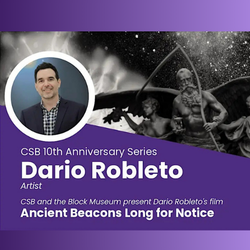
The Center for Synthetic Biology, in collaboration with the Block Museum of Art at Northwestern, is pleased to welcome Dario Robleto, award-winning multi-media artist, for a screening of his film Ancient Beacons Long for Notice. This third part of Robleto’s trilogy explores the legacy of the “Golden Record”—a gold disc representing Earth's diverse life and cultures, sent beyond our solar system on NASA’s Voyager space probes. The film asks a core question:“ is our moral obligation to fully account for our actions—the good and the bad—in perpetuity, off-planet, and to beings we have yet to confirm exist?” A community conversation after the screening will explore this question in the context of synthetic biology’s history, encouraging us to consider its ethical implications as we forecast the future.
Dario Robleto’s work has been widely exhibited and is held in prominent collections, including the Whitney Museum of American Art and the National Gallery of Art in Washington, D. C. A portfolio of the artists prints titled The First Time, The Heart (A Portrait of Life 1854–1913) was acquired by the Block in 2018 with support of Northwestern Engineering. His work has also been featured in numerous media outlets, including Krista Tippett’s On Being and The New York Times. Robleto has held numerous artist-in-residence positions at prestigious institutions, including the Smithsonian Museum of American History and the Radcliffe Institute for Advanced Study at Harvard. In 2025, he received an Honorary Doctorate of Humane Letters from Middlebury College.
From 2018 to 2023, Robleto Served as Artist-at-Large at Northwestern University’s McCormick School of Engineering and the Block Museum of Art, where he developed and screened the first two parts of his trilogy about the history of the heart and the Golden Record. The residency culminated in the exhibition The Heart’s Knowledge: Science and Empathy in the Art of Dario Robleto, as well as a publication of the same name. During his time at Northwestern, Robleto built strong ties with the Center for Synthetic Biology and explored the intersection of art, technology, and ethics in society.
This event leads up to the Center for Synthetic Biology’s 10-year Anniversary, where Robleto is leading the development of a time capsule representing the future of synthetic biology at Northwestern and in the world.
Event Details - Northwestern University, Evanston Campus
📅 Wednesday, April 15, 2026
🕒 3:00–5:00 PM | Film Screening & Discussion
📍 The Block Museum of ArtTIME Wednesday, April 15, 2026 at 3:00 PM - 5:00 PM
LOCATION Block Museum of Art, Mary and Leigh map it
CONTACT Block Museum of Art block-museum@northwestern.edu EMAIL
CALENDAR Block Museum of Art
-
Apr16
EVENT DETAILS
lessTitle: Speed Predictions for Online Energy-Efficient Scheduling
Abstract: We consider the scheduling problem of online speed scaling where the goal is to minimize the energy consumption of a machine that controls the speed at which jobs are processed. Recent work has leveraged the learning-augmented framework, where the algorithm is provided with predictions about jobs that will arrive in the future, to manage power usage more efficiently.We propose a novelprediction model for speed scaling where the predictions are about the machine speed (the output), instead of the jobs (the input). Machine speed predictions have multiple advantages. They are succinct and do not require knowledge of all the parameters of all the jobs. They can be provided dynamically, which allows them to incorporate data observed at runtime, instead of being provided up front. Finally, they lead to a natural definition of smoothness that does not require defining a measure of the prediction error.
We give an algorithm for dynamic machine speed predictions that is $(1+\epsilon)$-consistent and $O(1)$-robust. For offline machine speed predictions and job speed predictions, we provide an algorithm that achieves the stronger guarantee of $(1+\epsilon)$-smoothness, while maintaining $O(1)$-robustness. These guarantees are comparable to previous work on speed scaling with predictions, but without having to predict the entire input.
TIME Thursday, April 16, 2026 at 2:00 PM - 3:00 PM
LOCATION 3514, Mudd Hall ( formerly Seeley G. Mudd Library) map it
CONTACT Bob Guo BobGuo2023@u.northwestern.edu EMAIL
CALENDAR Department of Computer Science (CS)
-
Apr20
EVENT DETAILS
lessYou are warmly invited to come observe the teaching of your colleagues to get ideas for yourself.
TIME Monday, April 20, 2026
CONTACT Wynante R Charles wynante.charles@northwestern.edu EMAIL
CALENDAR Department of Computer Science (CS)
-
Apr20
EVENT DETAILS
lessMonday / Student Seminar
April 20 / 12:00 PM
Mudd 3514Speaker: Yuanyang Teng
Title: TBA
Abstract: TBA
Bio: TBA
TIME Monday, April 20, 2026 at 12:00 PM - 1:00 PM
CONTACT Wynante R Charles wynante.charles@northwestern.edu EMAIL
CALENDAR Department of Computer Science (CS)
-
Apr21
EVENT DETAILS
lessYou are warmly invited to come observe the teaching of your colleagues to get ideas for yourself.
TIME Tuesday, April 21, 2026
CONTACT Wynante R Charles wynante.charles@northwestern.edu EMAIL
CALENDAR Department of Computer Science (CS)
-
Apr22
EVENT DETAILS
lessYou are warmly invited to come observe the teaching of your colleagues to get ideas for yourself.
TIME Wednesday, April 22, 2026
CONTACT Wynante R Charles wynante.charles@northwestern.edu EMAIL
CALENDAR Department of Computer Science (CS)
-
Apr22
EVENT DETAILS
lessWednesday / CS Seminar
April 22 / 12:00 PM
Hybrid / Mudd 3514Speaker
Lev Reyzin, University of Illinois ChicagoTalk Title
On the Hardness of Learning Regular ExpressionsAbstract
"Despite the theoretical significance and wide practical use of regular expressions, the computational complexity of learning them has been largely unexplored. We study the computational hardness of improperly learning regular expressions in the PAC model and with membership queries. We show that PAC learning is hard even under the uniform distribution on the hypercube, and also prove hardness of distribution-free learning with membership queries. Furthermore, if regular expressions are extended with complement or intersection, we establish hardness of learning with membership queries even under the uniform distribution. We emphasize that these results do not follow from existing hardness results for learning DFAs or NFAs, since the descriptive complexity of regular languages can differ exponentially between DFAs, NFAs, and regular expressions.
This work is joint with Idan Attias, Nati Srebro, and Gal Vardi"
Biography
Lev Reyzin is a Professor of Mathematics, Statistics, and Computer Science at the University of Illinois Chicago and Co-Director of the IDEAL Institute. He works on the theory of machine learning, data science, and artificial intelligence. Prior to UIC, Reyzin was a Simons Postdoctoral Fellow at Georgia Tech and an NSF Computing Innovation Fellow at Yahoo! Research. Reyzin received his Ph.D. on an NSF doctoral fellowship from Yale under Dana Angluin and his bachelor’s degree from Princeton. He is currently the Chair of the Steering Committee for the ALT conference and the Editor-in-Chief of Mathematics of Data, Learning, and Intelligence. He has also served as a General Chair for FOCS 2024, the Program Chair for ISAIM 2020, and a Program Chair for ALT 2017. His work has earned awards at ICML, COLT, and AISTATS and has received extensive funding.Research Areas/Interests: theory of machine learning, data science, and artificial intelligence
---
Zoom Link
Panopto LinkTIME Wednesday, April 22, 2026 at 12:00 PM - 1:00 PM
LOCATION 3514, Mudd Hall ( formerly Seeley G. Mudd Library) map it
CONTACT Wynante R Charles wynante.charles@northwestern.edu EMAIL
CALENDAR Department of Computer Science (CS)
-
Apr23
EVENT DETAILS
lessYou are warmly invited to come observe the teaching of your colleagues to get ideas for yourself.
TIME Thursday, April 23, 2026
CONTACT Wynante R Charles wynante.charles@northwestern.edu EMAIL
CALENDAR Department of Computer Science (CS)
-
Apr23
EVENT DETAILS
lessThe legal system is built upon complex bodies of written text that function as operative rules governing rights, obligations, and outcomes. Recent advances in natural language processing have created new opportunities to automate aspects of legal analysis using language models (LMs). However, these models remain fundamentally probabilistic systems optimized for statistical prediction rather than faithful rule application. As a result, they often generate fluent legal language while failing to perform the precise, multi-step reasoning required to correctly interpret and apply legal rules. This dissertation investigates how language models can be improved and rigorously evaluated as legal reasoners through the integration of symbolic representations and methods grounded in legal domain knowledge.
Focusing on a tractable subset of legal tasks termed computational legal reasoning, this work develops neurosymbolic approaches that structure legal interpretation, rule application, and evaluation. First, it introduces a system for transforming natural language contracts into machine-readable representations through the extraction of Obligation Logic Graphs (OLGs), enabling contractual obligations to be represented as structured logical relationships and translated into executable code. Second, it presents Chain of Logic, a prompting method designed to improve rule-based reasoning in language models by decomposing compositional rules into their constituent elements before recombining the results to reach a final conclusion. Third, it introduces OpenExempt, a dynamic framework and benchmark that generates natural language legal tasks and their solutions from expert-crafted encodings of statutes and case facts, enabling fine-grained diagnostic evaluation of model behavior across controlled variations in reasoning complexity and task structure. Together, these contributions advance the study of language models as legal reasoners by introducing methods that improve interpretability, reliability, and diagnostic evaluation.
TIME Thursday, April 23, 2026 at 1:30 PM - 3:30 PM
LOCATION 3501, Mudd Hall ( formerly Seeley G. Mudd Library) map it
CONTACT Wynante R Charles wynante.charles@northwestern.edu EMAIL
CALENDAR Department of Computer Science (CS)
-
Apr24
EVENT DETAILS
lessYou are warmly invited to come observe the teaching of your colleagues to get ideas for yourself.
TIME Friday, April 24, 2026
CONTACT Wynante R Charles wynante.charles@northwestern.edu EMAIL
CALENDAR Department of Computer Science (CS)
-
Apr27
EVENT DETAILS
lessMonday / CS Seminar
April 27 / 12:00 PM
Hybrid / Mudd 3514Speaker
Tushar ChandraTalk Title
TBAAbstract
TBABiography
TBA---
Zoom: TBA
Panopto: TBATIME Monday, April 27, 2026 at 12:00 PM - 1:00 PM
LOCATION 3514, Mudd Hall ( formerly Seeley G. Mudd Library) map it
CONTACT Wynante R Charles wynante.charles@northwestern.edu EMAIL
CALENDAR Department of Computer Science (CS)
-
Apr29
EVENT DETAILS
lessWednesday / CS Seminar
April 29 / 12:00 PM
Hybrid / Mudd 3514Speaker
Bill Fefferman, University of ChicagoTalk Title
Have we seen a demonstration of experimental quantum advantage?Abstract
"A major goal for the field of quantum computation is “quantum advantage" -- the first experimental demonstration of a quantum computation that is beyond the capabilities of any classical computer. While we have now seen many quantum advantage claims made by experimental groups around the world, many of these claims have been disproven.In this talk we'll discuss the status quo regarding the latest experimental quantum advantage claims and the evidence for their classical hardness. We’ll then discuss the classical verification problem, and propose a new quantum advantage proposal that uses ideas from quantum error correction to enable a large gap between classical verification and simulation."
Biography
"Bill Fefferman is an Associate Professor in the Department of Computer Science at the University of Chicago. His research explores the power of quantum computers in both the near-term and the indefinite future. He is the recipient of an NSF CAREER award (2020), a Young Investigator Award from the Air Force Office of Scientific Research (2018), and a Google Scholar Award (2022). Before coming to Chicago he held research positions at the University of Maryland/NIST and at the University of California at Berkeley. He received his Ph.D. in computer science in the Department of Computer and Mathematical Sciences and the Institute for Quantum Information and Matter at Caltech."Research Area/Interest: Quantum computing, theory
---
Zoom: TBA
Panopto: TBATIME Wednesday, April 29, 2026 at 12:00 PM - 1:00 PM
LOCATION 3514, Mudd Hall ( formerly Seeley G. Mudd Library) map it
CONTACT Wynante R Charles wynante.charles@northwestern.edu EMAIL
CALENDAR Department of Computer Science (CS)
-
Apr30
EVENT DETAILS
lessJoin us for free bagels and coffee followed by an informal discussion hosted by CSPAC and CSSI.
TIME Thursday, April 30, 2026 at 9:00 AM - 11:00 AM
LOCATION 3514, Mudd Hall ( formerly Seeley G. Mudd Library) map it
CONTACT Wynante R Charles wynante.charles@northwestern.edu EMAIL
CALENDAR Department of Computer Science (CS)
-
May4
EVENT DETAILS
lessMonday / CS Seminar
May 4 / 12:00 PM
Hybrid / Mudd 3514Speaker
Moon DuchinTalk Title
TBAAbstract
TBABiography
TBA---
Zoom: TBA
Panopto: TBATIME Monday, May 4, 2026 at 12:00 PM - 1:00 PM
LOCATION 3514, Mudd Hall ( formerly Seeley G. Mudd Library) map it
CONTACT Wynante R Charles wynante.charles@northwestern.edu EMAIL
CALENDAR Department of Computer Science (CS)
-
May4
EVENT DETAILS
lessWednesday / CS Distinguished Lecture
May 20 / 12:00 PM
Hybrid / Mudd 3514Speaker
Julio OttinoTalk Title
TBAAbstract
TBABiography
TBA---
Zoom: TBA
Panopto: TBATIME Monday, May 4, 2026 at 12:00 PM - 1:00 PM
LOCATION 3514, Mudd Hall ( formerly Seeley G. Mudd Library) map it
CONTACT Wynante R Charles wynante.charles@northwestern.edu EMAIL
CALENDAR Department of Computer Science (CS)
-
May6
EVENT DETAILS
lessWednesday / Student Seminar
May 6 / 12:00 PM
Mudd 3514Speaker:
Title: TBA
Abstract: TBA
Bio: TBA
TIME Wednesday, May 6, 2026 at 12:00 PM - 1:00 PM
CONTACT Wynante R Charles wynante.charles@northwestern.edu EMAIL
CALENDAR Department of Computer Science (CS)
-
May13
EVENT DETAILS
lessWednesday / Student Seminar
May 13 / 12:00 PM
Mudd 3514Speaker:
Title: TBA
Abstract: TBA
Bio: TBA
TIME Wednesday, May 13, 2026 at 12:00 PM - 1:00 PM
CONTACT Wynante R Charles wynante.charles@northwestern.edu EMAIL
CALENDAR Department of Computer Science (CS)
-
May14
EVENT DETAILS
lessWednesday / CS Distinguished Lecture
May 14 / 4:00 PM
Hybrid / Mudd 3514Speaker
Prabhakar RaghavanTalk Title:
Can AI assist in Mathematics and Computer Science research?Abstract:
We share our experience using LLMs to obtain new results in mathematics and computer science. We begin with an illustrative example from load-balancing in planet-scale cloud systems, outlining the abilities and limitations of LLMs. Next, we describe our experience with AlphaEvolve, an evolutionary language model from Google DeepMind, to establish new results in the approximability of the Traveling Salesman Problem (TSP), and MAX-CUT problem. We also derive new bounds for several Ramsey numbers. Our methodology entails evolving fleets of Python programs that generate proof chunks to yield these results, and to accelerate proof verification by up to 10,000x. We suggest that our results on inapproximability and Ramsey theory could not have been discovered by hand, and conclude with reflections on the state and promise of AI in mathematics and CS research.Biography:
Prabhakar Raghavan is the Chief Technologist at Google, where he has held several senior roles since joining in 2012, including Senior Vice President with oversight of Search, Maps, Advertising, Gemini and Payments, and before that, responsibility for Gmail, Google Drive, Calendar and Google Docs. Previously, he led Yahoo! Labs and served as CTO at Verity, Inc following over a decade at IBM Research. He co-authored the textbooks Randomized Algorithms and Introduction to Information Retrieval. Raghavan received a PhD from Berkeley and a Dottore ad honorem from the University of Bologna, and is a member of the National Academy of Engineering.---
Zoom: TBAPanopto: TBA
TIME Thursday, May 14, 2026 at 4:00 PM - 5:00 PM
LOCATION 3514, Mudd Hall ( formerly Seeley G. Mudd Library) map it
CONTACT Wynante R Charles wynante.charles@northwestern.edu EMAIL
CALENDAR Department of Computer Science (CS)
-
May18
EVENT DETAILS
lessMonday / Student Seminar
May 18 / 12:00 PM
Mudd 3514Speaker: TBA
Title: TBA
Abstract: TBA
Bio: TBA
TIME Monday, May 18, 2026 at 12:00 PM - 1:00 PM
CONTACT Wynante R Charles wynante.charles@northwestern.edu EMAIL
CALENDAR Department of Computer Science (CS)
-
May27
EVENT DETAILS
lessCome celebrate with us at the annual end of year department awards on Wednesday May 27th. Details to come.
TIME Wednesday, May 27, 2026 at 3:00 PM - 5:00 PM
LOCATION TGS Commons, 2122 Sheridan Road map it
CONTACT Wynante Charles wynante.charles@northwestern.edu EMAIL
CALENDAR Department of Computer Science (CS)