Site Visits in San Francisco
MBP students recently went behind the scenes at biotechnology companies Amyris, Genentech, and Vaxcyte.
When Isha Ghadge (MBP '26) used to think about biotechnology, she felt on the outside looking in.
"I had a general idea of what biotech companies did," she said, "but I wasn't sure how their manufacturing units and labs actually functioned or how different teams collaborated."
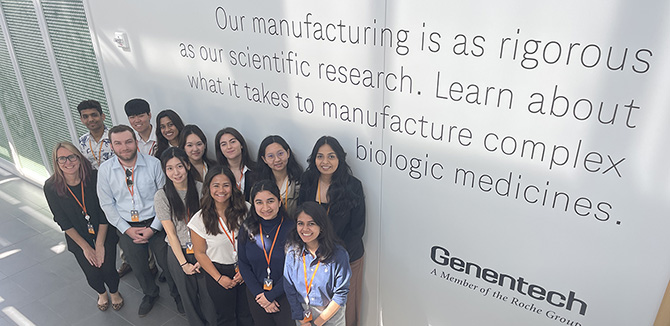
Ghadge now has an inside perspective on how science moves from research to real-world impact thanks to a trio of site visits in San Francisco, the birthplace of biotech. She and 11 of her classmates from Northwestern Engineering's Master of Biotechnology Program (MBP) recently spent two days in the Bay Area, where they toured Genentech, Vaxcyte, and Amyris.
Genentech launched in 1976 as the first-ever biotech company. Today, it develops novel treatments to help with cancer, diabetes, and growth hormone deficiency. Vaxcyte is a vaccine innovation company while Amyris uses synthetic biology to manufacture sustainable ingredients for various industries.
The MBP students met with Industry Advisory Board members Andy Lin and Gale Wichmann along with a collection of alumni at a private MBP reception.
"I didn’t have a clear sense of how the biotech industry functions, or where I might thrive," Ghadge said. "To me, this was a perfect opportunity to explore that and gain clarity on the type of environment where I could see myself growing."
Ghadge and classmate Kevin Baek (MBP '26) recently shared their highlights and favorite moments from the San Francisco experience.
What were your goals heading into the trip?
Baek: My biggest goal was to figure out what each company does and see if the biotechnology field aligns with my interests. I also wanted to make meaningful connections with industry professionals.
Ghadge: I wanted to get a closer look at the day-to-day operations of these companies — how their facilities function, how teams collaborate, and how things actually work on the ground. I wanted to pick the brains of people who work there, because that kind of insight just isn’t possible through a typical networking event or surface-level conversation.
What stood out to you about your time at Genentech?
Baek: My biggest takeaway was from the lab tour. It was interesting to see the large-scale bioreactors in person. It was also interesting to hear about the scale-up process and the steps Genentech takes for regulatory risk management.
Ghadge: One thing that stood out to me about Genentech was their rotational programs for students and recent grads. I liked how the programs were thoughtfully structured around specific functions or departments that naturally work together. It felt intentional and tailored, not just a generic list of options, but something that lets you explore areas based on your actual interests. I also appreciated that Genentech continues to invest in improving its manufacturing units. The fact that they’re still investing in foundational improvements shows a deep commitment to innovation, efficiency, and constantly doing better, even when they’re already well-established in the biotechnology industry.
What were the biggest takeaways at Vaxcyte?
Baek: My biggest takeaway was that the release of vaccines is different from the release of drugs. I also liked how we were able to hear about how the company started from co-founder Jeff Fairman. His journey and the decisions he made to help Vaxcyte position itself in the market were fascinating.
Ghadge: The company's journey, from a three-person startup to a key player in the vaccine space, was nothing but inspiring. What stood out was not just the innovative science behind their conjugate vaccine, but the thoughtfulness and intentionality that the company embodies. Also, it was amazing to learn that the team designed their own labs, designing the space to how they work best, rather than outsourcing the process. That level of ownership and attention to detail speaks volumes about their culture.
What did you learn at Amyris?
Baek: I found it interesting that they have a lot of automated machinery as well as a lot of wet lab work. It was also helpful to know that you don’t have to be in a lab to be contributing to the different projects. I was able to talk with a software engineer who worked there and found different roles required for Amyris to run well.
Ghadge: One thing I came to appreciate was the importance of synthetic biology — learning about everything they’ve managed to manufacture, from synthetically making Artemisinin for anti-malarial treatments to Squalane, which is used in beauty products. It made me realize just how impactful synthetic biology can be. I also valued that Gale Wichmann mentioned employees shouldn’t be spending their time on tasks that a robot could easily do, even as simple as repetitive pipetting. That absolutely stuck with me. It showed me that at Amyris, people are truly valued for their ideas, input, and creativity. It felt like a place where your contributions are genuinely respected and encouraged.
What did you enjoy about the alumni reception?
Baek:I found the get-together helpful as we were able to talk with people from different companies and different roles. It also helped that it was a less professional setting, allowing people to talk to each other more freely. The relaxed conversations allowed us to have honest conversations and learn about the diverse pathways into the biotechnology industry.
Ghadge: What really stood out to me was how genuinely excited everyone was to be there. Some alumni drove over an hour just to spend time with us, which says a lot. It made me realize how strong and supportive the Northwestern alumni network truly is. I left with so many valuable insights, especially around how to approach challenges I face and how to move forward.
How do you think you'll apply lessons learned from the trip to the rest of your time in MBP?
Baek: Trips like this are incredibly valuable because they provide a realistic glimpse into the working world of biotechnology. Being able to see these environments firsthand and speak with people in the field helped me better understand what to expect and how to prepare. Now I have a better understanding of what type of work I want to pursue.
Ghadge: The lessons I learned during this trip made me see the importance of networking and how powerful it is. As I continue my time at MBP, I want to be more intentional about using every opportunity, whether it’s an event or a casual conversation. I want to use them to connect with people and build meaningful relationships. Because of the sites we visited, I feel like I have a better foundation, and I feel more confident asking thoughtful, targeted questions at future networking events. It’s definitely changed the way I will approach these interactions.