Showing the Impact of Research
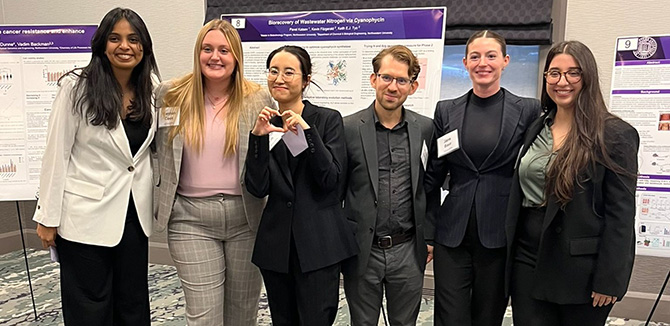
MBP students shared the findings of research conducted during their time in the program at the MBP Fall Research Symposium.
The title of Ana Martins' research project in Northwestern Engineering's Master of Biotechnology Program (MBP) was 13 words long.
"Mitochondrial Transplantation As a Strategy to Promote Pro-regenerative Macrophages and Improve Cardiovascular Health," does not easily roll off the tongue, so it was more important than ever for Martins (MBP '24) to make sure viewers of her research poster understood her project and its potential impact.
She succeeded in that mission.
Martins, Jane Baur (MBP '24), and Isha Ghadge (MBP '25) were named top poster presenters at the MBP Fall Research Symposium.
"I wanted my poster to show the highlights of my work instead of it being a compilation of things that I had tried or done," Martins said. "I knew in advance the key takeaways I wanted the audience to have and wanted to make sure that the poster could serve as a standalone and as a way to visualize everything I was explaining, since most of the audience would not be in the field or have much background knowledge about my topic."
Martins' project examined how to make innate immune system cells — or macrophages — be more regenerative. Her work was done in the cardiovascular regenerative engineering lab led by Bin Jiang, an assistant professor of surgery and biomedical engineering at Northwestern.
Martins felt her poster’s intentionality made it stand out.
"One thing I focused on was using my poster as a tool to really support my explanations," she said. "I made sure the layout, titles, and images all aligned with my talking points. This approach not only made it easier and quicker for me to present my work, but it also helped others follow along more easily."
Ghadge's poster approach was similar to Martins. Ghadge studied leukocyte transmigration and devised ways to block it in order to fight against maladaptive inflammation. Her work, which also focused on determining mechanisms for tumor transmigration, was done at the Muller Lab within Northwestern's Feinberg School of Medicine.
Ghadge had four main takeaways from her research. When she created her poster, she wanted to make sure audience members didn't just read about the findings, but instead understood their larger impact.
"My goal for the poster presentation was not just to walk them through what I did and how the project progressed, but to also make the audience see eye to eye about the bigger picture and the impact it would have on dealing with maladaptive inflammation," she said. "It is very important to start with a conclusion or the why of the project and then provide support for the conclusion because it makes unknown information much easier to digest."
Baur agreed.
Her research focused on healthcare conglomerates and investigating the drivers of US drug price inflation.
"The goal for my poster presentation was to take a topic that many are unfamiliar with and share it in a way that engaged the audience," she said. "I focused on illustrating how my research has broad, real-world impact, which I think helped the audience connect with and engage deeply with the content."
Included in the audience were members of the MBP Industrial Advisory Board (IAB), who represent some of the most prestigious organizations in the healthcare and life sciences space. Presenting to those industry leaders and getting feedback from them was perhaps the most memorable component of the symposium experience, the students said.
"The main reason I wanted to present in front of the Industrial Advisory Board was because of the perspective you gain," Ghadge said. "All of them came from different backgrounds with different perspectives, and having someone take a look at your research and share their views about it is so valuable. Getting that feedback and opinion is only going to help me better myself in the future."