Applying MBP Lessons to UCB Internships
Three current students look back on their time in London as interns for pharmaceutical manufacturer UCB.
Dhinal Thakker (MBP '26) has a science background and an interest in business and entrepreneurship. She believes what differentiates her is the ability to bridge technical expertise with strategic thinking.
This past summer, she put that knowledge to the test as a downstream process optimization intern at pharmaceutical manufacturer UCB. Dhinal planned and executed experiments, analyzed results, and presented biweekly updates to her managers.
"It gave me a clear view of how a biopharma organization operates at scale and how our work impacts patients," Dhinal said. "I gained confidence in experiment design and execution, data interpretation, and communicating results to diverse stakeholders."
Dhinal routinely found herself applying lessons learned in Northwestern Engineering's Master of Biotechnology Program (MBP). She relied on fundamentals learned in Bioprocess Engineering and Properties and Separation of Biologically Produced Molecules on a daily basis. She also benefited from Regulatory Sciences in Biotechnology and Technology Commercialization Fundamentals to help frame decisions throughout the experience.
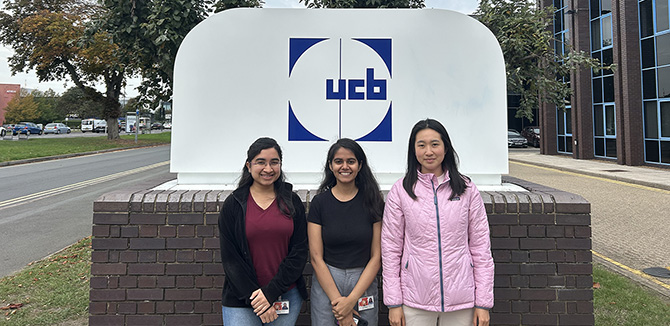
Dhinal wasn't alone with this experience. In fact, she was one of three MBP students who spent the summer at UCB's London-based facility. Ruiqi Fan (MBP '26) was an associate scientist intern at UCB while Esha Pradhan (MBP '26) was a molecular characterization intern.
Both echoed Thakker's feelings about being prepared for the opportunity thanks to their time in MBP.
"I was able to apply both the technical and communication skills I learned in MBP," Ruiqi said. "The bioseparation and downstream processing classes helped me understand the scientific principles behind my project. The emphasis MBP places on solving industry-relevant problems made it easier for me to approach real experimental challenges at UCB with a structured mindset."
Ruiqi also benefitted from the program's emphasis on communication, adding that she designed clear and logical presentations whenever she needed to provide project updates to her manager or colleagues.
Esha agreed.
"The professional development class, in addition to all the networking events, opportunities, and career fairs, played a huge role in building my confidence and comfort in striking up a conversation with colleagues and seniors at the company," she said.
Much of Esha's internship was spent focused on mass spectrometry, an analytical technique used extensively in the biotech industry. She had previous experience working with upstream and downstream processes, but this was an opportunity to explore a new field she believed would be relevant for her career post MBP.
Looking back on the experience, she sees how the internship helped her grow professionally and prepared her to thrive during the rest of her time in the program and after she graduates.
"Designing experiments towards an end goal, understanding data, keeping thorough records, and communicating effectively are skills transferrable to whichever lab I join for research," Esha said. "I now have a better understanding overall of the different domains that make up a biopharma company, which will enable me to have more informed, meaningful conversations and connections in the future."