

Getting to Know New Chair Sinan Keten
In a Q&A, Keten discusses his vision for the department, including opportunities in embodied AI and space and extreme environments, and his focus on collaboration across the department’s core strengths.
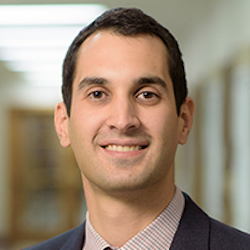
Sinan Keten sees an opportunity to build on the longstanding strengths of Northwestern Engineering’s Department of Mechanical Engineering while creating new connections across a field whose traditional boundaries are increasingly permeable.
The department has established strengths in mechanics and materials, design and manufacturing, and robotics and biosystems.
“The boundaries between these areas are very fluid,” said Keten, Jan and Marcia Achenbach Professor and chair of mechanical engineering. “One of my top priorities is to promote more cross-cutting collaborations between our three sub-disciplines, seeding efforts that can lead to multi-disciplinary research centers.”
Keten, who succeeded Wei Chen in September, plans to build on the department’s investments in teaching, laboratory spaces, faculty, and students while encouraging collaborations that span its core disciplines. In the following Q&A, he discusses those opportunities, his priorities as chair, and his vision for the department’s next chapter.
What is your vision for the Department of Mechanical Engineering, and how do you plan to guide it through the next phase of growth and innovation?
I am excited to lead a department with extraordinary strengths in research, education, and teaching at a moment when mechanical engineering is being reshaped by rapid technological change. As technological innovations create extraordinary opportunities to improve the human condition, they also challenge us to ensure that innovation serves society broadly and responsibly. Mechanical engineering stands at the center of this transformation, enabling advances in robotics, manufacturing, artificial intelligence, materials, healthcare, and sustainability that address society's most pressing challenges.
My goal as chair is to help our students, staff, and faculty create a better future through world-class research, innovation in teaching and learning, and a collaborative culture that prepares the next generation of engineers to lead discoveries in fields we cannot yet imagine. Strategically, we have identified space and extreme environments and embodied AI as important growth areas where we can build on our historic strengths. We plan to grow in these key areas, as well as others, through hiring outstanding faculty, continuing to attract top-notch students, and incorporating cutting-edge research into an innovative curriculum.
The department has identified embodied AI as an emerging area of emphasis, bringing together AI with materials, manufacturing, robotics, and human-machine systems. What opportunities does that create for Northwestern ME, both in research and in how students are educated?
Advances in AI are rapidly changing research, education, and engineering. Students and researchers are drawn to the challenge, where the hands-on skills emphasized in mechanical engineering, together with a fundamental understanding of physical systems, are increasingly valuable. Building the next generation of autonomous systems requires bringing together computation, mechanics, materials, manufacturing, and biology. This creates exciting opportunities for interdisciplinary learning and scholarship, already embedded in our department’s culture and reflected in the breadth and depth of our curriculum.
What excites you most about stepping into this leadership role, and what lessons from your own research career do you hope to bring to the position?
Solving complex problems and mentoring students are two things that I love about my job as the primary investigator of a large and thriving research group. To be surrounded by very smart, energetic people and to help them achieve their aspirations is incredibly rewarding. As chair, I notice certainly similarities in the nature of the job. I deeply enjoy mentoring junior faculty and celebrating their successes. I also like solving complex problems, some of which now involve satisfying tight constraints in physical and social paradigms.
How do you plan to build on Wei Chen’s accomplishments as chair, and what aspects of her leadership do you most admire or hope to continue?
Wei led the department admirably through a challenging period, always with a principled approach and genuine care for our community. As associate chair during her tenure, I learned a great deal from her leadership and had the opportunity to contribute to several of the policies and priorities established during that time. Her work strengthened the department’s decision-making and helped shape a compelling vision through McCormick’s strategic planning process.
My immediate priority is to advance the initiatives we began together while continuing to build a connected and supportive community.