

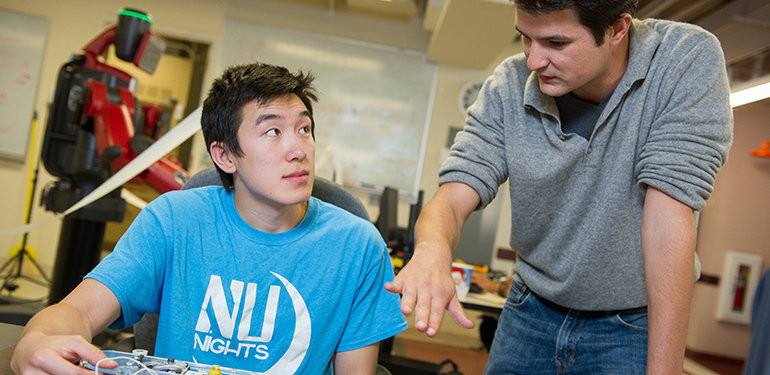
 With a solid foundation in mechanical engineering, undergraduates participate in advanced courses, projects, and research.
AcademicsUndergraduate Study
We provide students with a strong foundation in mechanical engineering, prepare them for leadership and innovation by emphasizing independent thinking and teamwork, instill a systematic approach to problem solving, and promote a keen awareness of the role of engineering in modern society. The distinguishing attributes of our undergraduate education are: Holistic, Cutting Edge, Experiential, and Award Winning.
Holistic
We train whole-brain engineers. Our curriculum integrates a solid foundation in technical subjects with multiple opportunities for creative problem solving, plus experience in design, entrepreneurship, and leadership.
Cutting Edge
Curricular flexibility is provided in the form of seven state-of-the-art concentrations such as aerospace, design, manufacturing, energy, and robotics, reflecting rapidly emerging areas of mechanical engineering. Our curriculum can be customized to suit a student’s interests and professional goals.
Experiential
We emphasize design thinking and hands-on learning through our flagship Engineering First and capstone sequences. Outside the classroom, many students engage in research with world-renowned professors for academic credit. Entrepreneurial and leadership opportunities are available in the innovation space at The Garage and the Farley Center for Entrepreneurship and Innovation.
Award-Winning
Our department has received the largest number of university-level teaching awards at Northwestern. We are also innovators of teaching tools such as the lab-in-a-backpack and the Northwestern Lightboard. Students are advised by faculty members one-on-one through graduation, creating continued and long-lasting relationships.
The mechanical engineering program is accredited by the Engineering Accreditation Commission of ABET (www.abet.org).
Explore the BS in Mechanical Engineering
The McCormick Experience
During their freshman year, students work in small teams in their Design Thinking and Communication class. One DTC project created by mechanical engineering students was an interactive puzzle for otters at the Shedd Aquarium, which can be seen in the 2014 LiveBIG: Shedd Partnership Feature Video.
Design Thinking and Communication is part of McCormick's Engineering First® program, an innovative curriculum for first-year engineering students at Northwestern. In addition to Design Thinking and Communication, students take four basic engineering courses covering:
- linear algebra
- MATLAB programing
- engineering mechanics
- statics
- dynamics
- differential equations
Real Projects for Real Clients
Throughout their time at Northwestern, students work on real-world projects from individuals, nonprofits, entrepreneurs, and industry by designing, building, and testing their ideas.
Past projects have involved collaborations with organizations such as:
- Shirley Ryan AbilityLab
- The Anixter Center
- Diveheart Foundation
- The Douglas Center
- Lamb's Farm
- Great Lakes Adaptive Sports Association
- The North Center
- SRAL Galvin Health and Fitness Center
- Shedd Aquarium
- Shore Community Services
Innovative Project Ideas
Some of the students develop their own projects. For example, a student who had a broken finger was able to use the knowledge and skills she learned as a mechanical engineering design major to create her own custom hand-splint.
Extracurricular Activities
Outside of the classroom, students enjoy participating in clubs, such as the technically-oriented Solar Car Team, the sustainability-focused Engineers for a Sustainable World (ESW), and the Entrepreneur@NU.
Design
Regardless of the students' specific focus, design plays a large role in the mechanical engineering program in terms of both course work and research. Mechanical engineering students at Northwestern have the opportunity to work in cutting-edge research facilities and centers, including the Integrated DEsign Automation Laboratory (IDEAL) and the Center for Robotics and Biosystems.
Students may also collaborate extensively with the Segal Design Institute, which administers the Design Thinking and Communication course. Students work closely with faculty beginning their freshman year and culminating with some senior design projects. The Segal Design Institute also offers a bachelor's degree in Manufacturing and Design Engineering as well as an undergraduate Segal Design Certificate.