

MICRO Summit Returns to Northwestern
Led by Professor Cécile Chazot, the program brought undergraduate researchers from across the country together for three days of scientific exchange, career development, and mentorship in materials science and engineering.
Led by Northwestern Engineering’s Cécile Chazot, the Materials Initiative for Comprehensive Research Opportunity (MICRO) returned to the University.
On May 8-10, MICRO welcomed undergraduate researchers from across the country for a multi-day program of scientific exchange, facility tours, and career conversations in materials science and engineering. Supported by the 3M STEM and Skilled Trades Program, the event highlighted both the breadth of materials research and the collaborative community that supports early-career scientists.
Chazot is the Julia Weertman Professor in Materials Science and Engineering at the McCormick School of Engineering. Chazot joined the Northwestern Engineering faculty in 2023 and leads the MICRO program, which she co-founded while a graduate student at MIT in 2021.
“The summit reflects the program’s mission to provide undergraduate students with meaningful research experiences and professional development opportunities,” Chazot said. “By combining student-led research presentations with mentorship, facility access, and career guidance, the summit offers a comprehensive introduction to the field.”
The summit opened with a day of undergraduate research presentations spanning the interdisciplinary nature of materials science and engineering, with students sharing work in biomaterials, computational modeling, imaging, and advanced characterization. Projects ranged from machine learning analysis of dental microstructures to simulations of polymer and supramolecular systems, reflecting both scientific depth and a deliberate emphasis on cross-disciplinary communication.
The presenters were:
- Michael Angelo San Juan, University of Texas at San Antonio: Use of machine learning to segment micro-CT images of mutant mouse enamel
- Ana Colliton, Oak Ridge National Laboratory/Northwestern University: Mesoscale structural and compositional gradients in human enamel using microXRD
- Anzheng (Alex) Tang, Carleton College: Grain boundary segregation beyond dilute limits using spectral modeling
- Alana Canty, Old Dominion University: Computational approach to understanding biopolymer fiber spinning
- Chi Nguyen, Davidson College: Cryo-electron microscopy reconstruction of peptide amphiphiles
- Jessica Shrestha, University of Southern Mississippi: Coarse-grained molecular simulations to model supramolecular copolymerization
“Each presentation emphasized both scientific motivation and emerging results, encouraging discussion across disciplines and helping students build confidence in communicating their research,” Chazot said.
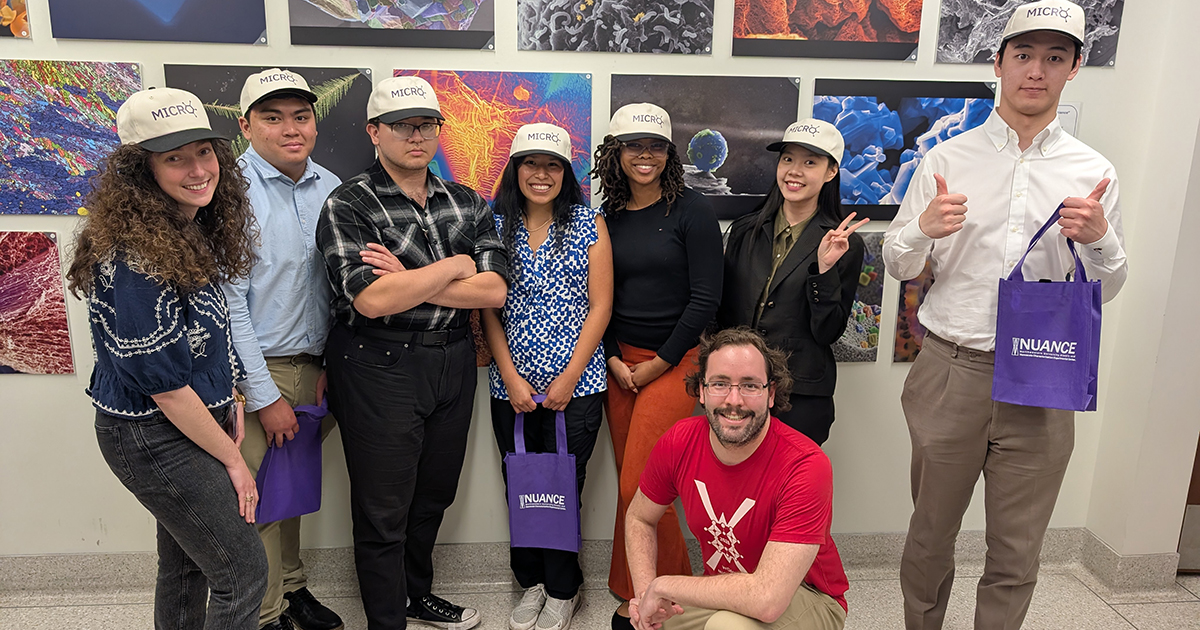
Participants also gained hands-on exposure to Northwestern's Atomic and Nanoscale Characterization Experimental (NUANCE) Center, where MSE PhD graduate Chris Sharpe (PhD '25) guided students through specialized instrumentation used for nanoscale imaging and materials analysis—illustrating how characterization tools underpin cutting-edge research.
Career development was a central component of the program. A panel on pathways after a PhD brought together speakers representing a range of career trajectories, including Chris Hareland of QuesTek Innovations, recent Northwestern PhD graduate and Querrey InQbation Lab entrepreneurship fellow John Misiaszek, and Tammy Lai, formerly at Nalco Water. Moderated by Chazot, the discussion explored opportunities in industry and academia as well as the skills and decisions involved in navigating postdoctoral career paths.
The program also featured a graduate student panel, where current Northwestern PhD students Natalie Fisher, Sebastian Marini, Abhiram Devata, and Ryan Zhou shared candid perspectives on research, coursework, and selecting a lab environment.
Community-building and mentorship shaped the summit as much as its formal programming. The Materials Science Student Association 5K was one of several informal activities that drew students, graduate researchers, and faculty together outside the lab and classroom, creating space for the kind of organic connection that structured events rarely produce.
"A central goal of the summit was to foster connections among students, faculty, and mentors," Chazot said. "Shared meals, informal breaks, and group activities created opportunities for participants to exchange ideas and build lasting relationships."