
The Problem
Researchers have lacked a reliable way to determine the complex atomic structures of material interfaces that affect how materials perform, degrade, and fail.

Researchers have lacked a reliable way to determine the complex atomic structures of material interfaces that affect how materials perform, degrade, and fail.
Researchers developed an AI-powered computational approach that combines machine learning, advanced structure searches, and quantum-mechanical calculations to predict interface structures.
The approach could help researchers understand and ultimately design interfaces that improve the performance, efficiency, and durability of materials in energy, electronics, and structural applications.
Professor Chris Wolverton, PhD candidate Chang-ti Chou
Small but mighty grain boundaries and interfaces are found in the materials that form everyday technologies including batteries, fuel cells, solar cells, electronics, and structural components. They influence the movement of ions, charge, heat, and stress in materials, affecting the efficiency, durability, and failure of common technologies.

Recent work by Northwestern Engineering’s Chris Wolverton leverages AI to help researchers determine the atomic structures of grain boundaries, where differently oriented crystals meet, and interfaces in a way that is more reliable than existing methods.
“The research raises the possibility of designing longer-lasting, safer, and more efficient technologies by understanding and eventually controlling these hidden boundaries inside materials,” said Chang-ti Chou, a PhD candidate in materials science and engineering and member of Wolverton’s research group.
Wolverton and his team developed an AI-driven computational approach that combines machine learning, advanced search techniques, and quantum-mechanical calculations to explore a much broader range of possible interface structures than conventional methods. The researchers then tested the approach on strontium titanate, a dense, high-melting-point oxide. The method identified stable grain-boundary structures whose predicted atomic arrangements closely matched experimental electron microscopy observations, even though the experimental data were not used during the calculations. This agreement provided an independent validation of the method’s predictions.
The approach could help researchers design higher-performing materials for energy, electronics, and structural applications.
Wolverton is the Frank C. Engelhart Professor of Materials Science and Engineering at the McCormick School of Engineering. Carried out with collaborators from Harvard University, the Max Planck Institute for Solid State Research, and the University of Illinois Urbana-Champaign, the research was presented in the paper “Predicting Interface Structure using the Minima Hopping Method with a Machine Learning Interatomic Potential,” published July 15 in npj Computational Materials. Chou served as the paper’s first author.
Interface prediction has long been a major challenge in materials science because researchers have lacked a reliable, generalizable way to determine the complex atomic structures of material interfaces. This work helps address that challenge by establishing a technical foundation for more predictive and reliable interface simulations. The approach could enable systematic studies of how interfaces limit or enhance performance across a range of technologies.
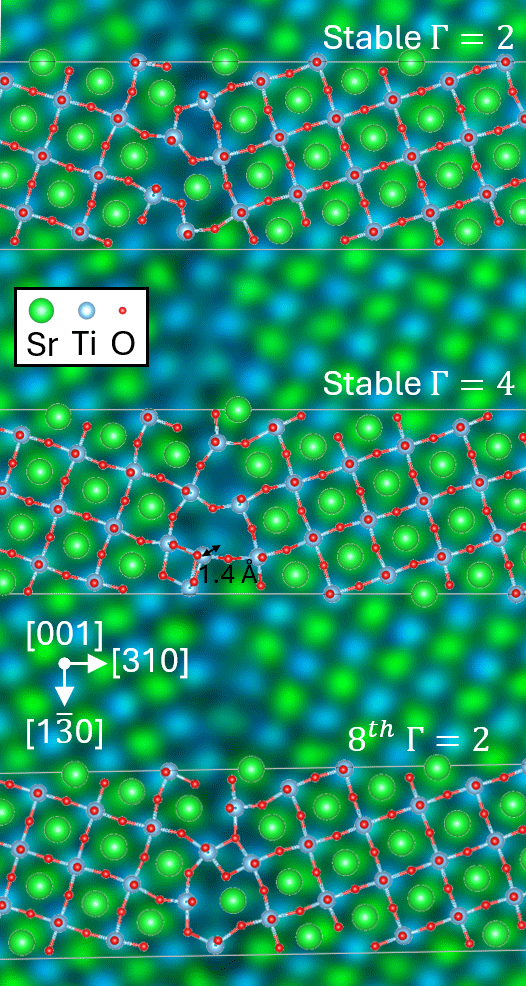
This paper builds on the team’s earlier work developing a computational method to predict the atomic structures of material interfaces. That earlier approach relied on simplified models that could not fully capture the complexity of interfaces with varying chemical compositions and atomic arrangements.
In the new study, the researchers use machine learning to create a more accurate model, expand their analysis to a wider range of interface compositions, develop a more broadly applicable way to train the model, and compare their predictions directly with experimental observations.
“Our previous work established the search framework, while the current study improves its accuracy, generality, and experimental relevance,” Wolverton said.
The researchers’ next step is to apply the framework to more complex grain-boundary problems with important scientific and technological implications. They are already using the approach to study how grain boundaries affect hydrogen transport in fuel-cell materials and alter the electronic properties of solar-cell materials.
By testing the framework in these more complex systems, the researchers hope to better understand how the atomic structure of grain boundaries can limit performance or, in some cases, provide useful functionality.