Using Robotics to Inspire Kids
MSR students look back on their time demonstrating projects to visitors at Chicago's Griffin Museum of Science and Industry
David Khachatryan (MSR '25) was standing among dozens of roboticists and hundreds of visitors inside Chicago's Griffin Museum of Science and Industry when a second-grader taught him a valuable lesson.
Khachatryan and his classmates from Northwestern Engineering's Master of Science in Robotics (MSR) were demonstrators as part of the museum's annual Robot Block Party, where attendees get to learn about and interact with all types of robotics.
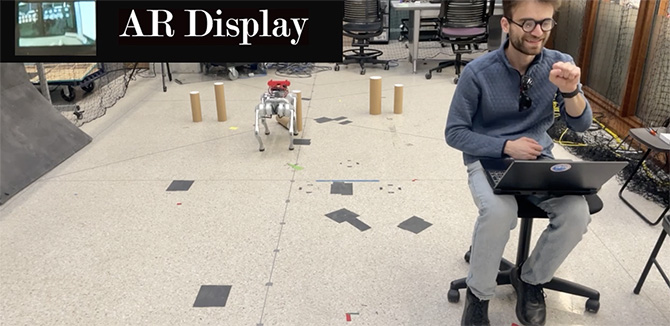
Khachatryan showed his winter quarter independent project that saw him teleoperate a quadruped robot dog using augmented reality (AR) glasses.
During one of the demonstrations, an 8-year-old asked how the robot knew where to go and what to do. Khachatryan quickly realized he couldn't explain the way he would if he was talking to a professor or fellow roboticist.
"You're not going to give them the whole speech," Khachatryan said. "I feel like I got better at explaining in simpler and shorter terms, which is something you have to know for your career. If you're at a job interview, you can't spend 10 minutes talking about one project. As more people were asking, I got better at talking about it."
The project had two components. The first aspect of Khachatryan's work relied on machine learning to recognize gestures that mapped to certain dog movements. The second component was the AR glasses integration that allowed Khachatryan to see from the dog's perspective.
Khachatryan learned a number of other lessons from the experience.
By showcasing his project, he was reminded that what he thinks is interesting is not always what will stand out to other people. One of the components of the project he was proudest of was the integration with AR glasses. However, he quickly discovered that more attendees were interested in making the robot dog move using hand gestures.
Part of that disconnect was because of the small display screen on the glasses, Khachatryan said, but the other explanation was the gestures made it far easier for guests to interact with the robot dog.
Another key lesson Khachatryan discovered was the difference between working in a controlled lab environment compared to an open setting with more variables.
One of the gestures Khachatryan programmed was holding his thumb down, which meant the robot should sit down. The code he initially wrote, however, was for his own thumb. Because many of the attendees at the Robot Block Party were kids, their thumbs were much smaller.
"The machine learning program would think it was a fist, and fist meant go," Khachatryan said. "That was really tricky and interesting. After the first day at the museum, I went home and changed some code to make sure it was safe."
Zhengxiao Han (MSR '25) found himself practicing the same communication fundamentals as Khachatryan while he demonstrated his own robot dog at the museum.
"I avoided jargon because there were a lot of non-technical audience members trying to talk about technical concepts with me," Han said. "For this situation, I would use terms that are easier to understand, such as 'see and understand what you are doing' instead of 'vision language model' and 'build a map in your room' for simultaneous localization and mapping'."
Throughout the experience, Han tried to imagine himself as one of the children seeing so many different robots on display. He was excited to show off the work he did, but his larger goal was to inspire people to explore the field he's fallen in love with.
"I found myself interested in robotics when I was a kid, so I think it's pretty important for kids to be exposed to as many areas as they can," he said. "When I recall my original robotics motivation, it's not a concrete vision. It's just an urge, a feeling like 'it's so cool.' That's what I wanted to bring to the audience, especially for the kids. I hope one day when they recall this event, they will remember there was a robot that's so cool, and that's enough."