

Grad Spotlight: Rohan Sohini
Sohini is graduating with a bachelor’s of science in applied mathematics
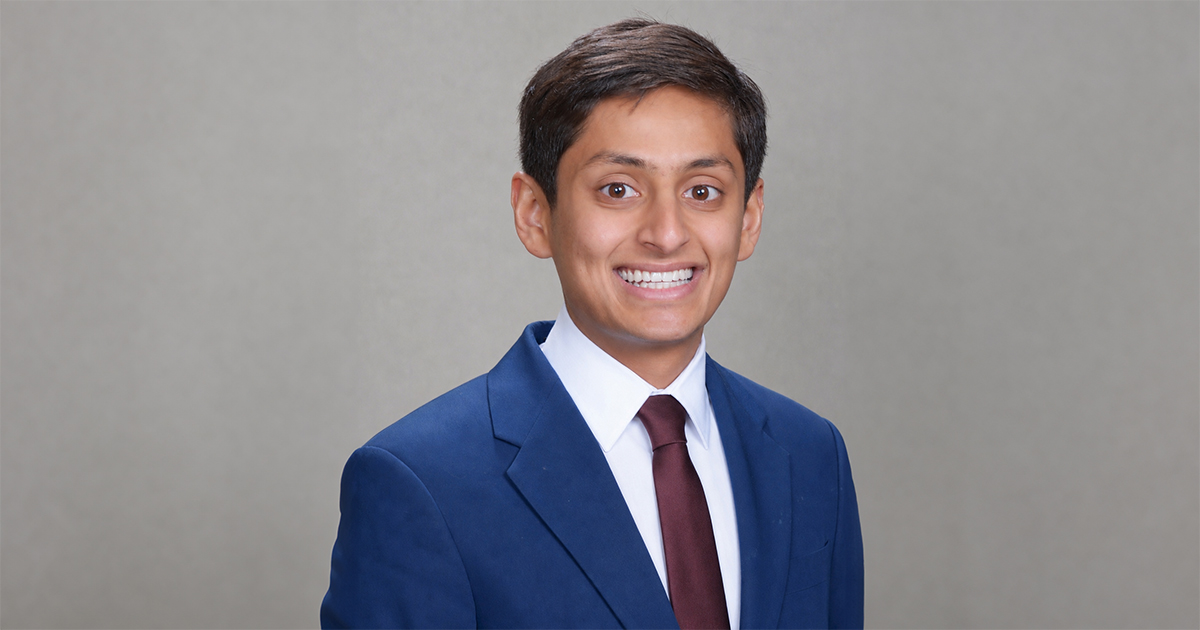
Rohan Sohini doesn’t need many words to say how he feels about winning a Fulbright Fellowship to study machine learning at Helmholtz Munich.
“I am super thankful to have won the Fulbright research award,” Sohini said.
During those 10 months, Sohini will develop machine learning models to study the dynamics of RNA expression in human cells. As an aspiring researcher, he recognizes the value of building skills in biological machine learning.
“This opportunity will give me the chance to apply a lot of the content that I have learned throughout my undergraduate degree in an impactful setting,” Sohini said. “Outside of research, I am grateful to be able to explore a new country. I look forward to learning about German culture and making new friends.”
Sohini is graduating with a bachelor’s of science in applied mathematics and a minor from the Machine Learning and Data Science program. After the fellowship, he plans to attend medical school, with the goal of becoming a physician scientist working on computational healthcare projects involving large datasets.
Sohini spoke with the McCormick School of Engineering about his undergraduate experience, advice to future students, and more.
Why did you decide to pursue engineering at Northwestern?
Since I was a kid, I have loved building and tearing down devices. I would spend a lot of time repairing electronics, from broken iPhones to Apple watches, and I was extremely fascinated with their intricate and functional designs. I also spent many hours working with my dad at his physical therapy clinic. I loved the healthcare environment, so I decided to bridge my two interests through a biomedical engineering degree at Northwestern. During my first year, I realized that I enjoyed the math component of engineering, and I decided to pivot to applied mathematics.
How did the McCormick curriculum help build a balanced, whole-brain ecosystem around your studies in your major?
I really enjoyed the Design Thinking and Communication classes as a first-year student. On one hand, they provided a small classroom environment where I could closely interact with my professors and get constant design and communication feedback compared to our other classes like our packed general chemistry courses. On the other hand, the DTC classes gave me an opportunity to be creative. Learning how to brainstorm, sketch, and build in the Ford shops felt really liberating, especially as a first-year student. Getting to work on a problem that was directly impactful for our partner, a physical therapist, gave our project meaning and made it an unforgettable experience.
I didn’t realize it then, but I ended up pivoting to applied math, where I no longer am working hands-on in the shop. Having the DTC experience to do just that with engineers from all backgrounds ended up being an important component of my education because it helped me understand the type of design choices that my fellow engineers have to make in their fields.
One of my favorite classes was COMM_ST 102-0: Public Speaking, a required speech course for our engineering curriculum. Writing speeches on a bi-weekly basis really pushed me out of my comfort zone in a way other engineering courses had not. It forced me to iterate through my written speeches and rehearse them until I felt confident enough to present. In my class, I ended up writing my best man speech for my older brother where I gave it a month later at his wedding.
What skills or knowledge did you learn in the undergraduate program that you think will stay with you for a lifetime?
My undergraduate degree taught me more than course content. It taught me how to think through scientific problems. I learned to read and synthesize literature, identify promising research directions, pick up unfamiliar material quickly, and structure a project from start to finish. Learning how to learn has been the most valuable outcome of all. Beyond academics, college sharpened my written and oral communication, and gave me real practice in the skills that matter long-term, including building relationships, networking, and presenting ideas clearly.
What advice do you have for current and future Northwestern Engineering students?
Dedicate your time in undergrad to a handful of extracurriculars. It is easy to take on too much, especially alongside coursework, which can lead to burnout and frustration. Whatever you choose to commit to, give it your full effort and try to learn as much as possible from it.
Is there anything else you’d like to discuss about your Northwestern experience?
The most important component of my Northwestern experience has been the people that have shaped it. I would first like to thank my friends and the community that I have built in Brown Sugar, my a cappella group. Then, I would like to thank several professors including Yogesh Goyal, Alvin Bayliss, Richard Silverman, and Moses Chan who have continually supported me and my endeavors. Lastly, I would like to thank everyone involved with the Center of Synthetic Biology, including Christine Akdeniz and Erica Hartmann, who have helped shape my future research aspirations.
Editor's Note: This is the third in a series of Q&As with graduating Northwestern Engineering students. Stay tuned for more reflections leading up to the June 15 Undergraduate Convocation.