
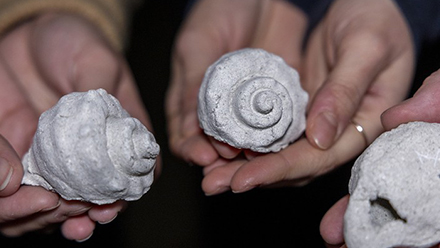
Forget Imitation Crab - Researchers Test Snackable Snails
Shedd Aquarium and Northwestern Engineering students design tasty artificial shelled treats for ocean predators.
Advisors: Stacy Benjamin and John Anderson - Segal

Innovative, adaptable curriculum is central to our mission to educate with an eye toward future challenges.
The field of engineering is evolving and the ways we teach must keep pace. Concurrent with Northwestern Engineering’s mission to revolutionize the methods of engineering is our mission to empower students to use these methods and envision new ones. We are prioritizing innovative, adaptable curriculum and programs to prepare the next generation of engineers to address challenges in an ever-changing landscape.
Setting the stage with data, programming, design, and entrepreneurial thinking
More than 25 years ago, Northwestern Engineering's Engineering First curriculum pioneered design thinking in undergraduate education nationally — most visibly through Design Thinking and Communication, where first-year students partner with industry and nonprofits to solve real client problems while building engineering, writing, and communication skills.
Now we're taking the next step: a redesigned core curriculum built around data and statistics, programming, and entrepreneurial thinking. Today's engineers innovate through data — the backbone behind breakthroughs from AI and advanced manufacturing to biohybrid systems, materials design, and risk modeling. Starting in year one, students will take three new Engineering Foundations courses — Python programming, probability and statistics, and linear algebra — shifting the core curriculum's center of gravity from mechanics toward data analytics and reasoning under uncertainty.
Alongside this, we're weaving entrepreneurial thinking into the curriculum early — training students from day one to connect their work to companies, markets, and policy, so they're ready to make the greatest possible impact.
“Technical solutions – new designs, products, processes - have limited impact unless a pathway can be built for success in the marketplace. Whether launching a new enterprise or new directions within an established company, entrepreneurial thinking skills are essential to gather support for any new innovation.”
Wes Burghardt
Associate Dean of Undergraduate Engineering
Shedd Aquarium and Northwestern Engineering students design tasty artificial shelled treats for ocean predators.
Advisors: Stacy Benjamin and John Anderson - Segal
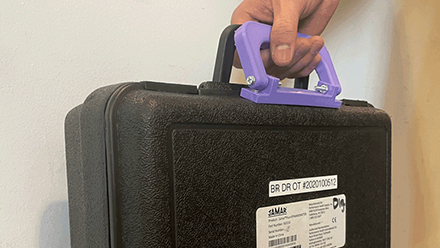
DTC students collaborated with Shirley Ryan AbilityLab to design a solution to prevent broken dynamometers.
Advisor: Kiki Zissimopoulos - Segal

DTC students designed a natural air purifier - named Arbor - that uses moss.
Advisor: Janice Mejia - IEMS, Segal
Weaving design thinking throughout the undergraduate curriculum alongside other newly defined engineering methods
Design thinking has been a focus in the first-year engineering experience for many years at Northwestern Engineering. It has helped our students build valuable skills in creativity, teamwork, and user-focused problem-solving. Design thinking skills complement technical skills, enabling our students to discover and create the best possible solutions.
Now, we will move to more deeply incorporate the design thinking mindset, process, and tools throughout the undergraduate curriculum and into senior-year capstone courses, ensuring that our unique approach to design innovation is leveraged alongside technical content. This pairing will give our students a unique advantage as they move into industry or academia.
“We have a unique opportunity to build on the skills acquired in first-year design courses by integrating those skills with discipline-specific technical content as students mature within their individual degree programs.”
Wes Burghardt
Associate Dean of Undergraduate Engineering
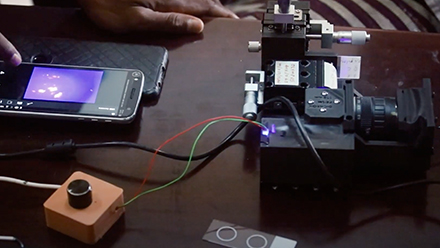
Biomedical engineering students developed an automated staining system using a 3D printing technology.
Advisor: Matthew Glucksberg - BME
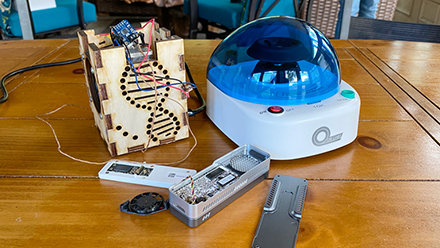
Student startup provides insightful genetic analysis while preserving privacy.
Advisor: Hayes Ferguson - Farley
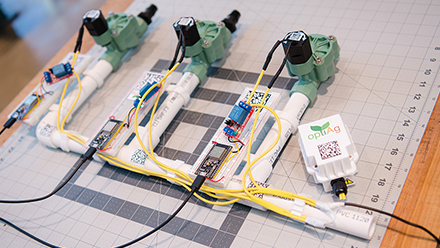
Student develops prototype device to help farmers more efficiently use water.
Advisor: Peshkin - ME
Adapting our curriculum and degree offerings to match the needs of a rapidly evolving engineering landscape
At all academic levels, Northwestern Engineering will continue to provide a curriculum that’s as nimble as it is rigorous. By creating new degree programs and specializations, and expanding existing offerings, we will prepare our students to drive impact and transformation in their chosen fields.
“We regularly enhance our degree portfolio using insights from our faculty, groundbreaking research, and industry partners to ensure students graduate with the specialized competencies needed.”
Shelley Finnigan
Associate Dean for Master’s and Professional Education
Recent degree innovations: Engineering Foundations, AI Major, Master of Science in Mechanical Engineering and Materials Science & Engineering.

Students will build skills to develop data science pipelines using computational data analysis to design and control engineering systems.
Director: Jill Wilson - IEMS
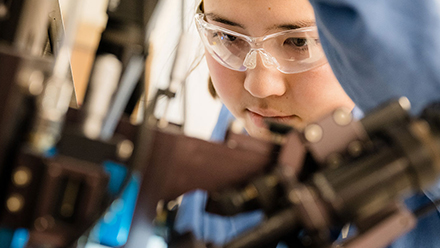
New program will leverage the strengths of the two departments.
Codirectors: Yip-Wah Chung - MSE; Greg Wagner - ME
Read about the Joint Mechanical Engineering, Materials Science MS Program
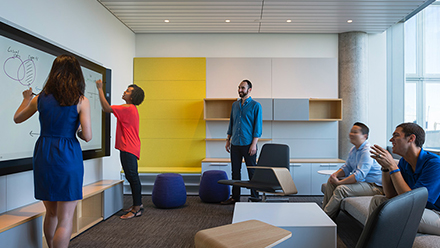
Accelerated five-quarter program to address the intersection of business and technology management.
Codirector: Andrew Fano - MBAi