

The Next Era of Engineering Education
A new core curriculum and degree program will provide students with a foundation tailored for their goals.



Strategic Vision: Transform Engineering Education
Northwestern Engineering prioritizes innovative, adaptable curriculum and programs to prepare the next generation of engineers to address challenges in an ever-changing landscape.
Technology continues to accelerate at an unprecedented pace. Artificial intelligence is reshaping commerce and industry. Complex, interconnected global challenges demand new ways of thinking and working. To meet this moment, engineering education must evolve.
At Northwestern Engineering, such evolution is not new—it’s foundational. For decades, the McCormick School of Engineering has embraced an adaptable curriculum, regularly introducing innovative courses, minors, and certificates designed to prepare students to have a meaningful impact across disciplines and industries.
This coming fall will mark the most significant advancement in the undergraduate experience since the school’s Engineering First® program debuted more than 25 years ago. Northwestern Engineering will unveil a comprehensive redesign of its undergraduate core curriculum and launch a new bachelor of science in engineering (BSE) degree program and an AI major.
“The core curriculum changes, the BSE program, and the AI major will vastly enhance the experience of our students,” says Wesley Burghardt, associate dean for undergraduate engineering. “This is important and exciting work.”
Refining the Core Curriculum
Northwestern Engineering’s redesigned core curriculum—effective for incoming first-year students this fall—reflects engineering’s shifting center of gravity by emphasizing data and statistics, programming, and entrepreneurial thinking as essential foundations for modern practice.

Today’s engineers power innovation with data. The ability to interpret and harness it is the methodological backbone, decision-making engine, and discovery accelerator behind breakthroughs from AI and advanced manufacturing to biohybrid systems, concurrent materials design, and risk modeling.
To meet an evolving landscape, the new first-year technical requirements will include three Engineering Foundations courses—one in Python-based programming, one in probability and statistics, and one in linear algebra. This new model shifts the focus from engineering mechanics to data analytics and probabilistic reasoning, equipping students to build discipline-specific applications, reason under uncertainty, and model complex systems.
Elevating Entrepreneurial Thinking
The updated core curriculum also aims to broaden students’ opportunities to cultivate crucial skills in entrepreneurship with a reimagined Design, Communication, and Innovation requirement (formerly Design and Communication).
Beginning in fall 2026, two Farley Center for Entrepreneurship and Innovation introductory courses—Principles of Entrepreneurship (ENTREP 225) and Engineering Entrepreneurship (ENTREP 325)—will be included as options for fulfilling the core requirement. Previously, these courses were offered only as unrestricted electives.

Burghardt notes that the expanded fulfillment options build on the interdisciplinary, innovation focus of the existing design, writing, and oral communication options.
“A hallmark of engineering practice is effective storytelling—thinking critically, pitching ideas, and communicating effectively,” Burghardt says. “Transformative technologies succeed not only because they work but because engineers can compellingly communicate why they matter.”
Building More Flexible Pathways
Not every incoming undergraduate student arrives with the same goals, academic background, or pre-engineering experiences. The new core curriculum is designed to meet the needs of individual students.
“We’re recalibrating the fundamental engineering skills that each of our degree programs will build upon with discipline-specific training,” says Burghardt, who chairs the working group leading the curriculum changes.
Mechanics-centric programs—including mechanical engineering, biomedical engineering, and civil and environmental engineering— will continue to require a rigorous two-quarter engineering mechanics sequence to align depth with disciplinary imperatives in those subject areas. Students in programs outside these mechanics-intensive disciplines will gain a solid grounding through a foundational physics mechanics course.
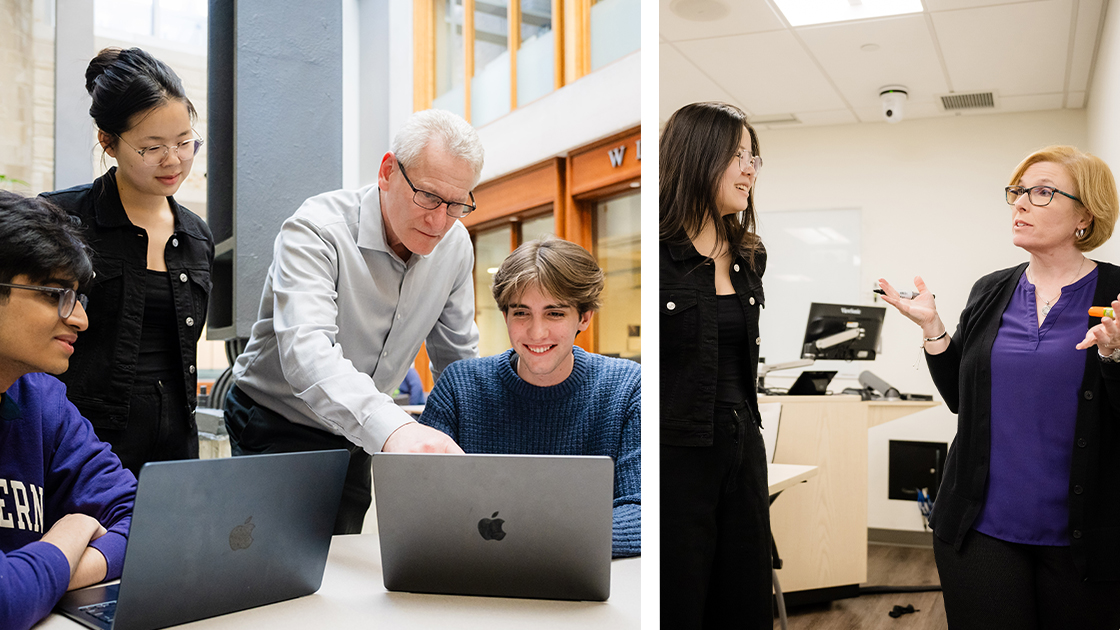
“Also, while the former model was built on the premise that every student should jump in and progress through the same sequence at the same pace, the new core curriculum creates more entry points and flexibility,” Burghardt says.
All core technical requirements will be offered every quarter, enabling students to chart the course most appropriate for them.
Launching the Bachelor of Science in Engineering Degree
Also in fall 2026, Northwestern Engineering will launch a new bachelor of science in engineering degree. The BSE structure creates one degree program that will house majors and facilitate a flexible pathway for creating new and interdisciplinary majors in the future. The school’s 13 existing standalone bachelor of science degree programs will remain to preserve accreditation and continuity.
“Our goal is simple but ambitious: create a degree structure that ignites the creativity and ingenuity of McCormick faculty to develop ideas for exciting, forward-looking areas of study,” Burghardt says.
The benefit isn’t simply administrative. Students enrolled in other Northwestern schools can pursue second BSE majors as seamlessly as they currently can add complementary Northwestern Engineering certificates and minors.
Learning to Build, Deploy, and Use AI Responsibly
The first major to debut under the new BSE degree is AI, a domain that underpins innovation across industries, drives discovery at the frontiers of research, and shapes how technology affects people and communities. Graduates with AI expertise are in high demand in advanced degree programs and across a broad spectrum of employers including tech companies, startups, healthcare, government, and nonprofits.

Designed to prepare students to become versatile builders and critical thinkers amid constant technological advances, the AI major curriculum will equip students with a deep, practical understanding of how to build, deploy, and use intelligent systems responsibly.
“We aim to prepare students for the future of a quickly changing and expanding field,” says Sara Owsley Sood, Chookaszian Family Teaching Professor of Instruction and associate chair for undergraduate education. “The AI industry demands specific technical skills that differ from the existing core computer science curriculum, including computer vision, knowledge representation and reasoning, natural language processing, machine learning, and robotics.”
Through rigorous training in machine learning, natural language processing, AI systems and infrastructure, data structures and algorithms, and the mathematical foundations that underpin modern AI, students will learn to design efficient, reliable, and scalable solutions to complex problems.
Equally important, the program emphasizes the human and societal dimensions of AI, training students to apply user-centered design principles and critically evaluate the impacts of AI on privacy, sustainability, and intellectual property.
The new major builds on McCormick’s popular AI minor and AI concentration in the Department of Computer Science. Beginning this fall, Northwestern students may choose to declare the AI major as a new major, a change in major, or a second major. More BSE majors and potential joint major programs will launch in the coming years.
Measuring Impact, Ensuring Success
As with any new change, faculty and staff will assess the new core curriculum. They will employ an evaluation plan developed by curriculum working group member Jennifer Cole in collaboration with Northwestern’s Searle Center for Advancing Learning and Teaching. Cole, associate professor of instruction and assistant chair of chemical and biological engineering, brings expertise as the director of the Northwestern Center for Engineering Education Research to the assessment planning process.
Faculty will compare how students meet objectives under the new and old structures to ensure changes have the desired effect. Beyond assessing measurable outcomes, the working group is also developing a survey instrument to capture more holistic insights: how students experience their first year and how that experience shapes their emerging identity as engineers.
“Our goal is to assess not only what students can demonstrate technically, but how they perceive their growth, confidence, and sense of belonging in the Northwestern Engineering community,” Burghardt says.