

Robots That Evolve, Adapt, and Endure
AI-designed metamachines run in the wild, recover from damage, and reconfigure their bodies—embodying intelligence that senses, adapts, and acts in real-world environments.
Sam Kriegman - CS, ME, ChBE

We’re tackling the grand challenges of today and tomorrow with a distinctly Northwestern mindset.
The grand challenges we face today are obvious: Tackling climate change. Exploring space travel. Maximizing AI. Eradicating disease.
Equipped with new methods of engineering and an educational skill set rooted in whole-brain thinking, we will use our expertise to approach these problems in uniquely targeted ways to make the greatest possible impact.
AI meets the physical world, interacting with and learning from its environment
Animals learn faster than today’s AI because, in experiencing the physical world, their bodies are sensorized and actuated in ways that curate exactly the right data. They sense and act in a continuous loop with their environment. Cracking and leveraging these principles of causal coupling is one of the most consequential frontiers in AI, and one where Northwestern is distinctly positioned to lead.
Embodied AI is built on two complementary elements: the physical hardware of sensors, actuators, and mechanical platforms that gives intelligence to a body, and the computational architectures that let the body sense, decide, and act in real time. Drawing on strengths in robotics, neuroscience, biology, medicine, cognitive science, machine learning, and computing systems, as well as our partnerships across the University and industry, Northwestern engineers embed intelligence into physical systems that sense, adapt, and act in the real world: in buildings, cities, the natural environment, and the human body itself.
Impact areas include: wearable and implantable devices for monitoring, rehabilitation, and assistive technologies; sensor networks for monitoring natural and built environments; intelligent robots; smart building and urban infrastructure systems; neuroscience- and biology-inspired AI systems.
AI-designed metamachines run in the wild, recover from damage, and reconfigure their bodies—embodying intelligence that senses, adapts, and acts in real-world environments.
Sam Kriegman - CS, ME, ChBE

Brenna Argall's Project DRIVE software lets users steer powered wheelchairs with their eyes, embedding adaptive intelligence into assistive mobility.
Brenna Argall - ME, CS
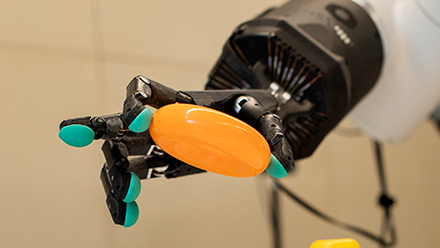
Northwestern's NSF-funded HAND ERC unites dexterous, sensor-rich hardware with AI-learned control to build robot hands that can augment human labor.
Ed Colgate - ME
Kevin Lynch - ME

Mitigating climate change and building resilience for communities, industries, and ecosystems
Climate change is testing every system that modern life depends on: the energy that powers our industries, the land that grows our food, and the built environments in which we live. Northwestern engineers are pursuing solutions for both slowing climate change and adapting to its effects. We are developing technologies to reduce greenhouse gas emissions while building resilient systems for communities, agriculture, industry, and the natural world they depend on. Situated along the Great Lakes industrial corridor, our work spans urban and rural contexts — protecting water security, strengthening agricultural systems, restoring natural ecosystems, and addressing the health consequences of a changing climate.
Impact areas include: designs for cities, agriculture, and natural systems; management of waste and pollution; fuel cells and energy-harvesting technologies; diagnostic tools for farmers; water treatment and monitoring systems.

Northwestern's new Thriving Planet Institute unites researchers to tackle interlinked water, land, and air challenges affecting community and ecosystem resilience.
Jennifer Dunn - ChemBE
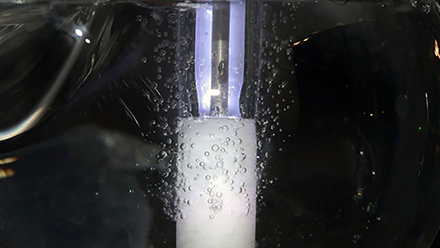
Plasma "lightning" converts methane into methanol in one electrified, low-heat step—cutting emissions from conventional production and capturing leaked greenhouse gas
Dayne Swearer - ChemBE

At an NU Water symposium co-led by Professor Aaron Packman, global partners convened to discuss regional solutions for water security amid a worsening climate challenges.
Aaron Packman - CEE

Reaching extreme frontiers, thriving there, and bringing what we learn back home
Surviving and thriving in extreme conditions—from the lunar surface to deep subsurface, extreme-temperature, and disaster-affected environments on Earth—demands specialized devices, infrastructure, and communication systems. Northwestern engineers are developing technologies to advance closed-loop systems for materials, food, water, energy, and waste that could help sustain human activity anywhere.
Our work is intentionally dual-purposed: the same materials and methods used to build habitats on Mars, for example, could also help rapidly deploy infrastructure in areas affected by natural disasters, monitor or respond to environmental contamination, or assist us with inhabiting or harnessing harsh environments here on Earth.
Impact areas include: mobile, collaborative robots for construction, manufacturing, and space exploration; sensing and monitoring systems; team dynamics; processing local resources to cast critical infrastructure on extraterrestrial surfaces.
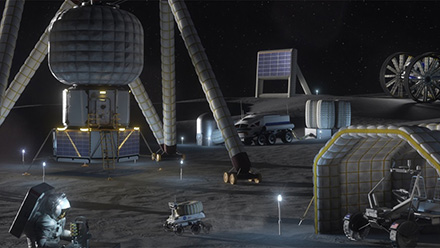
The student group explored expandable technology for lunar structures.
Ian McCue - MSE
Ryan Truby - MSE, ME

Research find that heat strengthens pure metals under extreme impacts, enabling tougher materials for space environments.
Christopher Schuh - MSE

A new idea among a rich history of proposals to make the surface of the cold planet habitable
Hooman Mohseni - ECE

Improve the quality of life, not just longevity
Working with partners at Northwestern’s Feinberg School of Medicine and Northwestern Medicine, our engineers are developing tools to prevent and detect disease before it takes hold, building digital twins of the human body to model health and disease, and redesigning how patients and providers understand, communicate, and act on health information. From AI-driven diagnostics and wearable sensors to health systems engineering, this work advances medicine that is predictive, personalized, and capable of extending healthy function across the full lifespan, not only treating disease once it appears.
Impact areas include: implantable sensors to detect, monitor, and treat disease; wearable tech and AI tools for healthy aging and independent living; biomaterials to regrow cartilage and support reconstructive surgeries; computational models and digital twins of the human body to predict responses to disease and treatment; systems-engineering approaches to hospital operations and care.

Researchers developed theoretical computational models of how cells make molecular decisions, modeling health and disease.
Krishna Shrinivas - ChBE

Robotic exoskeletons link therapists and stroke patients in real time for adaptive, personalized gait rehabilitation.
Kevin Lynch - ME
Daniel Ludvig - Research Assistant Professor

A new strategy grabs cancer-driving proteins and directs them to the cell’s disposal system, opening treatment paths for previously untreatable cancers.
Nathan Gianneschi - MSE, BME