Research Thesis Track
9 courses + 1 academic-focused project
Students may complete the research-focused thesis in their fourth quarter or start early in the third quarter of the program.

Our admissions team is coming to a city near you.
VIEW OUR STEM GRADUATE PROGRAMS TOUR SCHEDULEModern manufacturing is transforming industries around the world. Prepare to join a new generation of innovators and leaders driving manufacturing’s future — across fields spanning medical devices and semiconductors to clean energy and decarbonization technologies.
Students in Northwestern’s Master of Science in Advanced Manufacturing program work closely with faculty and researchers in state-of-the-art laboratories and industry collaborations. Our curriculum trains students to analyze and optimize flexible manufacturing systems, design new processes, and apply advanced technologies to solve real-world industrial and research challenges. Participants gain a strong foundation in core principles while exploring emerging areas that define the future of manufacturing.
The basics at-a-glance
Students complete either a research-focused thesis or an industry-focused project, gaining hands-on experience with real-world problem solving.
Students typically complete the degree in three to four quarters of study.
9 courses + 1 academic-focused project
Students may complete the research-focused thesis in their fourth quarter or start early in the third quarter of the program.
9 courses + 2-3 small industry-focused projects
Students may complete one project per first, second, and third quarter (ideal for BS/MS students with an existing department network) or complete all projects in their fourth quarter.
Students are encouraged to complete an internship during the summer quarter of the program to gain industry experience.
Connect with experts in a leading urban manufacturing hub
Our proximity to Chicago places students at the heart of a vibrant manufacturing hub, opening doors to valuable industry connections and career opportunities. Courses are enhanced by adjunct faculty who are active leaders in their fields, bringing industry insight into the classroom. Local partnerships with organizations and labs such as Argonne National Laboratory, DMG Mori, mHUB, MxD, and the Illinois Manufacturers Association provide pathways to internships, applied research opportunities, and professional connections that fuel both learning and career growth.
Unique Program Features
The Master of Science in Advanced Manufacturing builds on the McCormick School of Engineering’s long-standing expertise in manufacturing research, innovation, and education, and is supported by Northwestern’s network of nationally funded centers, award-winning faculty, and collaborations across Chicago, the Midwest, and beyond.
We accelerate the journey from discovery to impact by building on fundamental science to develop flexible manufacturing systems, address supply chain challenges, and create computational tools for rapid design and optimization.
Learn directly from internationally recognized experts and industry leaders through class work, collaborative projects, guest talks, and regional industry events.
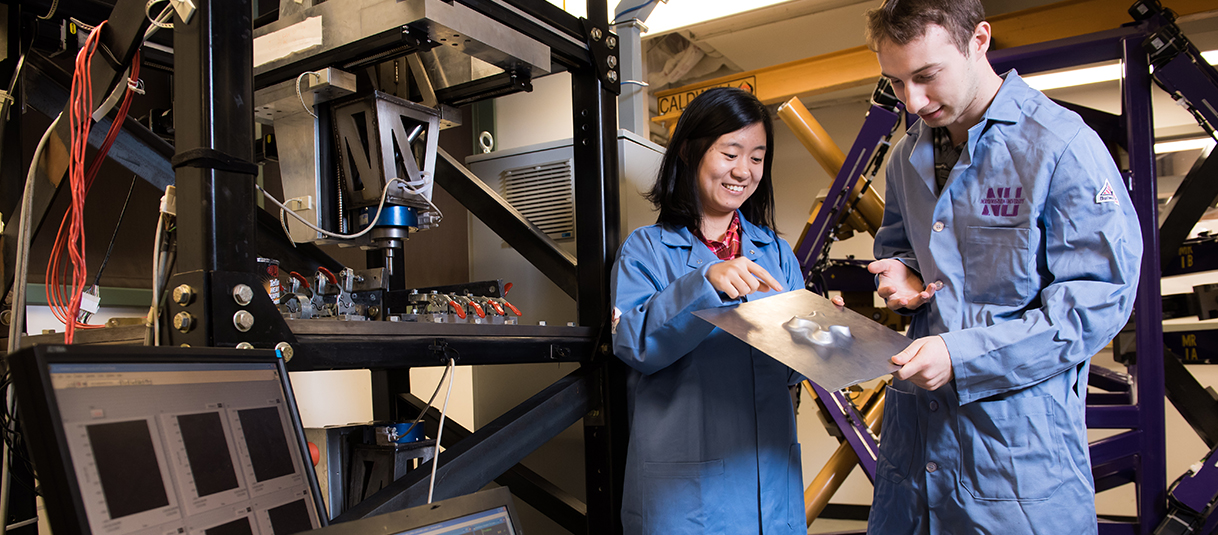
Conduct research in cutting-edge facilities for additive manufacturing, deformation-based manufacturing, micro/nano fabrication, and automation. Access advanced computing tools for physics-based and data-driven modeling that support research across multiple scales.
Collaborate with experts across the university — within data science and AI to sustainability and materials innovation — to push the boundaries of what’s possible.
Work with faculty and researchers through initiatives such as the NSF-funded HAMMER Engineering Research Center and the Northwestern Initiative for Manufacturing Science and Innovation (NIMSI).
These experiences prepare students for leadership in manufacturing innovation, operations, and research.
Make an impact in both industry and research
Students who complete the practicum thesis often move into roles in process development, manufacturing infrastructure management, and other applied positions.
Students who pursue the research thesis are well positioned for PhD programs or careers with national research labs, corporate R&D teams, and academic or technical research organizations.