

Attracting Material Success
Alan Lund combines expertise in materials and business to fuel innovation in magnet manufacturing and supply chain management.

As a graduate student in materials science at Northwestern Engineering, Alan Lund (PhD ’02) spent countless hours on the scanning electron microscope, imaging nickel-based superalloys to better understand them at the smallest scales.
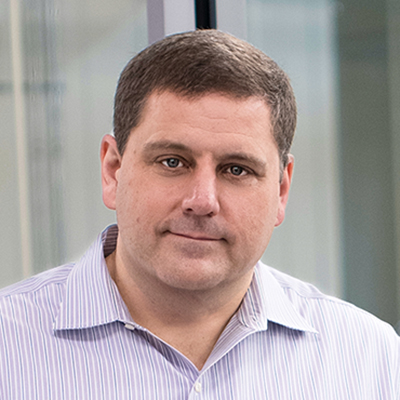
He found the work interesting—metals, with their “friendly” molecular bonds, were his favorite material. But after a long day of preparing and imaging samples, he would stand back from his computer and walk out to his favorite spot on the Evanston campus: the lakefront. There, on the concrete blocks so familiar to Northwestern students, he would gaze out at the beauty of Lake Michigan and decompress. “It was always very calming for me,” he says.
Yet research kept calling him back to his lab, and nearly 25 years later, he has built a solid and successful career based on materials. Having founded three companies, he now leads a team at MP Materials, a company that mines and processes rare-earth elements in the United States and turns them into high-performance magnets used in transportation, energy, robotics, defense, and aerospace.
Lund’s success can be credited to his technical and business skills, his underlying vision—to create a supply chain in the United States that doesn’t rely on shifting geopolitical relationships— and plain old hard work.
“You can’t be afraid to just go at a problem,” he says. “Solving challenging problems requires working your tail off, and that’s something critical I learned at Northwestern.”
Commercializing materials research
After earning his PhD studying with Professor Peter Voorhees and before joining the Massachusetts Institute of Technology as a postdoc, Lund spent a summer at the National Academies of Sciences working on science policy. At MIT, he joined a research group led by Christopher Schuh, then a young professor building up his portfolio and now dean of Northwestern Engineering.
You can’t be afraid to just go at a problem. Solving challenging problems requires working your tail off, and that’s something critical I learned at Northwestern.Executive Vice President of Magnetics,
MP Materials
It was an exciting time—the collaborative lab had good energy and produced many impactful scientific publications. As things turned out, the research also had a key commercial application. The nanocrystalline alloys produced through an electrochemical method were ideal for creating surface coatings. This led Lund and Schuh to found Xtalic, which develops and sells specialized coatings for high-performance electronics.
Lund had considered a career in academia, but the move into the marketplace set him on the path he knew was right for him. “I wanted to be able to drive innovation while having a direct and measurable impact on the real world,” he says.
After 10 successful years with Xtalic, Lund and Schuh founded another company, Veloxint, which manufactures nanocrystalline powders. Through Veloxint, Lund met another entrepreneur with whom he cofounded Braidy Industries, an aluminum alloy manufacturer, which led to the first new aluminum rolling mill being built in the United States in more than 40 years. “I’m very proud to have started this multi-billion-dollar project to transform how aluminum is supplied within the United States,” he says.
Drawn to magnets
When the COVID-19 pandemic hit and Veloxint was purchased, Lund found himself thinking about the failures in the supply chain the pandemic had revealed. Seeking his next opportunity, he reached out to MP Materials, which owned and had just brought back online the only rare-earth mine and processing facility in the United States.
Lund envisioned his own role at the company. MP Materials was looking to turn rare earths into high-performance magnets for leading-edge technologies, including wind turbines, electric vehicles, robotics, and autonomous flight systems. Creating such magnets requires electrochemical processes and powder metallurgy—two of Lund’s areas of technical expertise. He pitched himself to the company and was hired in 2021.
As executive vice president of magnetics, Lund has signed foundational customers—including GM and Apple—and has overseen the construction of a 250,000-square-foot magnet manufacturing facility in Fort Worth, Texas.
When the United States had trade friction with China, which mines most of the world’s rare-earth elements and produces most of the magnets made from them, the US Department of War invested in MP Materials to construct an even larger manufacturing facility, set to break ground in the near future.
With production from MP Materials’s mine, which now supplies up to 15 percent of the world’s rare-earth elements, Lund and his team are working to realize the company’s mission—creating a robust, end-to-end magnet supply chain in the United States, insulated from geopolitical disruptions.
“MP is part of a broader reshoring of manufacturing to the United States,” Lund says. “And I think that is a lofty and worthy goal.”
Though Lund no longer can retreat to the Evanston lakefront to recenter himself at the end of a busy day, he remains connected to Northwestern. He has served on the Department of Materials Science Advisory Board, kept in touch with professors, and sent his 14-year-old son to campus for the Center for Talent Development’s summer programs.
“My son was gushing about campus, and I was excited because Evanston is a place I love,” Lund says. “It’s a unique place in the world, and I’ve always had in the back of my mind that it would be a great place to end up, too.”