

Ludmilla Aristilde Delivers Distinguished Lecture on Soil Chemistry
Annual lectureship recognizes research leaders in soil and environmental chemistry

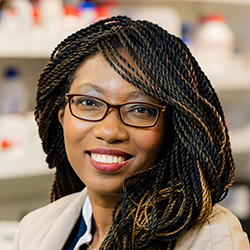
Northwestern Engineering’s Ludmilla Aristilde delivered the Donald L. Sparks Distinguished Lectureship in Soil Chemistry at CANVAS 2026, an annual conference hosted by the American Society of Agronomy, Crop Science Society of America, and Soil Science Society of America.
Aristilde, a professor of civil and environmental engineering at the McCormick School of Engineering and a core faculty member of the Center for Synthetic Biology, gave the talk “Unraveling the Role of Iron Oxides as Traps and Catalysts for Organic Matter Fate in Soils: A Molecular-Scale Journey” on Nov. 3 in Portland, Oregon.
The lecture explored how organic matter interacts with iron minerals in soils and sediments, affecting how long organic matter persists and how it moves through the environment. Over the past 14 years, researchers in the Aristilde lab have combined laboratory experiments, spectroscopy, chemical analysis, and molecular modeling simulations to examine these interactions at the molecular scale.
The talk also highlighted how a better understanding of these binding mechanisms can improve predictions of the environmental fate of organic matter, with important implications to contaminant transport and climate change feedbacks.
Established in 2024, the Donald L. Sparks Distinguished Lectureship in Soil Chemistry spotlights scientists whose work has had a significant impact on soil and environmental geochemistry. Aristilde was selected as the 2026 lecturer for her research on the biogeochemical cycling of contaminants, nutrients, and carbon.
Aristilde investigates how natural minerals and biological catalysts influence these processes, with implications for nutrient cycling, ecosystem health, agricultural productivity, and environmental biotechnology. Her current research spans carbon metabolism in environmental bacteria, the activity of nutrient-cycling extracellular enzymes, and the interactions of biomolecules and organic contaminants with environmental materials.