

A Conversation with Chair Prem Kumar
Kumar discusses his vision to focus the department on solving grand challenge problems
While Northwestern Engineering conducts a global search for the next John A. Dever Chair of Electrical and Computer Engineering, chair and professor Prem Kumar leads the department.
And he has big ideas for big changes. Starting now.
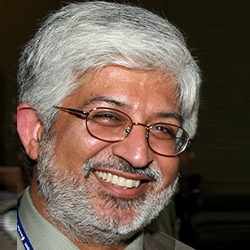 “Given the pace of change, mostly driven by AI, we cannot wait,” said Kumar, director of the Center for Photonic Communication and Computing and executive committee member of the Institute for Quantum Information Research and Engineering (INQUIRE).
A Northwestern faculty member since 1986, Kumar aims to refocus the department on serving humanity by solving grand challenge problems. To that end, he plans to explore common goals across McCormick and the University and invites the next generation of engineering leaders to join the department in finding answers.
In the following Q&A, Kumar, who succeeded Randall Berry in September, discusses his vision for the department’s next chapter.
What is your vision for the department, and how will you guide it forward?
We need to reinvent ourselves. Historically, the department has been organized in disciplines: computer engineering; signals and systems; and solid state, photonic, and quantum technologies. Instead, I want us to focus on grand challenge areas, which aligns very well with Dean Schuh’s strategic goals for McCormick.
My vision includes four pillars, notional at the moment, which all have tentacles to other departments. First, we need a sustainable future, and ECE can play an even bigger role. One pillar covers the whole scope of low-energy-footprint information and communication technologies (ICT)—from materials to devices to systems to life cycle.
Second, we want to develop a mechanistic understanding of the brain as an electrochemical system. How do neuronal circuits work? What are the circuit dynamics in the brain? How do neurotransmitters react? And of course, there is a whole field of bio-integrated electronics and electroceuticals—Professor John Rogers is a pioneer in this area. From both a signals and a hardware point of view, ECE brings critical expertise to bear.
Third, as access to space becomes more affordable, how do we harvest orbit access to solve problems? ECE can play a central role in exploring what causes and drives Earth’s climate, detecting and mitigating space junk, and improving sensing and communications on our planet and beyond.
The last pillar is quantum technologies, computing, sensing, and communications. Classical communications and computing technologies are ubiquitous today. The Marauder's Map was magical in the 1990s, but now we all carry it in our pockets. Today, we ponder the quantum internet. And, just like the people in the 1950s and 1960s inventing the internet couldn’t predict how it would be used, we don't fully know the applications of quantum technologies and the quantum internet. All we know is that it's a new frontier and we have to explore it.
What lessons from your own career do you hope to bring to the position?
My experience as a program manager at the Defense Advanced Research Projects Agency (DARPA) from 2013 to 2017 shaped my opinion about repositioning ECE. At DARPA, we were not interested in a discipline. We organized programs around challenges. And I learned that solving problems is tricky. Money is one thing, of course, but so is picking the right problem to solve at the right time.
Northwestern ECE spans research areas including AI engineering, computing and systems, intelligent systems, networks, and quantum and nanoengineering. What’s an example of an opportunity to amplify connections across ECE’s strengths?
With the growth in AI, energy demand is on the rise. ECE can make that slope gentler by inventing devices that are more energy efficient. After Northwestern’s Manufacturing with Embodied AI event, I reached out to ECE Professor Ted Sargent, who also leads the Paula M. Trienens Institute for Sustainability and Energy, and Lee Zachos, the executive director of the institute. Their focus is on the supply side of energy—energy production in an environmentally friendly way. In ECE, we can address the demand side. We’re going to hold a brainstorming session for ECE and Trienens Institute faculty affiliates in early December.
How do you plan to build on Randy Berry's accomplishments as chair?
Randy is a very generous person, and his research is top-notch. I really appreciate his steady leadership during the turbulent times of COVID-19 and then the federal government shutdowns.
We have great people here, and we need to organize ourselves to keep pace with our evolving landscape. My job is to provide the leadership that brings our faculty’s individual strengths together to do something really big.