

Cultivating Data-Driven Approaches with Plant Science
Students measure, analyze, and model multi-scale plant signals with computational tools
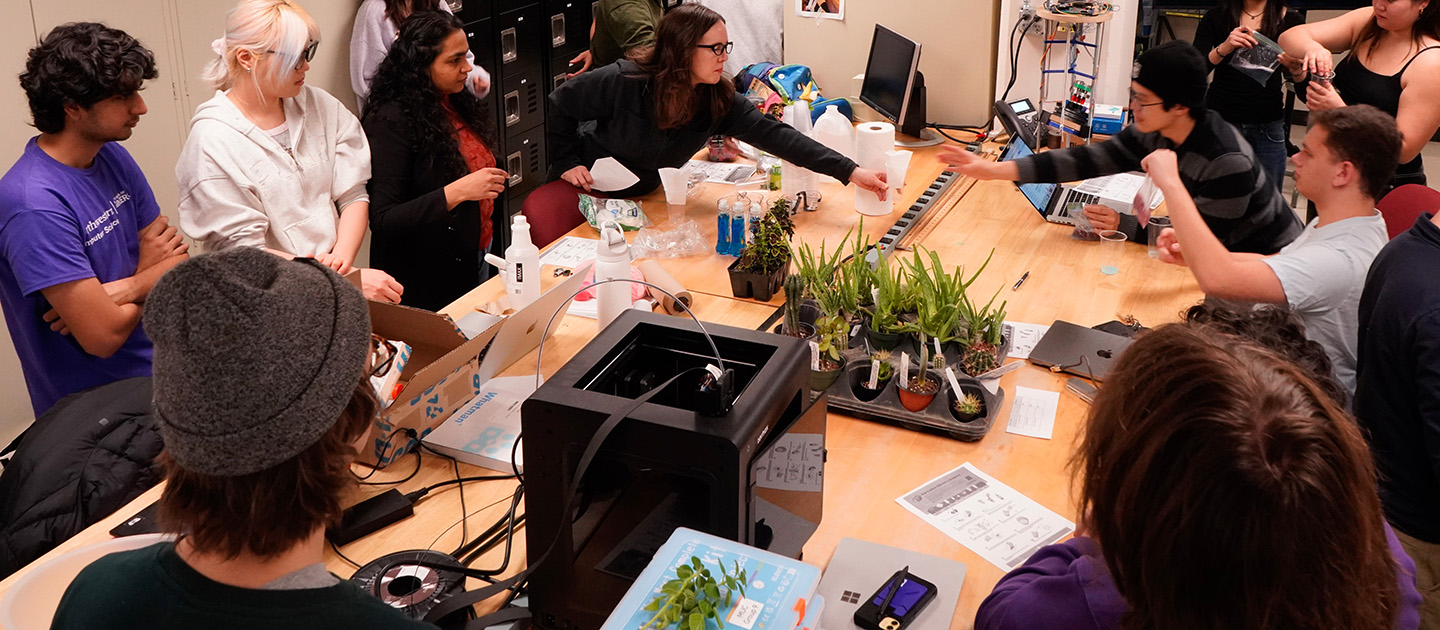
For many people, photosynthesis is a dusty middle- or high-school memory.
But in Northwestern Engineering’s new Data-Driven Plant Science course, photosynthesis is a live signal to measure, analyze, and model with computational tools.
The course introduces students to data-driven approaches in plant science—bridging experimental biology with embedded sensing, bioinformatics, and machine learning.
Students like Miller Watson, who has been coding since age 9, were drawn to the interdisciplinary course as a fresh detour off the beaten path of their usual studies in computer science, computer engineering, and engineering design.
“Computer science's true strength lies in its combination with other disciplines, its ability to enhance other fields,” said Watson, a fourth-year student in computer science. “And this class is a perfect example of that. Just through a little computer science knowledge, we're able to transform plant care. And it opens so many new possibilities when you think about intersections like this.”
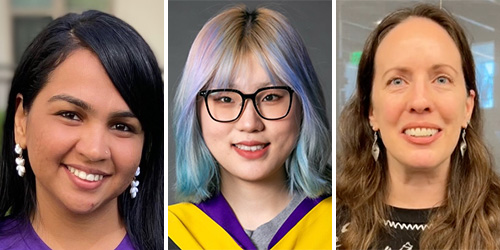 The course launched this winter in partnership with Northwestern and the Chicago Botanic Garden’s joint Program in Plant Biology and Conservation at the Weinberg College of Arts and Sciences. Professors Nivedita Arora and Susan Strickler developed the course in collaboration with Qitong Li (MS ’25), a research specialist in Arora’s VAK Embodied System Lab; and course peer mentor Raj Dave, a master’s degree student in computer science.
Through lectures and hands-on laboratories, students in the Data-Driven Plant Science course learn to design experiments, collect and visualize sensor data (e.g. carbon dioxide, temperature, humidity) with an Arduino microcontroller, extract and process RNA, and apply computational methods. The curriculum covers RNA sequencing and Linux-based bioinformatics alongside machine learning methods for interpreting complex biological datasets.
“In this age of AI, one of the most important skills which students need to learn through their courses or research work is creative systems thinking across boundaries of disciplines,” said Arora, the Allen K. and Johnnie Cordell Breed Junior Professor of Design and assistant professor of computer science and electrical and computer engineering at the McCormick School of Engineering. “And that is what we aim to do.”
Rather than being given datasets to work on, Arora and Strickler enable students to collect and understand the data for the specific plant science questions they choose to investigate.
“When I was in grad school studying plant biology, we didn’t think about sensors and how we can use electrical engineering or computer science in our experiments,” said Strickler, adjunct associate professor of plant biology and conservation and associate conservation genomics scientist at the Chicago Botanic Garden. “I love this new world we’re in where we have these types of approaches and classes that allow students to explore how different fields can work together.”
Planting the seeds
The genesis of the course was seeded two years ago, when Arora and her lab began to think about how plants could serve as living batteries for Internet of Things devices. Arora, Strickler, and Li—a master's degree student in computer engineering at the time—were particularly interested in plants adapted to arid environments through crassulacean acid metabolism (CAM) photosynthesis, in which succulents, cacti, orchids, and other CAM plants reduce water loss by opening their stomata (pores) at night to fix carbon dioxide (CO₂).
Over two years, their collaborative research—supported in part by the American Society of Plant Biologists and Northwestern Institute on Complex Systems (NICO) —led to the development of a lower-cost (roughly $30) microcontroller-based toolkit designed for scientists, students, hobbyists, and farmers to investigate plant phenotypes.
“This is low power, frugal, accessible, and democratizable instrumentation for collecting real-time data,” Arora said. “Think about big, very expensive medical equipment versus the relatively frugal diagnostics from a smartwatch. That’s what we’re translating for non-destructive plant data collection.”
Along with Sarah Jones (Chicago Botanic Garden), Li, Arora, and Strickler pilot tested the toolkit via a workshop they co-organized for the Chicago Botanic Garden’s US National Science Foundation Research Experience for Undergraduates (REU) Genes to Ecosystems internship program last summer. The experience, Li explained, later informed the development of the course.
Frugal plant toolkits in action
At a March 12 showcase event, student teams presented their final projects, which integrated the microcontroller toolkit with hardware, biology, computation, and DIY custom components. The five teams investigated topics including heat wave resilience, biohybrid robotic systems, the genetics of photosynthesis modes, houseplant health monitoring, and sound-induced stress response.
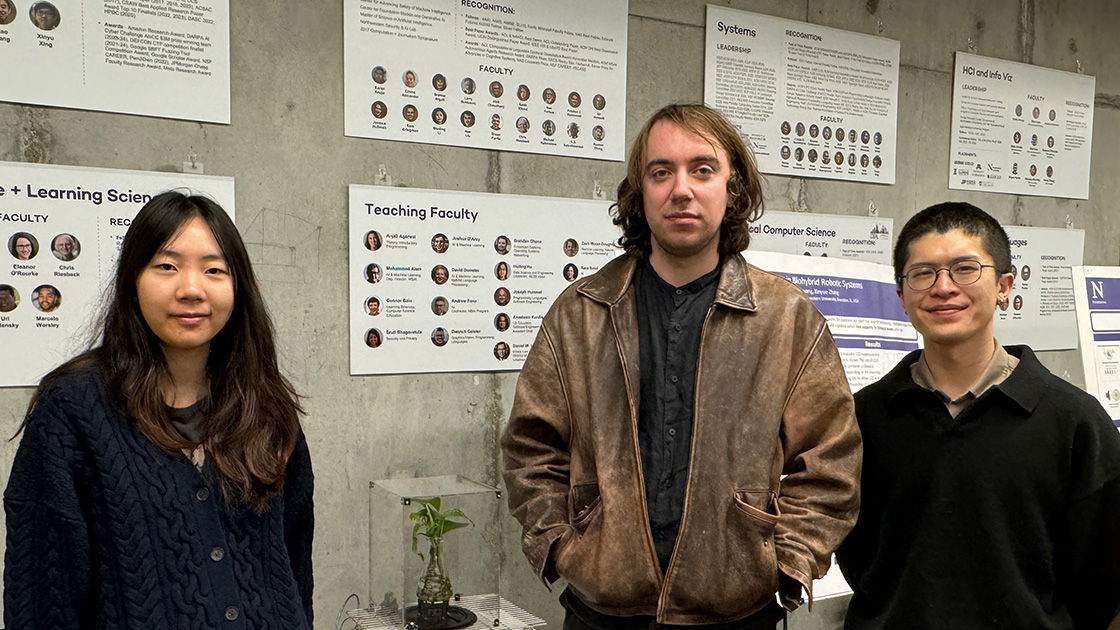
Plants as Sensors in Biohybrid Robotic Systems
- Finn Petrie, second year PhD student in mechanical engineering
- Kevin Ouyang, second year PhD student in the Technology and Social Behavior Program
- Xinyue Zhang, first-year student studying computer science
The team posed the question: What if the agency of organic life could be directly integrated into robotic systems? To investigate, they prototyped a robotic system that allows a plant to locomote to optimal conditions, using CO₂ as an indicator of the plant's health and environmental suitability. Using CAD software, a 3D printer, and laser cutter, the team iteratively designed a motor-controlled breathing mechanism whereby an iris door in the bottom of the plant’s airtight container toggles open and closed to let CO₂ escape, enabling measurement of the gas at different room locations as a correlate of light proximity.
“This course allowed me to explore my interest in ecological robotics, and how living systems can inspire robots that are lower powered, biodegradable, and have less impact on the environment,” Petrie said.
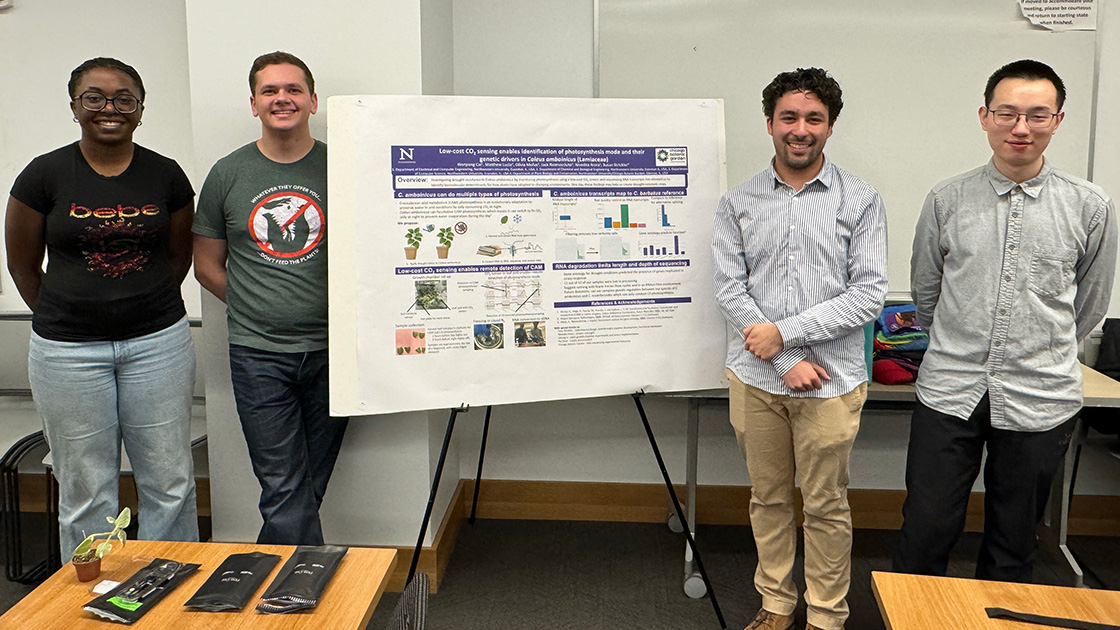
Low-Cost Co₂ Sensing Enables Identification of Photosynthesis Mode and Their Genetic Drivers In Coleus amboinicus (Lamiaceae)
- Wenpeng Cai, first-year master’s degree student in computer engineering
- Matthew Lucia, third year chemical and biological engineering PhD student
- Olivia Mofus, fourth-year student in computer science
- Jack Riconosciuto, third-year student in computer science
With an eye toward the potential of engineering drought-resistant crops, the team studied Coleus amboinicus, a plant which can switch between C3 (the most common type) and CAM photosynthesis. This mechanism, called facultative CAM, allows plants to adapt to drought conditions by reducing water loss during carbon dioxide absorption. After subjecting Coleus amboinicus to drought stress to induce CAM photosynthesis, the team extracted RNA from plant tissues and converted it into DNA for sequencing. By examining which genes were active at different times, the team aimed to understand the molecular regulation of the shift from C3 to CAM photosynthesis. This work is a trial run for a similar experiment Strickler and her team at the Chicago Botanic Garden will run this spring.
“We learned in class that the chloroplasts from plant to plant are incredibly similar genetically and structurally, so a plant’s ability to switch into CAM is more about how the rest of the cell talks to chloroplasts,” Riconosciuto said. “If we can figure out what is happening under the hood to regulate that change, in theory, you could determine how to get other plants to go into CAM.”
Smart Plant Pot: A Multi-Sensor System for Monitoring Plant Stress Under Controlled Light and Water Conditions
- Guoyu Qiao, first-year student in computer science
- Ethan Torain, first year student in Northwestern's Master of Science in Engineering Design Innovation (EDI) program
- Miller Watson, fourth-year student in computer science
- Xuanhui Weng, first-year master’s degree student in computer science
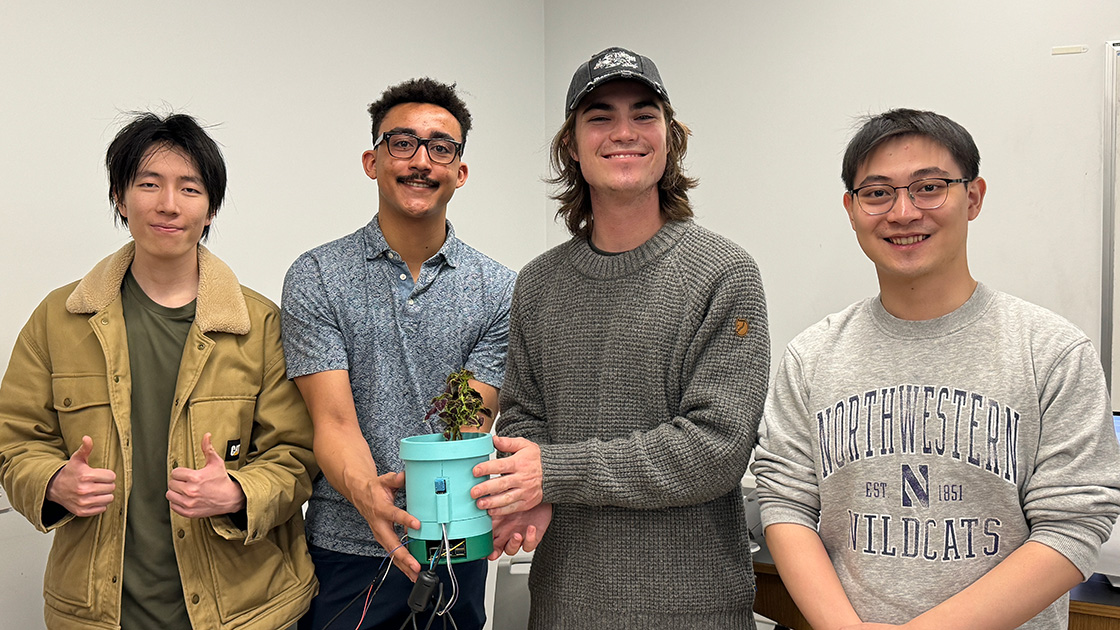
The team identified challenges in monitoring common houseplant stressors such as underwatering, overwatering, and environmental factors, leading them to develop a smart plant system to improve indoor plant care. The team designed and 3D printed a smart pot prototype housing multiple sensors to continuously monitor environmental variables and detect early indicators of plant stress. Using the OpenAI API, they developed a mobile app that enables real-time plant health monitoring and delivers personalized plant care recommendations by integrating the sensor data with standard plant care guidelines.
“One thing that will really stick with me after this course is how I collaborate with people from interdisciplinary backgrounds. It was such an amazing experience,” Watson said. “Once the project brief was decided and the teams formed, it was really interesting to figure out where everyone's skills align and how we can work together to produce an outcome that we're happy with but also reflects what we've learned in the course.”
Industry-Feasible Stress-Priming Coffee Plants for Climate Change Resilience
- Welldone Matanga, fourth-year student pursuing a combined bachelor’s degree in computer science and master’s degree in computer engineering
- Tate Mazer, master’s degree student in engineering design innovation
- Ishani Pidara, fourth-year student in computer science and international studies
- James Tenney, second-year electrical engineering student
As heat waves exacerbated by climate change severely impact yields of the temperature-sensitive Coffea arabica plants, the team hypothesized that there are more scalable methods to protecting seedlings than heat-priming, which is effective but not practical for large-scale farming operations. Using a bespoke heat chamber, the team demonstrated that biochemical priming Coffea arabica seedlings with salicylic acid (derived from aspirin) can provide similar or better protection against heat stress relative to heat priming.
“I'm super proud of the fact that we were able to cobble together all of these things on with limited time and budget,” Tenney said. “We managed to build our own little heating chamber from scratch that we continued using in the plant lab because it works so well.”

Good Vibes Only
- Alison Bai, fourth year BA/MS student in computer science
- Joanna Dahlan, first-year master's degree student in plant biology
- Sophia Fresquez, fourth-year student in computer science
- Leena Shafi, fourth-year BA/MS student in computer science
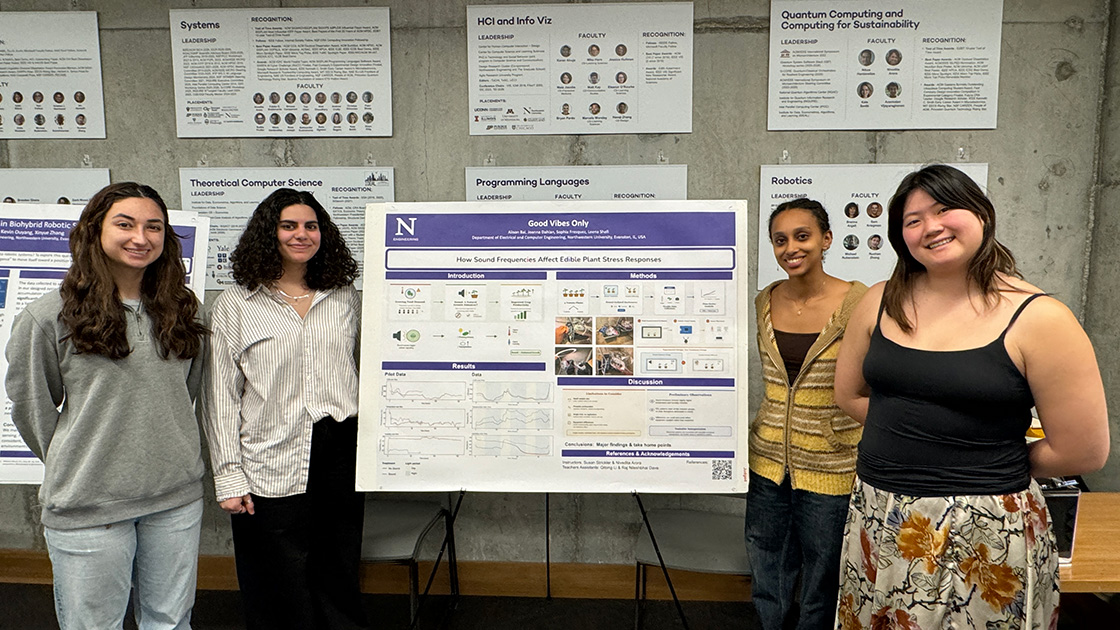
Inspired by research on sound frequencies increasing the nutrient density of strawberry plants, the group investigated whether high-frequency sound influences tomato plants' stress responses positively or negatively, using a control group with no sound and a treatment group exposed to a continuous 1000 Hz buzzer sound for 24 hours, with lighting to mimic natural conditions. They used an Arduino microcontroller with sensors to measure CO₂, temperature, and humidity.
“This is one of my first interdisciplinary courses that I've taken, not only between computer science and plant biology, but also between computer science and computer engineering,” Bai said. “And this was my first experience wiring with Arduinos and tracking it onto an SD card reader. It was incredibly fun despite the incredible difficulty of isolating an independent variable in an experiment such that you can say, ‘yes, specifically A concluded specifically B.’”
Bringing the farm to the classroom
As Li, Arora, and Strickler were progressing on the development of the frugal microsensor toolkit prior to the start of the course, Northwestern’s Paula M. Trienens Institute for Sustainability and Energy connected the team with the Illinois Farm Bureau. Arora noted that what started with an idea exchange and knowledge transfer with a group of local farmers has grown into a friendship.
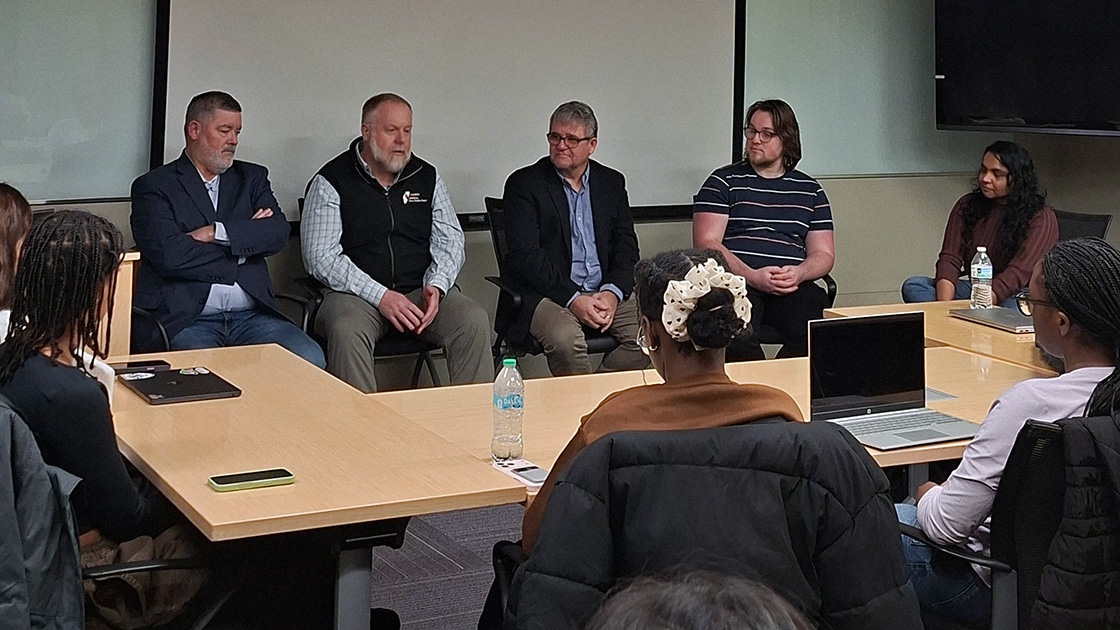
She invited a panel of Illinois Farm Bureau members to week five of the Data-Driven Plant Science class for a Q&A session with the students. The farmers explained that, before sensors, satellite imagery, and other technology, they would only find out if something had gone wrong at harvesttime. With real-time data, farmers can make decisions throughout the growing season.
One of the panelists, who typically plants about 34,000 corn seeds per acre, is keen to one day be able to monitor the health and status of every single seed.
“How do we do that?” seventh-generation farmer Adam Henkel asked the class. “This is what you are going to do in the future. You’re going to come up with these ideas and this technology.”
The Data-Driven Plant Science course is cross-listed in Northwestern Engineering’s Department of Electrical and Computer Engineering (COMP_ENG 395, 495) and Department of Computer Science (COMP_SCI 396, 496). It will be offered again in spring 2027.