
The Problem
A large share of donated kidneys are unused due to inefficiencies in the allocation and acceptance process rather than medical unsuitability.

A large share of donated kidneys are unused due to inefficiencies in the allocation and acceptance process rather than medical unsuitability.
Researchers developed a data-driven adaptive algorithm that dynamically adjusts organ offer strategies based on observed acceptance behavior and system feedback.
Improving allocation efficiency could increase transplants, reduce wait times, and better honor the intent of organ donation without requiring new medical technologies.
Professor Sanjay Mehrotra, Former postdoctoral fellow Masoud Barah, Vikram Kilambi (PhD '17, MS '13)
Northwestern Engineering’s Sanjay Mehrotra is helping more kidneys get where they are needed.
According to a 2025 CBS News study, nearly one in three kidneys donated are unused. Instead of saving lives, the organs are discarded, effectively wasting a precious gift.
Developed by Mehrotra after a long-term McCormick School of Engineering research effort, the Sliding Scale AdaptiVe Expedited (SAVE) algorithm could cut kidney nonuse in half, with the potential of saving more than 3,000 lives each year.

Mehrotra is the Emma Ann Reynolds Professor of Industrial Engineering and Management Sciences at Northwestern Engineering. Northwestern collaborators were Masoud Barah, a former postdoctoral fellow; and Vikram Kilambi (PhD '17, MS '13). An expert in methodologies for decision-making under uncertainty and their application to problems in health systems engineering and other operations research applications, Mehrotra uses analytical modeling, data science, and machine learning to optimize kidney transplantation systems.
He presented his latest work in the paper “A Sliding Scale AdaptiVe Expedited Rescue Algorithm for Deceased Donor Kidney Transplantation,” published March 25 in the American Journal of Transplantation.
Currently, a deceased donor kidney is offered to a candidate, but the longer a decision on whether or not to accept the kidney takes, the higher the risk that the kidney won’t be usable. Often, if a second candidate is offered the kidney and declines after any delay, the organ is no longer viable. Mehrotra’s algorithm flags a high risk of nonuse and expedites offers to multiple candidates at once, increasing the odds of successful transplantation.
SAVE is poised to advance the field of organ donation by moving from static allocation rules to adaptive policy design. It also introduces a feedback-driven, self-correcting mechanism in which observed behavior of the transplantation system—such as nonuse rates—dynamically informs decisions. SAVE turns past data into clear recommendations for what to do next by statistically modeling acceptance decisions, embedding them within a digital twin of the national kidney allocation system, and using that framework to design outcome-changing policy interventions. Finally, it operationalizes fairness–efficiency trade-offs by maintaining compliance with regulatory constraints like those under the National Organ Transplant Act while demonstrating that efficiency gains can be achieved without undermining policy integrity.
The benefits are obvious.
The approach is a policy and software intervention that does not require new medical technology. It could increase the number of lives saved each year by thousands. It has potential to increase transplants, shorten wait times—especially for patients open to higher-risk organs—and make better use of donated organs. It also carries strong emotional weight, as reducing organ discards better honors donor intent and addresses families’ expectations that donated organs will be used to help others.
“At its core, the message is simple and powerful,” Mehrotra said. “We are throwing away viable kidneys while patients die waiting—and this work shows we don’t have to.”
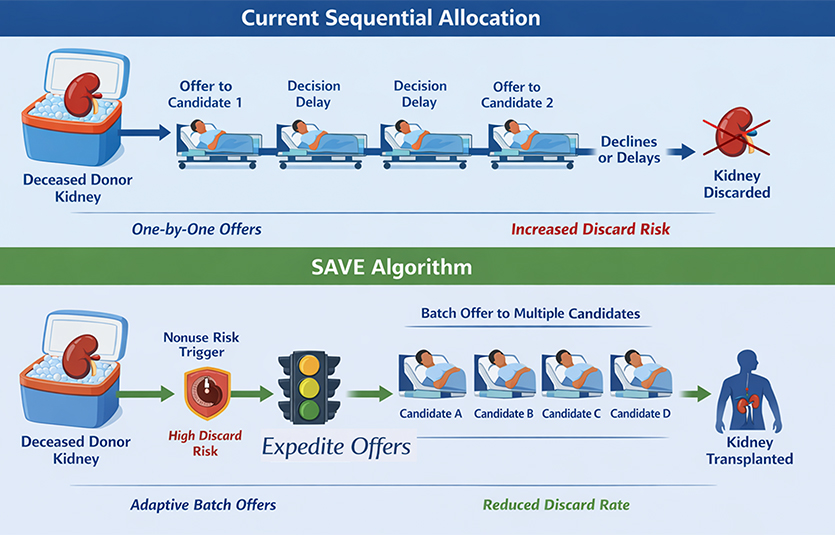
Before implantation, there are challenges to overcome, such as regulatory constraints—particularly the sequential allocation requirements under the National Organ Transplant Act—which may limit adaptive batching without reinterpretation or modification, and behavioral resistance from transplant centers that may be hesitant to accept higher-risk kidneys or face increased decision pressure from batch offers.
These barriers, Mehrotra said, could be addressed through pilot programs run via the Organ Procurement and Transplantation Network or waiver-based trials that allow controlled experimentation within existing policy frameworks. Mehrotra added that complementary strategies include deploying decision-support tools, sharing robust outcome data to demonstrate safety, and aligning incentives through performance metrics tied to organ utilization.
Moving forward, Mehrotra and his team are exploring with pilot implementation in a controlled Organ Procurement and Transplantation Network setting, focusing on high-risk kidneys where gains are largest. The work would then move to prospective validation measuring real-world outcomes such as transplant rates, graft survival, and equity impacts. This would be followed by integration of additional signals like cold ischemia time triggers, “provisional yes” dynamics, and center-specific acceptance profiles. Finally, Mehrotra aims to translate the approach into policy by working with regulators to reinterpret or adapt sequential allocation rules under the National Organ Transplant Act while framing SAVE as both compliant and more efficient.
Mehrotra stressed that this is a systems problem rather than a medical limitation: many discarded kidneys are clinically usable, and the true bottleneck lies in process inefficiency, not biology. He said the SAVE approach is both scalable and low-cost, as it does not depend on new drugs, devices, or surgical techniques.
“It is fundamentally a data-driven algorithmic and policy innovation, which makes it unusually high-impact relative to cost,” Mehrotra said.