

Bažant, Farha Named to National Academy of Inventors
Zdeněk Bažant and Omar Farha are among 169 new fellows in 2025 class
Northwestern Engineering’s Zdeněk Bažant and Omar Farha have been named 2025 fellows of the National Academy of Inventors (NAI).
NAI fellow status is the highest professional distinction awarded solely to academic inventors. The program recognizes academic inventors who have demonstrated a “spirit of innovation” by creating or facilitating inventions that have made a tangible impact on quality of life, economic development, and social welfare.
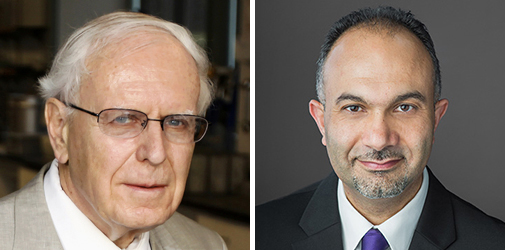
Bažant and Farha are among 169 new fellows in the 2025 class, which represents 127 research universities and governmental and nonprofit research institutions worldwide. The 2025 class collectively holds more than 5,300 issued US patents and includes recipients of the Nobel Prize, the National Medals of Science and Technology and Innovation, and members of the National Academies of Sciences, Engineering, and Medicine, among others.
The 2025 class of fellows will be honored and presented their medals by a representative of the United States Patent and Trademark Office at the NAI 15th Annual Conference on June 4 in Los Angeles.
Zdeněk Bažant
Bažant is McCormick Institute Professor and Walter P. Murphy Professor of Civil and Environmental Engineering at the McCormick School of Engineering. Among engineers, he is well-known for his definitive analyses of the collapse of the World Trade Center towers on September 11, 2001, and of the excessive deflection and subsequent tragic collapse of the Koror-Babeldaob Bridge of record span in Palau in 1996.
He has made a number of lasting contributions, the most impactful being Bažant’s inventions of the size effect, size effect law, gap test, shard test, and squash test (with collaborators). He holds six patents, the latest being stiff grips for stabilized fracture testing of composites. He also formulated the crack band model, the microplane constitutive law, the Age-Adjusted Effective Modulus method for aging creep effects in concrete structures, the thermodynamics of adsorption role in creep, statistical sorption isotherm for the filling of nanopores, and more. Bažant’s work has earned him a number of honors. He’s a member of the National Academy of Sciences, National Academy of Engineering, American Academy of Arts and Sciences, and the Royal Society of London. He’s also a member of the national academies of Austria, Japan, Canada, Czechia, India, Italy (Lincei), Greece, and Spain. In 2016, he received the Austrian Cross of Honor for Science and Art. Among skiers, he is known for his 1959 mass-produced patent of safety ski binding, exhibited in the New England Ski Museum at Cannon Mountain, New Hampshire. Next May, he is scheduled to receive his 10th honorary doctorate from Clarkson University.
Omar Farha
Farha is Charles E. and Emma H. Morrison Professor in Chemistry and chair of the Department of Chemistry and (by courtesy) professor of chemical and biological engineering at the McCormick School of Engineering. He is an executive editor of the academic journal ACS Applied Materials and Interfaces, and the chief scientific officer of Numat Technologies.
Having published more than 700 articles and holding 17 patents, Farha’s research spans a wide range of areas in chemistry and materials science, addressing challenges from energy to national defense. His accomplishments have earned numerous honors, including fellowship in the European Academy of Sciences; the Kuwait Prize; the Japanese Society of Coordination Chemistry’s International Award for Creative Work; American Chemical Society Inorganic Nanoscience Award; the Royal Society of Chemistry’s Environment, Sustainability and Energy Division Early Career Award; the American Chemical Society’s Satinder Ahuja Award for Young Investigators in Separation Science and its ENFL Emerging Researcher Award. Northwestern’s Department of Chemistry has also established the Omar Farha Award for Research Leadership in his honor, presented annually to a research scientist who exemplifies exceptional stewardship, collaboration, and leadership in chemical research.