
The Problem
Measuring how materials respond to different deformation speeds is imperfect, leaving gaps and uncertainties across strain rates.

Measuring how materials respond to different deformation speeds is imperfect, leaving gaps and uncertainties across strain rates.
A single, self-consistent method to measure hardness across 11 orders of magnitude in strain rate using traditional indentation and laser-induced particle impact testing on the same material surface.
This approach fills a critical measurement gap, enabling accurate predictions of how materials perform in real-world scenarios like crashes, impacts, or aerospace conditions.
Postdoctoral researcher Luciano Borasi, Dean Christopher Schuh
Under traditional methods, measuring material strength requires stitching together data from multiple tools, labs, and assumptions, each covering only a slice of how materials deform, from slow and steady pressure to extreme, high-speed impacts. That patchwork approach leaves gaps in understanding and inconsistencies across results.
A new method from Northwestern Engineering researchers provides needed clarity.
The team developed a method to evaluate a material’s hardness across 11 orders of magnitude in strain rate: from slow deformation over minutes to impacts occurring in billionths of a second, only using a single testing platform and consistent definitions.
“We created an approach that can cover the full range of strain rates in a self-consistent way,” said Luciano Borasi, the study’s lead author. “We’re not switching materials or tools. We’re just changing how we impact the material.”

Borasi is a postdoctoral researcher in the lab of Dean Christopher Schuh, who collaborated on this work. Borasi and Schuh reported their findings in the paper “Self-Consistent Hardness Measurements Spanning Eleven Decades of Strain Rate on A Single Material Surface,” published earlier this month in the journal Nature Communications.
The team’s method combines traditional instrumented indentation with laser-induced particle impact testing (LIPIT). Traditional indentation tools can apply loads that result in strain rates as low as one 10,000th of a second to as high as one per second. LIPIT, which uses a laser to accelerate micro-scale particles into a surface, enables measurements at extremely high strain rates, up to one hundred million per second.
That is equivalent to observing how a material behaves when hit by something moving hundreds of meters per second.
By engineering new shapes and masses for the impacting particles, the researchers accessed strain rates that previously fell into a measurement gap. Until now, those intermediate strain rates could not be directly tested, forcing researchers to rely on estimates or data stitched together from different sources.
The resulting dataset spans from the very slowest deformation speeds, such as what might be observed in long-term structural loading, to the fastest, such as what happens during a high-speed crash or projectile impact. Importantly, all measurements were made on the same material surface, using consistent definitions of hardness and strain rate, and by a single operator.
“At very low strain rates, the material deforms by moving defects in the structure,” Borasi said. “At high strain rates, those defects still move, but the limitations are something different.”
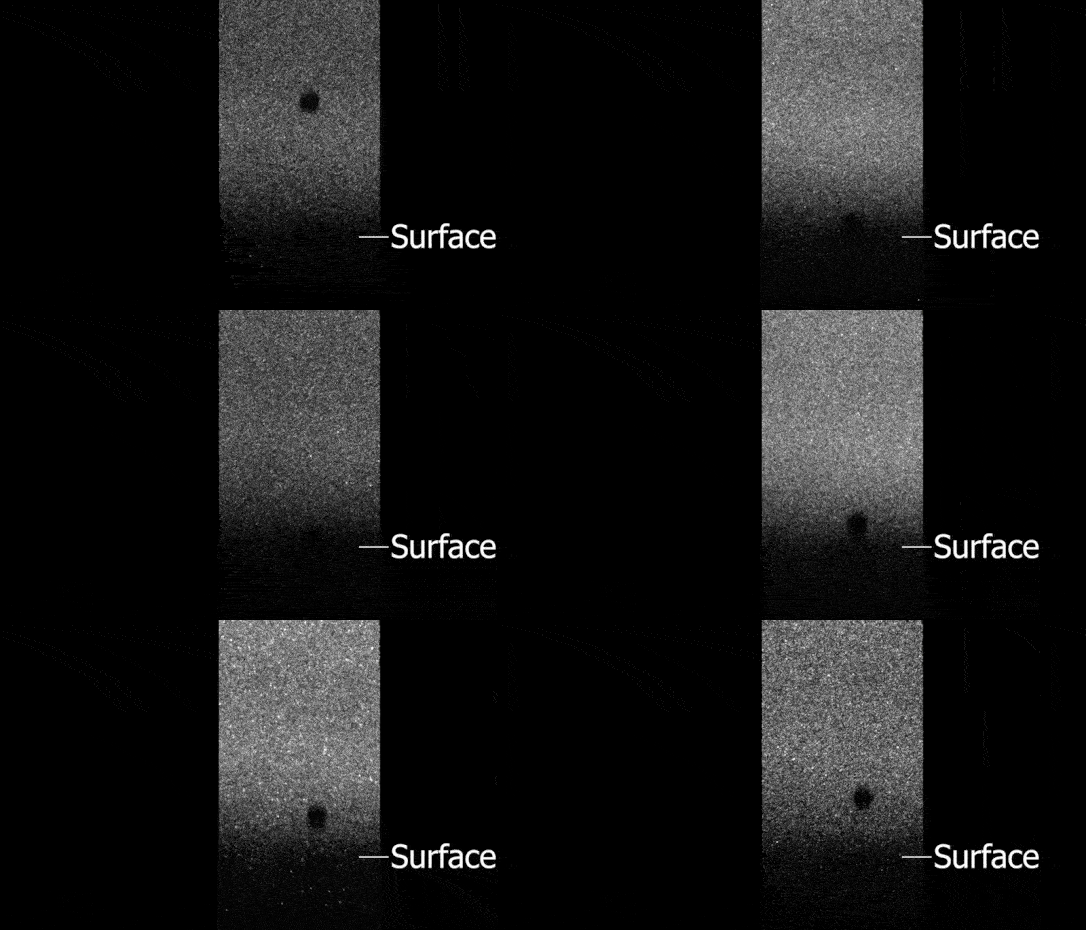

These differences in deformation mechanisms had been theorized, but this is the first time they have been observed continuously within one unified dataset.
By having a clearer, more accurate understanding of how materials perform under strain, researchers could better access materials used across a range of applications, from defense and aerospace to automotive safety.
“When a material is impacted by a bullet, or when something is launched into space, or even in a car crash, these are events that take place very fast,” Borasi said. “This method can help us better understand how materials behave in that range.”
This new approach could also improve materials design and modeling so optimal materials are used for specific needs. Engineers often use computer models to predict how materials will perform, but these models are only as accurate as the data they rely on.
“Those models were inaccurate,” Borasi said. “Now we can provide much more data and improve their accuracy.”
The team now plans to move beyond pure metals to alloys.
“In the real world, we use mixed compositions,” Borasi said. “So, we will start to evaluate different engineering metals and study the details of the mechanisms we are now able to observe.”