
The Problem
Many direct air capture systems rely on heat and oxygen-sensitive materials, which can make them energy-intensive, less efficient, and less durable in real-world air conditions.

Many direct air capture systems rely on heat and oxygen-sensitive materials, which can make them energy-intensive, less efficient, and less durable in real-world air conditions.
Researchers devised an electrified direct air capture system using manganese oxide to capture CO₂ from the air when charged and releases it when the voltage is reversed, working efficiently even in oxygen- and humidity-rich conditions.
This approach could remove hard-to-eliminate emissions and reduce existing atmospheric CO₂, moving closer to net-negative emissions.
Professor Ted Sargent, Professor Omar Farha, Postdoctoral fellow Zeyan Liu
Direct air capture (DAC) removes carbon dioxide (CO₂) directly from the air, complimenting efforts to limit new emissions. The approach can help reduce existing CO₂ accumulation in the atmosphere and reduce future accumulation. This is especially important at a time when industries such as aviation, shipping, and cement production remain difficult to fully decarbonize.

Recent work from the lab of Professor Ted Sargent advances electrified DAC technology as a potential path to net-negative emissions when powered by low-carbon electricity.
“Direct air capture is complex because CO₂ is extremely diluted in air, and the process has to work in the presence of oxygen and humidity—two factors that affect sorbent performance or durability,” said Zeyan Liu, the paper’s first author. “This work reports a new path that remains effective under those conditions.”
In the study, the team demonstrates a new type of DAC system that uses a common inorganic material—manganese oxide (MnO₂)—to capture CO₂ from the air when electrically charged. After optimizing its operation, the system captures CO₂ under real-world air conditions while remaining largely unaffected by oxygen and humidity. The CO2 can be released when the voltage is reversed.
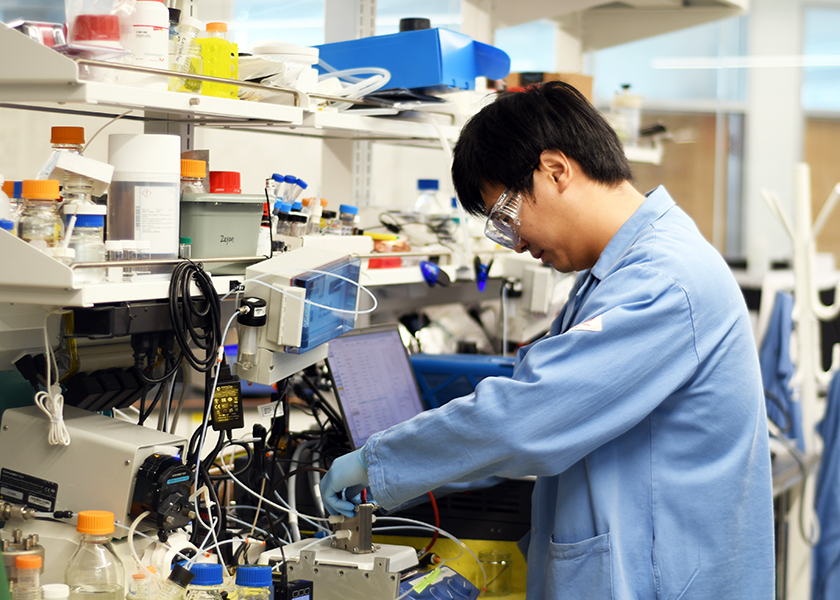
Sargent is the Lynn Hopton Davis and Greg Davis Professor of Chemistry at the Weinberg College of Arts and Sciences, professor of electrical and computer engineering at Northwestern Engineering, and director of the Paula M. Trienens Institute for Sustainability and Energy. The work was presented in the paper “Electrified Reversible Surface Mineralization of CO2 for Direct Air Capture,” published Feb. 13 in Nature Energy. Liu is a postdoctoral fellow in Sargent’s lab. Omar Farha, Charles E. and Emma H. Morrison Professor in Chemistry and chair of the Department of Chemistry and (by courtesy) professor of chemical and biological engineering, collaborated on the research. The work was also the result of a project sponsored by TotalEnergies, an integrated energy and petroleum company based near Paris in Courbevoie, France.
"The paper is the first demonstration of carbon capture using reversible surface mineralization mechanism,” Sargent said. “It’s also a great example of what makes Northwestern such a special place: by working with Professor Omar Farha and his team, world leaders in solving problems in chemistry and materials science relevant to energy and the environment. Uniting their chemical brilliance with our group’s expertise in electrochemistry and systems, we were able to document a notable advance underpinned by frontier materials chemistry.
“The next step will be to design new electrochemical systems that further improve key measures like cost and efficiency per surface area.”
The manuscript builds on earlier work using electrochemical methods to capture carbon, focusing on improving a key limitation for electrified DAC: sensitivity to oxygen. Traditional DAC methods that rely on heat use considerable energy. Because the energy often comes from fossil fuels, the overall carbon removal is less impactful. Organic materials used in some systems can also break down or lose effectiveness when exposed to the oxygen in air, which makes long-term operation challenging.