

Engineering Better Medicines
At KBI Biopharma, Sigma Mostafa works to transform breakthrough drug concepts into safe, manufacturable treatments for patients worldwide.

Knowing her work has the potential to improve lives inspires Sigma Mostafa (PhD ’00) every day in her role as chief scientific officer (CSO) at KBI Biopharma.
A global contract development and manufacturing organization (CDMO), KBI provides accelerated drug development and biologics manufacturing services to life science companies. In a rapidly evolving field, the company helps partners discover, develop, and commercialize innovative medicines and vaccines.
“Truly lifesaving drugs are being developed. We work to make them manufacturable to produce in a large-scale, compliant way so they can safely go into humans and be effective. It’s a fascinating field,” Mostafa says. “Watching drugs being developed and shaping the future of those drugs, then hearing about the impact they have on patients, is absolutely amazing. It’s a very rewarding experience.”
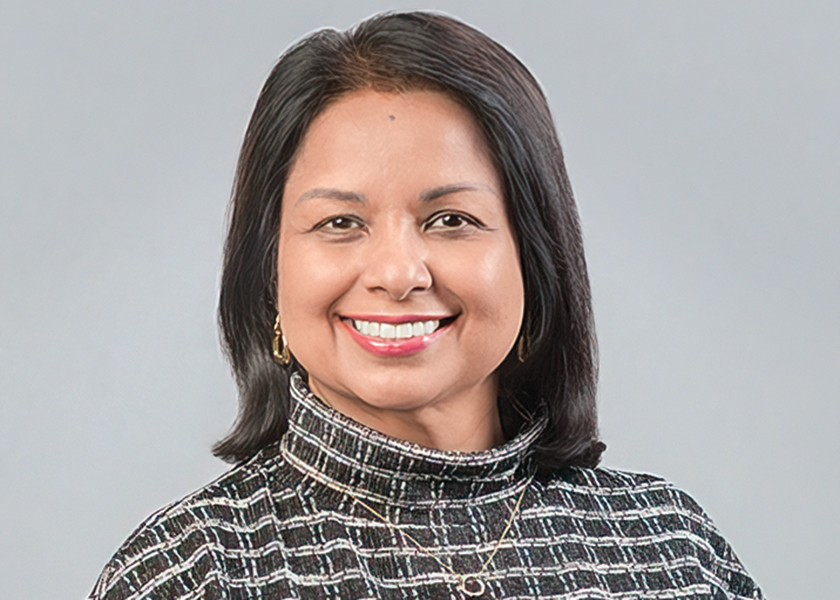
Mostafa began her career as a research scientist at Eli Lilly and Company and later honed her expertise at Organon/Diosynth Biotechnology, a Merck & Co. subsidiary. She joined KBI in 2010 as director of upstream process development, later serving as vice president of upstream and downstream process development and senior vice president and site head. She became CSO in 2023.
In the 16 years since Mostafa joined KBI, she has helped transform the Durham, North Carolina-based company from a fledgling startup to a top 10 global CDMO. She grew the mammalian process development department from five to 50 programs per year and is responsible for 40 percent of KBI’s revenue.
She credits her Northwestern chemical and biological engineering PhD experience with giving her the technical expertise and initiative to lead KBI’s exponential growth.
“The knowledge I gained through my research was important,” she says. “What a PhD education does, especially when you work with leading researchers, is give you a methodology for working with very complex problems and sticking with them until you become an expert and can solve critical issues. It also offers a core level of confidence that you can solve pretty much any problem.”
She cites two of her professors at Northwestern, Terry Papoutsakis and William M. Miller, as major influences, noting how their pioneering research resonated with her and their guidance helped her thrive. Today, she honors those relationships by mentoring members of her own team.
“The mentors I had were world class,” she says. “I believe in the mentor relationship and try to do the same with my mentees. We have dedicated folks who are passionate about what they do. I really enjoy going into the office and working with these brilliant people.”