

Northwestern Engineering Hosted International GameNets 2026 Conference
Professors Randall Berry and Ermin Wei led the organizing committee of GameNets 2026, held Mar. 26-27 at the Ford Engineering Design Center
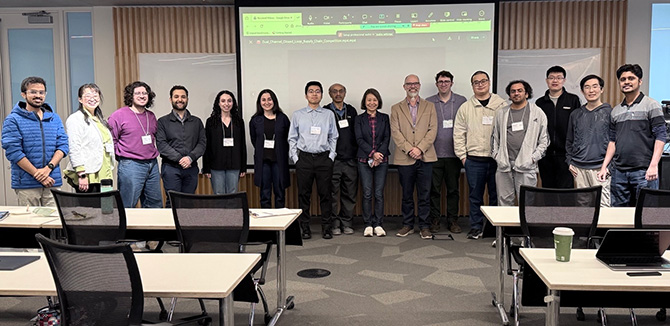
On March 26–27, Northwestern Engineering hosted the Fourteenth European Alliance for Innovation (EAI) International Conference on Game Theory for Networks (GameNets 2026), welcoming researchers and practitioners to campus (and virtually) to explore the latest advances at the intersection of game theory and networked systems.
 The GameNets 2026 conference organizing committee was led by general chair Randall Berry, with Ermin Wei serving as general co-chair.
Berry is the John A. Dever Chair of Electrical and Computer Engineering at the McCormick School of Engineering. Wei is an associate professor of electrical and computer engineering, industrial engineering and management sciences, and (by courtesy) computer science.
Northwestern’s in-person GameNets 2026 attendees were joined by participants from institutions including the Illinois Institute of Technology, Pennsylvania State University, Purdue University, Toyota Technological Institute at Chicago, the University of California San Diego, the University of Chicago, the University of Illinois Chicago, the University of Illinois Urbana-Champaign, and the University of Michigan. Virtual attendees logged in from around the world, including the IMT School for Advanced Studies Lucca, the Indian Institute of Technology Bombay, New York University, Southern Illinois University Edwardsville, and the University of Exeter.
“This was a great event that brought together researchers working at the intersection of game theory and networks,” Berry said. “It was great to host GameNets 2026 at Northwestern.”
A multi-agent decision theory, game theory provides a mathematical tool to understand and evaluate the complex interactions between interdependent rational players and predict strategic choices. Sessions highlighted how game-theoretic models help analyze and optimize complex networked systems, from wireless and vehicular communications to resource allocation and network security.
Through game theory models, researchers gain insights into communication systems, including congestion analysis, resource management, and network design and security. Game theory also illustrates traffic equilibrium and strategic behavior in transportation networks, and aids in the analysis of the economics of networks, including the study of spectrum auctions, network pricing, and e-commerce markets.
Co-located with GameNets 2026 at the Ford Motor Company Engineering Design Center, Wei also co-organized the Institute for Data, Econometrics, Algorithms, and Learning (IDEAL) LLMs and Strategic Agents for Machine Learning workshop. Presenters discussed topics including fairness and incentives in federated learning, strategic classification problems, preference learning and human feedback, and multi-agent reasoning.