


Research / Application AreasFluids and Materials
Fluids research in ESAM spans vast scales from the equal flow inside tiny droplets to turbulence inside and on the surface of the sun and other stars.
Faculty
- David Chopp*
- Daniel Lecoanet*
- Michael J. Miksis*
- Neelish Patankar
- Petia Vlahovska*
- Sasha Tchekhovskoy
Recent Publications
Jump to a Section
- Biofluid Mechanics
- Interfaces
- Convection and Instabilities
- Magnetohydrodynamics
- Helioseismology
- Turbulence
- Applied Math Fluids Lab
Biofluid Mechanics
 Biofluid Mechanics is the subject of applying fundamental ideas from fluid mechanics to better understand the biology of living systems. This is a field that is moving very rapidly today because of the development of new experimental techniques that have allowed for quantitative measurements of specific biological systems, e.g., the motion of a cell.
Research within ESAM involves the development of mathematical models of interesting biological systems, the development of new analytical and computational methods to solve these models, and interaction with experimental groups to verify the validity of the investigation. Specific areas of current research include biofilms (an aggregation of bacteria on solid surfaces surrounded by gas or liquid), vesicle and cell dynamics, and the dynamics of aneurysms.
Faculty
M. Mani*, M.J. Miksis*, N. Patankar, P. Vlahovska*
Interfaces
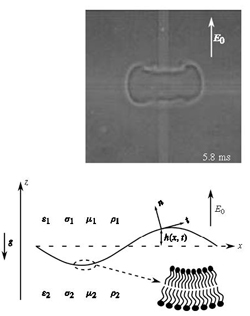
 Interfaces separate distinct phases of material. The systems can be fluid-fluid, like air-water, solid-solid, like alpha-beta phases of alloys, or fluid-solid. Interfaces are the site of concentrated "forces" such as surface tension or latent heat, and interfacial deflection couples with bulk diffusive processes to generate waves, convection, droplets, and many other configurations in dynamical instabilities.
Research in ESAM includes the development of numerical methods to drive the dynamics of interfaces efficiently, the theoretical analysis of droplet shape and motion, as well as experimental studies theory.
Many examples of interfacial phenomena and the numerical methods used to solve the models are discussed in many of the other research topic descriptions.
Faculty
D. Chopp*, M.J. Miksis*, P. Vlahovska*
Applied Math Fluids Lab
The Fluids Lab of the Department of Engineering Sciences and Applied Math provides unique opportunities for hands-on experimental experience that highlights the principles of modeling and key mathematical concepts.
Faculty
P. Vlahovska*