Sure and Steady
Sharwin Patil (MSR ‘25) springboarded from his final MSR project—an effort to help other roboticists—to a full-time role helping a startup attempt to revolutionize online grocery fulfillment.
Whether it is holding a carbonated soda or a surgical scalpel, no one needs a shaky robot arm.
Sharwin Patil (MSR ‘25) is making it easier for roboticists to smooth robotic movement, no matter the application.
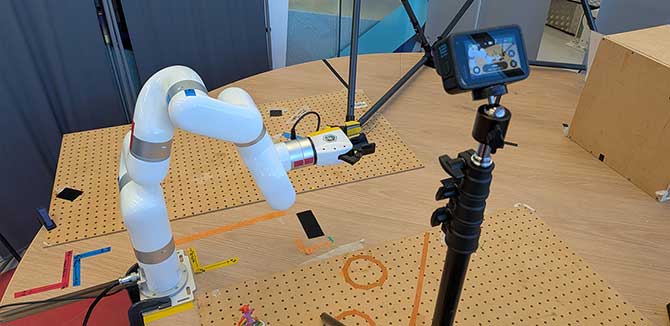
His final project in Northwestern Engineering's Master of Science in Robotics (MSR) program was creating an open source ROS 2 package that allows users to perform obstacle avoidance motion planning with any robot arm.
“Whenever you're moving a robot arm, if you want it to move in a straight line, that does not necessarily mean that all the joints need to move in a linear fashion,” Sharwin said. “If you force the motors to move that way, you'll run into jitteriness. Even if the jerk is not continuous, you'll see it in the robot arm.”
Though he graduated in December, Sharwin is continuing to fine-tune the project as he prepares to launch the open source package to the general roboticist community.
The project proved particularly complex because his goal was to make the package applicable to any type of robot arm.
“I wanted this to be very generalized,” he said. “I wanted to build a library where anybody can take whatever robot arm they have on hand and my library of knowledge about the robot arm to perform potential field-based trajectories.”
Sharwin is a strong proponent of creating open-source projects that the larger robotics community can use. He previously created a versatile Robot Operating System (ROS) package for Delta robots—a type of parallel robot known for its precision and speed in industrial applications— for an independent project during his second quarter in MSR.
“The nice thing about MSR was exposure to different robots,” he said. “Being able to have that exposure to a bunch of different platforms made it easy for me to understand what different uses look like, which makes it easier to actually write my library.”
It also made it easier for Sharwin to not be nervous about his post-MSR future.
Sharwin is now a full-time robotics software engineer at a startup called Fulfil. The California-based company is developing automated robot-based systems for grocery fulfillment, with technology now being piloted inside a Whole Foods Market near Philadelphia.
The company positions its approach as a way for retailers to make online grocery ordering more efficient and cost‑effective. The system can pack orders with high accuracy in roughly 10 minutes and tracks inventory at the individual‑item level, a capability that could help reduce waste and improve order reliability.
“The problem space is very interesting,” Sharwin said. “We have a lot of different optimization approaches, and I think we solve a lot of what others have deemed to be impossible or hard problems.”
Sharwin’s specific responsibility is to help integrate picking robots with those at the end of aisles in the warehouse that take what’s picked and pack it safely for pickup by customers.
“A lot of the work I do is at the high-level software level,” he said. “There's a lot of optimization and planning involved to correctly coordinate the interaction between these two robots and to correctly plan every grocery order to then ultimately pack it into multiple bags or to one bag and then hand it off to the customer.”
Sharwin said the MSR program prepared him well for the job. The program allowed him to build his own interests on top of the stable foundation it provides.
“MSR is what you make of it,” he said. “You have a lot of opportunities to conduct your own independent projects, but at the same time, no one lets you dig yourself into a hole. They do a really good job of setting up resources, setting up guidelines, and helping you iron out what these projects need to look like in order to be successful.”