

Aaron W. Saak Offers Four Directionally Correct Principles for PhD and Master’s Graduates
Saak and Dean Christopher Schuh spoke at the June 15 PhD Hooding and Master’s Recognition Ceremony
Since graduating from Northwestern, Aaron W. Saak (MS '97, PhD '00) has spent his career in industrial technology companies, moving from roles in engineering to business leadership. Along the way, he learned an important distinction: the difference between being “directionally correct” versus being “precisely accurate.” In business, Saak said, being directionally correct can often get you far.
Saak invited graduates to reframe that idea of being “directionally correct” through a thought experiment, asking them to imagine projecting 25 years into the future from the vantage point of their own graduation day. He noted that most people would likely picture familiar milestones—careers, family, travel, and other expected life outcomes—but would not be able to anticipate the disruptive events and technologies that ultimately shape the world.
To underscore that uncertainty, he listed developments that would have been inconceivable at the time of his own PhD graduation in 2000, including Bitcoin, COVID-19, TikTok, generative AI systems such as Claude, and even the cultural rise of Taylor Swift. The point, he suggested, is that the future is inherently unpredictable, reinforcing the importance of aiming in broadly correct directions rather than expecting precise foresight.
“My guess is that many things you are envisioning for your future are directionally correct—but far from precisely accurate,” Saak said. “And you know that is not a failure of your imagination—it is simply the nature of predicting the future.”
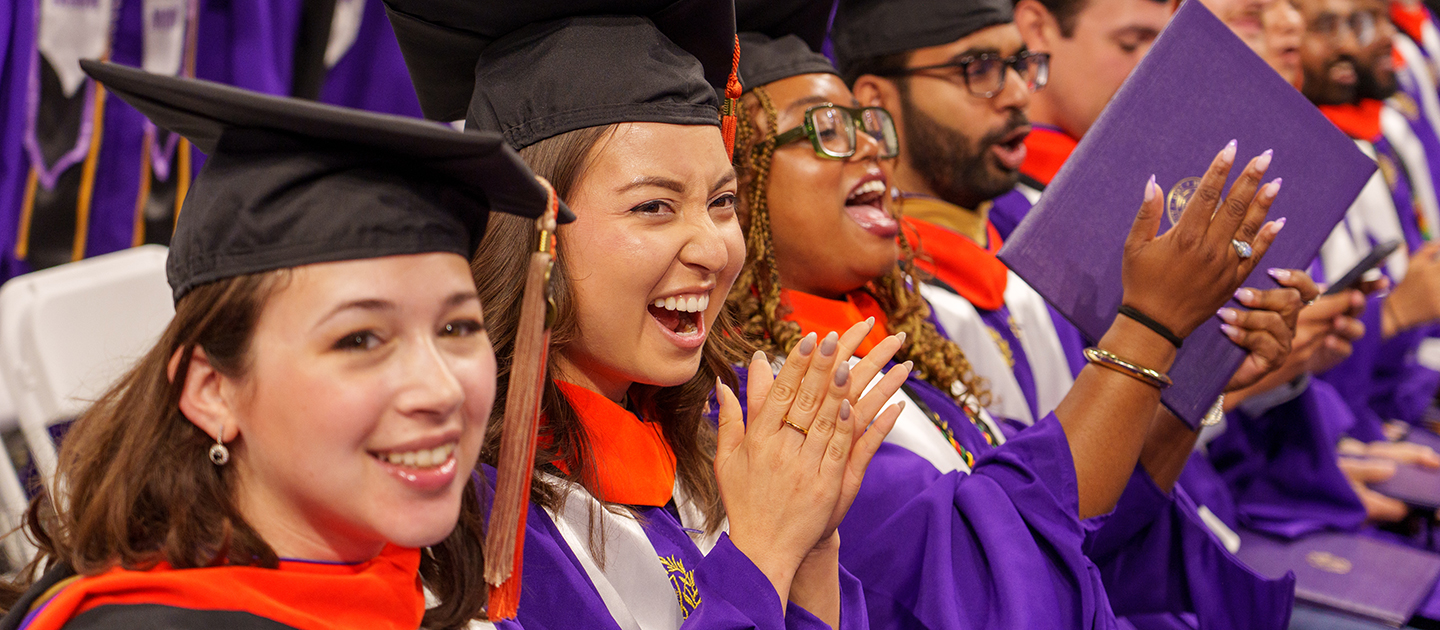
President and CEO of Crane NXT, Saak spoke at the June 15 McCormick PhD Hooding and Master’s Degree Recognition Ceremony, held at Welsh-Ryan Arena. Saak, who holds both a PhD in materials science and engineering and a master’s degree in industrial engineering from Northwestern, was introduced by Christopher Schuh, dean of Northwestern Engineering.

Schuh emphasized that the challenges facing humanity are growing more complex and interconnected, underscoring the increasing importance of the work world graduates are entering. He noted that Northwestern engineers are uniquely positioned to respond, combining rigorous scientific research with whole-brain thinking that integrates logic and analysis with creativity, market awareness, psychology, and a deep understanding of people. In this role, he said, engineers and innovators serve as a critical bridge between ideas developed in labs or conference rooms and their successful adoption in the marketplace and broader society.
“Whether you are starting new careers or moving up in current ones, whether you plan to join academia or industry, embrace your role as the bridge between these two worlds,” Schuh said.
During his career, Saak has shown that ability.
Drawing on those experiences, he encouraged graduates to build something “remarkable,” expressing his hope that when they are asked about their accomplishments 25 years from now, they won’t simply list their title or recite their publications.
“I hope your answer is a story. A story about a problem you felt compelled to solve. A person you championed and mentored. A moment where you had to navigate uncertainty and create and execute a clear vision for your organization,” Saak said. “That is whole-brain thinking and that is what this education is for.”
To point the graduates in the right direction, Saak shared the four “directionally correct” principles that have guided him for the past 25 years.
Focus on what is not changing
While the world is becoming more complex and rapidly shaped by unforeseen technological change, Saak stressed it is equally important to focus on what remains constant. He pointed to enduring scientific principles and persistent human needs as stable anchors for innovation, including the laws of thermodynamics, the global need for clean water, and fundamental human desire for connection, improved health, and more efficient production of goods that are faster, better, and cheaper.
“When the world around you feels like it’s changing, let what is permanent be your foundation,” Saak said, “and use the critical thinking skills you have built here to navigate your way forward.”
Live with a “healthy” paranoia
Saak recalled his time as a graduate student, when limited resources made simple routines like the weekly Department of Materials Science and Engineering’s coffee hour in Cook Hall especially meaningful, serving as both a source of food and a way to connect with fellow students and mark departmental milestones.
He reflected on one such occasion honoring Jerry Cohen at the end of his tenure as dean of the McCormick School of Engineering, noting Cohen’s reputation as a distinguished materials science and engineering professor. During the tribute event, Professor Bruce Wessels described Cohen as having a “healthy paranoia,” observing that despite his success and standing, Cohen remained preoccupied with questions about securing future research grants, supporting his PhD students’ progress, and ensuring Northwestern Engineering could continue to keep pace.
“He never stopped trying to understand the world around him, to anticipate what was coming, and to use his skills to stay ahead of it,” Saak said. “That is healthy paranoia. Not anxiety—not fear—but a disciplined, demanding, and relentless curiosity that refuses to be complacent.


Balance the “healthy paranoia” with confidence
Saak asked graduates to recognize the significance of their achievement as Northwestern alumni, emphasizing that completing a master’s or doctoral degree from one of the world’s leading engineering schools reflects real capability, training, and access to a powerful professional network. He encouraged them to draw on those strengths over the next 25 years as they confront new and often unpredictable challenges, noting that while they will not always have answers and will inevitably make mistakes, they are well equipped to adapt and thrive.
He acknowledged that regrets and “do over” moments are part of any career path but stressed that graduates should not lose sight of what their achievement already demonstrates. Earning the degree, he said, is proof of their ability and resilience, and something they should carry forward with confidence and pride.
“Let it give you confidence in solving whatever challenge life puts in your path,” Saak said.
View more photos from the event >>
Balance confidence with gratitude
Saak highlighted that individual achievement is inseparable from the support of others, noting that everything graduates celebrated is in some meaningful way a result of the people who believed in them, encouraged them, and loved them throughout their journey. He acknowledged that this can be a difficult lesson for highly capable and independent-minded individuals to fully accept, but stressed that no one builds anything of significance alone.
He illustrated this point with a personal memory of his own graduation day, recalling a photograph taken in Northwestern’s Shakespeare Garden after the ceremony with his family and his then-future wife, Jennifer, a fellow McCormick graduate. He described the image as a simple but treasured reminder not only of receiving his degree, but of the presence and support of the people who made that moment meaningful.
“I hope that each of you today or in the days ahead, in whatever form it takes, finds a moment to give gratitude and experience a simple, irreplaceable moment of joy with the people who helped get you here,” Saak said.