

Building Solutions and Community at WildHacks 2026
Nearly 250 students representing 53 universities completed 68 innovative software projects
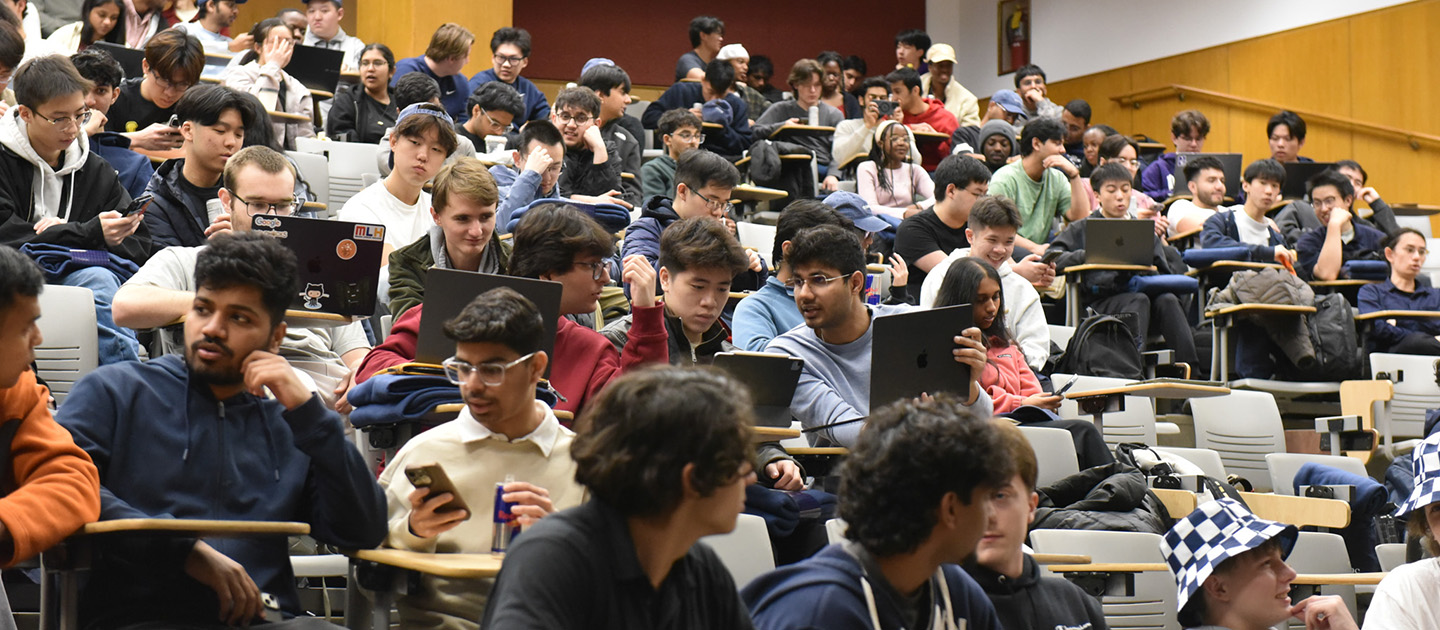
Collaborative, creative, and fast paced, WildHacks is Northwestern’s largest hackathon—an annual, coding competition where students of all experience levels come together to learn, build, and innovate in an energetic, supportive atmosphere.
Themed “Time,” WildHacks 2026 was held April 11-12 in Mudd Hall and the Technological Institute. Nearly 250 participants from 53 colleges and universities dedicated the weekend to building functional and compelling software within three tracks—childhood games (past), problem-solving for community causes (present), and predictive data storytelling (future). Alongside 105 Northwestern participants, hackers joined the in-person event from across the country. Local and regional institutions included the Illinois Institute of Technology, Purdue University, the University of Chicago, the University of Illinois Chicago (UIC), University of Illinois Urbana-Champaign, and the University of Wisconsin-Madison.
 “Technology changes so quickly,” said WildHacks 2026 director Kris Yun, a third-year student pursuing a double major in computer science at Northwestern’s Weinberg School of Arts and Sciences and social policy through Northwestern's School of Education and Social Policy. “We encouraged participants to consider the past and present, and how they plan to write their own futures.”
Delivering the opening keynote, Andrew Hotz (’02), director of programmatic media at Google, reflected on his own journey through time. A theater major at Northwestern’s School of Communication, Hotz earned an MBA in media and finance from Columbia Business School. Prior to joining Google, he served as the executive vice president of worldwide digital marketing and chief data strategist for Warner Bros, leading a team overseeing digital marketing, media, influencers and data/analytics on films including, Aquaman, The Batman, Crazy Rich Asians, Elvis, Joker, and Ready Player One.
WildHacks student engagement and recognition
A total of 68 software projects were submitted within the three tracks.
The top-rated teams presented an in-depth demo of their projects’ functionality in an interactive session with the panel of judges and fellow hackers. In prior years, ten teams moved into the final round, but Yun and the organizing committee expanded the competition to 25 teams.
“This year, we really wanted as many students as possible to benefit from the opportunity to demo their application, discuss their design and collaboration process, and share their key findings,” Yun said.
Northwestern’s Jefferson Wu won first place overall for Wildcat Arcade, an application that enables users to play Nintendo’s Wii Sports Resort games on a smart phone without a Wii console.
Attenda Health, developed by Northwestern students Bodie Feinberg, Oscar Jakacki, Aiden Tian, and Andrew Xue, earned second place. The mobile-first web application decentralizes the nursing call bell system and features a personalized, real-time queue of patient requests designed to make the patient care process more efficient.
A team including Northwestern student Alan Tai, UIUC students Inika Goyal and Krithin Nara, and Sara Khan of Western Governors University, won third place for Arcitec, an energy audit system that generates actionable information about how a building consumes energy, where inefficiencies exist, and what improvements could meaningfully reduce costs and emissions.
 “In the age of AI, students can iterate on the code quicker than before, and the ideas and impacts become more important than ever. WildHacks participants know the importance of focusing their project ideas on real-world impact for everyday life,” said Yiji Zhang, a WildHacks 2026 judge and assistant professor of instruction at Northwestern Engineering. “Hackathons remain an important opportunity for students to experience the entire product building process and learn something new quickly.”
Additional winning projects included:
- The end-to-end origami learning platform Paper Zoo, by Northwestern students Ryan Chun, Prakul Madaan, Brandon Wang, and Tony Yu earned the childhood games track prize.
- A UIC team including Ayush Bhardwaj, Han Dang, Yamaan Nandolia, and Nathan Trinh won the community track award for Haven, a navigation and daily support app built for people who are sensitive to environmental stressors such as loud noises, bright lighting or crowded spaces.
- The arterial blood vessel analysis tool VacuSense, built by Northwestern team Vivian Chang, Dustin Liang, Jason Ta, and Hub-Varith Varith won the data storytelling track prize.
- VibeBuild—developed by Northwestern team Evan Gerns, Raymond Gu, Ethan Lao, and James Nguyen— won the crowd favorite award. The AI-powered system generates Minecraft builds using text prompts or assists with manual construction detailed blueprints.
“Hackathons are unique spaces for students to build problem-solving and collaboration skills,” Yun said. “The teams need to think about the problem they want solve for specific users, then push lots of code and resolve merge conflicts within 24 hours to develop a solution.”
Hackers also had the opportunity to enter their projects into extra challenges presented and judged by Major League Hacking (MLH), a student hackathon league platform that provided support for WildHacks 2026. The MLH challenge winners included Wildsnacks.tech (best .Tech domain name), K-Means Bike (best use of DigitalOcean), Intelux (best use of ElevenLabs), Chronicles (best Use of Gemini API), Vouch It (best use of Solana).


Setting up Wildhackers for success
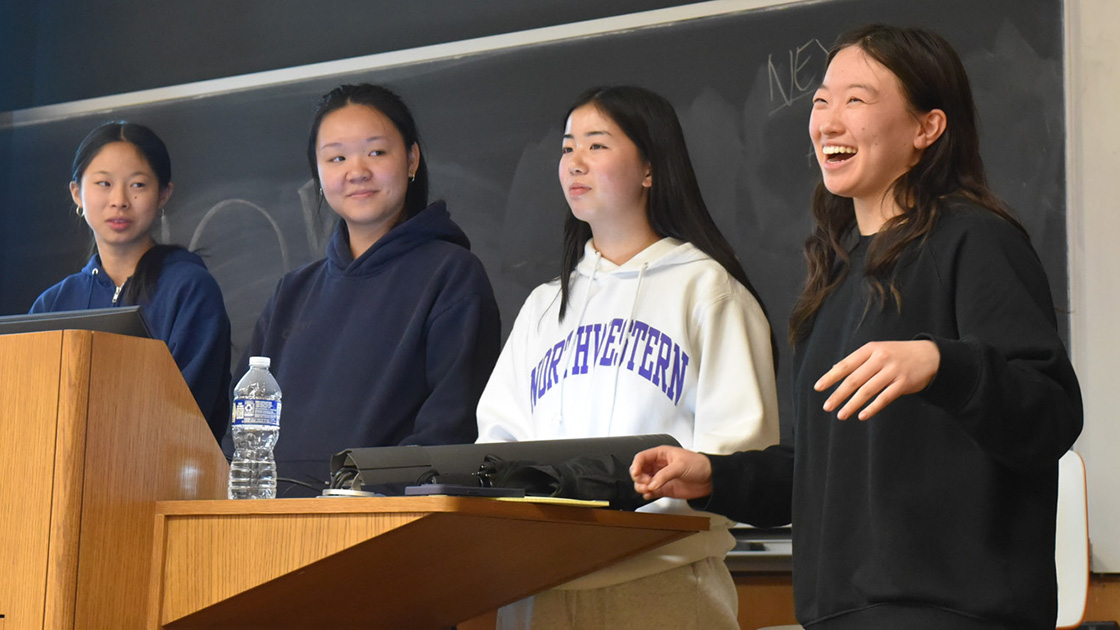
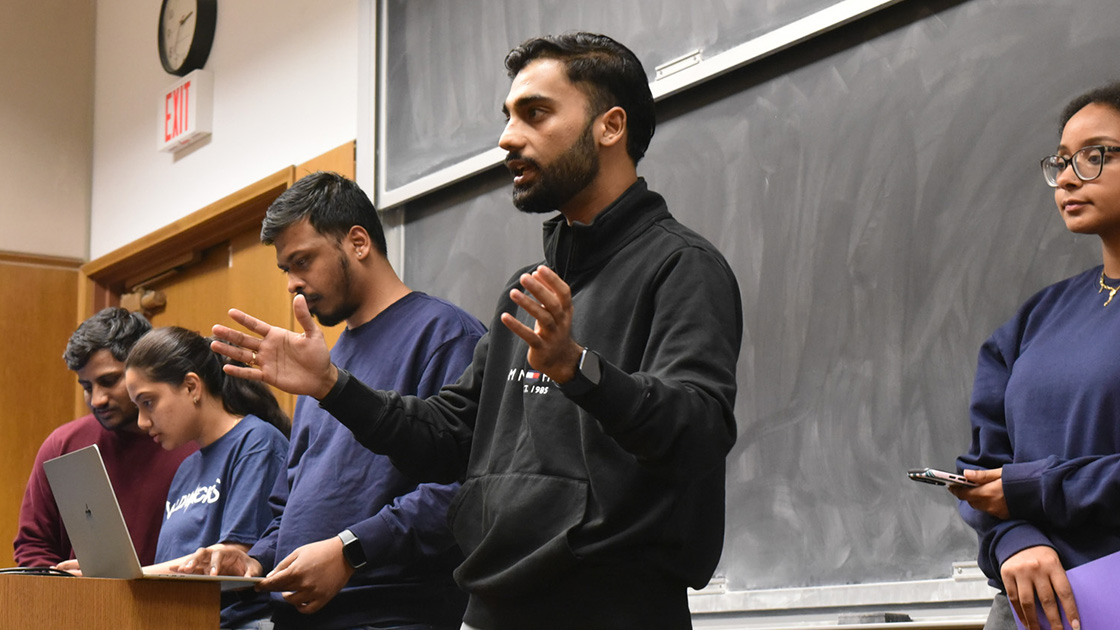
Helming WildHacks as director for the second time, Yun has served on the WildHacks organizing team all three years at Northwestern and is excited to pass the baton to a new leader that will continue building community and improving the WildHacks experience. The WildHacks 2026 organizing team also included:
- Felice Ciputra and Zahid Syed: codirectors of corporate engagement
- Vivian Chen and Samreen Ibrahim: codirectors of logistics
- Melinda Chang and Silvia Fang: codirectors of technology
- Maanvi Sarwadi and Mimi Zhang: codirectors of marketing and design
- Junho Hong, Trenton Kim, and Sophia Zeng: logistics team
- Vicheda Narith, Lauren Tan, and Chisa Yan: marketing team
- Larry Ling, Miya Liu, and Didier Munezero: technology team
- Adedamola Adejumobi and Sophie Shin: corporate engagement team
“Our driving force for this event was to build community and prioritize improving the hacker experience by providing more support resources, expanding available meeting room space, and ensuring that students felt comfortable,” Yun said. “I am so grateful for the organizing team—the scale and quality of this event wouldn’t be possible without them.”
To support newer hackers and participants with varying degrees of experience, the WildHacks team hosted a hybrid WildHacks Workshop Week, from April 6-10. Student organizations including ColorStack, Develop + Innovate for Social Change (DISC NU), Emerging Coders, and Northwestern University's Student Chapter of the Institute of Electrical and Electronics Engineers (NU IEEE) led workshops. Workshop Week topics included command line/Linux, Git and GitHub, Python and FastAPI, and frontend web development. The organizing committee also staffed a Discord-based help channel throughout the event to aid hackers.
In addition, two career pathways workshops were held during WildHacks weekend. Women in Computing led a discussion on “Finding Your Path in Tech” and engineers from IMC Trading hosted a tech talk on software and hardware engineering careers.
Supporting the event
Additional Northwestern WildHacks 2026 project judges included Nabil Alshurafa, associate professor of preventive medicine at the Feinberg School of Medicine; Andrew Finke, a candidate in the multidisciplinary MBA + MS in Design Innovation (MMM) Program through the Segal Design Institute and Kellogg School of Management; Dietrich Geisler, assistant professor of instruction; and Todd Warren, software consultant and adjunct lecturer in computer science and entrepreneurship.
Forty representatives from academia, industry, and the event sponsors also volunteered their time to evaluate project submissions.
WildHacks 2026 was supported in part by the InclusionNU Fund, a grant distributed by Northwestern’s Division of Student Affairs Department of Campus Inclusion and Community (CIC) that supports registered student organizations in implementing programs and events for students focused on community and belonging, wellness, and education and awareness.
Additional sponsors of the event included Northwestern Computer Science, The Garage at Northwestern, Hudson River Trading, IMC Trading, and Major League Hacking. Event partners included Anthropic, Appifex AI Technologies, Balsamiq, Monster Energy Company, Pure Buttons, Redbull, and Susquehanna.