
The Problem
The most promising path for scalably small refrigeration is with semiconductors called transverse thermoelectrics, but current models of their electronic behavior cannot explain their experimentally observed properties.

The most promising path for scalably small refrigeration is with semiconductors called transverse thermoelectrics, but current models of their electronic behavior cannot explain their experimentally observed properties.
This research provides the missing framework to model and improve these materials by showing that the so-called band gap in transverse thermoelectric materials changes with temperature and by developing a new method to measure that gap directly.
Better understanding and optimization of transverse thermoelectrics could enable compact cooling for sensors, data centers, and, eventually, quantum computers.
Professor Matthew Grayson, Professor George Schatz, Qing Shao (PhD ’22), Juncen Li (PhD ‘23)
Cryogenic temperatures are necessary for infrared sensing and for achieving superconductivity, but currently require liquified gases like liquid nitrogen or liquid helium, using century-old technology with bulky mechanical pumps and large gas storage reservoirs.

Novel, compact, solid-state cryogenic cooling devices will be needed to replace liquid nitrogen and liquid helium in tomorrow’s devices, and recent work from Northwestern Engineering’s Matthew Grayson could bring that closer to reality.
Proposed in 2013 by Grayson, a professor of electrical and computer engineering, transverse thermoelectrics (TTEs) are unusual crystals designed for solid-state cooling. They can convert heat into electricity, or electricity into cooling power. However, these TTEs have mixed conduction of positive and negative charges that makes them difficult to characterize and therefore difficult to optimize. In his latest research, Grayson discovered why these materials were so difficult to model: a parameter called the bandgap, which is the energy to create a negatively charged electron and a positively charged hole pairwise, is actually strongly temperature dependent.
Although the temperature dependence of the bandgap is known for semiconductors, it is normally not as critical. But TTE bandgaps are so small that the change of the bandgap with temperature is almost as large as the bandgap itself. This work shows for the first time how much the bandgap does, in fact, depend on temperature. It also introduces a way to measure that temperature dependence directly from experimental data.
In collaboration with Grayson, Qing Shao (PhD ’22) and Juncen Li (PhD ’23) applied this analysis to two quite differently behaving experimental datasets of the TTE, Re4Si7. The analysis nonetheless found excellent agreement, validating this approach. Working with George Schatz, professor of chemistry at the Weinberg College of Arts and Sciences and (by courtesy) professor of chemical and biological engineering at the McCormick School of Engineering, the defect energies were also calculated to better understand exactly how many electrons and holes are native to the crystals studied here. And in partnership with Jiong Yang of the Materials Genome Institute of Shanghai University, the band gap energies were calculated and showed excellent agreement with the experimentally deduced values.
“Without this analysis, prior works had mistakenly assigned observed material properties to the wrong underlying physics, preventing the field from advancing,” Grayson said. “With the correct analysis introduced here, these materials can be properly characterized, improved, and optimized. And before this work, there were very few ways to electrically measure the bandgap of semiconductors. This work presents an entirely new method for doing so.”
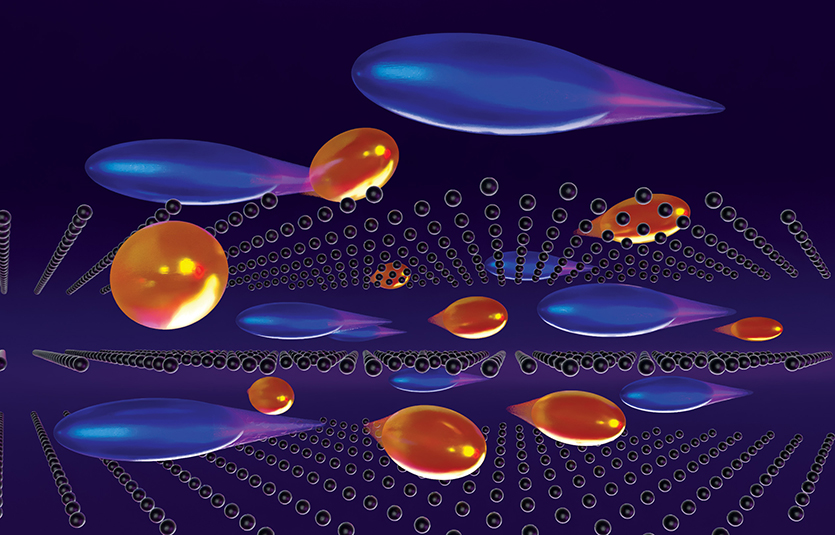
The implications could be far-reaching.
“These materials could help with integrated thermal management to cool computer chips in data centers and to convert waste heat into electrical energy,” Grayson said.
Grayson is an expert in the design, fabrication, and electrical and thermoelectric characterization of electronic devices and materials. This research is featured on the inside-cover of the Journal of Materials Chemistry A in the paper “Essential Role of Temperature-Dependent Band Gaps in (p × n)-Type Transverse Thermoelectrics: Partial Gap Analysis of Re4Si7,” published Feb. 3.
Moving forward, Grayson said the next steps are to teach the greater thermoelectric community how to apply this method to a broader range of materials so that new transverse thermoelectric materials can be discovered and optimized.