

Backed by Philanthropy, CEVO Advancing Personalized Glaucoma Treatment with AI and Imaging
The center will advance its work by developing cutting-edge tools to better treat the disease
The Northwestern University Center for Engineering in Vision and Ophthalmology (CEVO) connects engineering innovations with clinical needs in ophthalmology by developing, translating, and sharing new tools to improve the diagnosis and management of vision loss, and ultimately, to restore sight.
Backed by a $400,000 gift from the Forsythe Family Foundation, CEVO will advance its work on glaucoma by developing innovative tools to better understand and treat the disease.
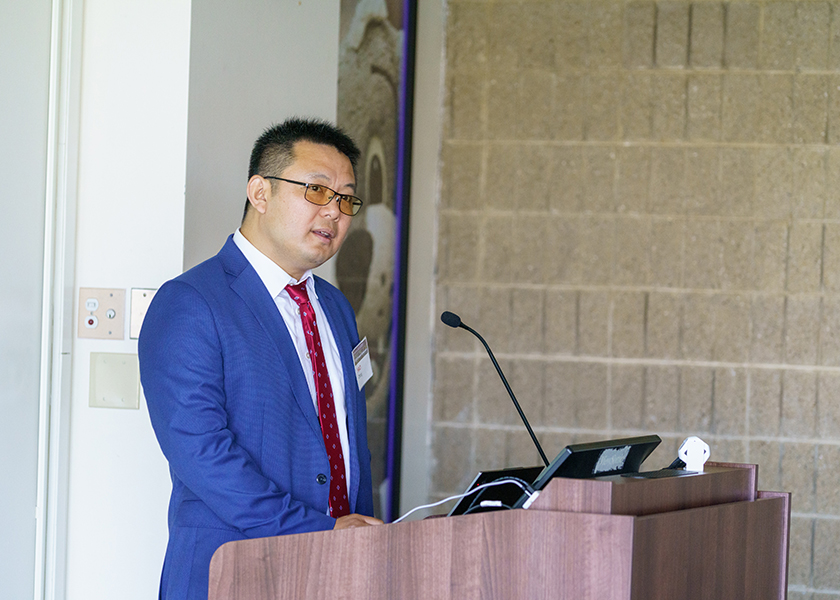
“This support will be a cornerstone for building the infrastructure for the center and our important work to move forward,” said Northwestern Engineering’s Hao F. Zhang, the CEVO director.
Launched last year, CEVO engineers will create a new high-resolution, AI-integratable imaging technology to capture the detailed anatomy of the eye’s fluid drainage process, a system that helps maintain healthy eye pressure. These images, taken at approximately 1 µm resolution, will be used to generate a digital twin of each patient’s eye.
This level of detail could improve the next generation of personalized treatments for glaucoma, one of the world’s leading causes of permanent blindness.
Current treatments come up short
Glaucoma leads to damage to the optic nerve, which connects the eye to the brain and is essential for vision. This damage is most often linked to elevated pressure inside the eye, known as intraocular pressure. The eye constantly produces a clear fluid called aqueous humor, which flows through the front of the eye and drains out through a network of sophisticated, tiny channels. When these drainage pathways become blocked or don’t work properly, fluid builds up and pressure increases. Over time, this elevated pressure can harm the optic nerve and lead to vision loss.
“The root cause is believed to be the impaired outflow, and then the reduced flow causes the pressure,” Zhang said. “If we can find a way to address the flow challenges, we can prevent pressure from building up downstream. That’s the initial goal.”
Currently, the only proven non-surgical treatment to treat pressure buildup inside the eye is intraocular pressure reduction through medication. However, this form of treatment becomes less effective over time, and ultimately, many patients need surgery. One of the first-line surgical procedures is known as minimally invasive glaucoma surgery (MIGS), which safely and quickly lowers intraocular pressure by placing a stent in the eye along the flow pathway. While MIGS can be effective for many, its overall success has been limited.
Zhang and colleagues believe this is due to a lack of personalized information about each patient’s eye structure and function, which prevents tailored surgical planning. These models may also inform decision making in second line surgical treatments that attempt to bypass some of the channels and possibly provide insight into additional targets for medical treatment.
Using AI for personalized care
CEVO’s high-resolution, AI-integrated imagery could bridge that gap and help create a 3D model of each patient’s eye. Instead of placing the stent in the easiest insertion area, a surgeon could view the digital twin and know exactly where to place the stent informed by a well-trained AI agent to predict the surgical outcome ahead of the actual surgery.
This gift from the Forsythe Foundation and CEVO is perfectly timed to accelerate our discoveries which will undoubtedly lead to better treatment for our patients.
“AI is now driving all aspects of our lives,” Zhang said. “Engineering and AI have to be integrated.”
Zhang is a professor of biomedical engineering at the McCormick School of Engineering. He codirects CEVO with Nicholas J. Volpe, the George W. and Edwina S. Tarry Professor of Ophthalmology and chair of the Department of Ophthalmology at the Northwestern University Feinberg School of Medicine.
“One of Northwestern’s great strengths is the expertise it has in both engineering and ophthalmology,” Volpe said. “This gift from the Forsythe Foundation and CEVO is perfectly timed to accelerate our discoveries which will undoubtedly lead to better treatment for our patients.”
Northwestern Engineering’s Cheng Sun, a professor of mechanical engineering, and Mark Johnson, a professor of biomedical engineering, are also contributing to the research.