

A Conversation with New Chair Danielle Tullman-Ercek
In a Q&A, Tullman-Ercek discusses her vision for ChBE, her priorities as chair, and how her experiences in research, education, and industry will inform her leadership.
Taking on the role of chair of Northwestern Engineering’s Department of Chemical and Biological Engineering (ChBE) has offered a new perspective on a community Danielle Tullman-Ercek already knows well.
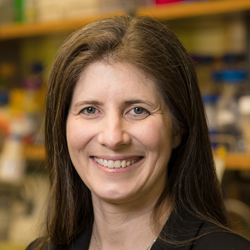
The first weeks in her new role have been shaped by conversations with faculty, staff, and students about their work and what they hope to accomplish. Those interactions are helping inform how Tullman-Ercek approaches the department’s future.
“I am most excited to get to know all of my colleagues in this new capacity,” said Tullman-Ercek, who is also James N. and Nancy J. Farley Professor in Manufacturing and Entrepreneurship and co-director of the Center for Synthetic Biology. “Just one month into the role, the highlight of each day has been hearing from faculty, staff, and students about the ideas, opportunities, and goals they aim to achieve.”
Tullman-Ercek, who succeeds Justin Notestein as department chair, also brings lessons from her own research career, including firsthand experience with the role industry partnerships can play in advancing research and opening opportunities for students.
In the following Q&A, she discusses those experiences, her priorities as chair, and what excites her about leading ChBE.
What is your vision for the Department of Chemical and Biological Engineering, and how do you plan to guide it through the next phase of growth and innovation?
The Department of Chemical and Biological Engineering is a thriving community of people working to solve societal problems across application areas from energy to materials to sustainability to human health. My vision is to maintain that identity as we continue to add expertise that complements the community we have, and to ensure that we maintain our strong collaborative and engaged spirit.
Northwestern ChBE spans areas from synthetic biology and biotechnology to sustainability, materials, and catalysis. Where do you see the greatest opportunities to build connections across those strengths and shape the department’s next chapter?
Our educational mission is the heart of the department and thus the most natural place to build such connections. Some of our most successful interdisciplinary efforts emerged through training programs that fostered curricula as well as collaborative interactions. For example, our synthetic biology program took off upon securing funding to launch a new graduate curriculum for training both in the classroom and in the lab.
We will also aim to build connections through strategic faculty hiring. Bringing in scholars whose work spans multiple areas can create bridges across the department and open entirely new avenues for collaboration. I would be particularly excited by opportunities at intersections such as materials and catalysis or process systems engineering and sustainability, where we can build upon existing strengths.
A third opportunity is to foster and support faculty-led interdisciplinary teams striving to solve ambitious scientific and/or societal challenges. These collaborations can in turn become large, center-scale initiatives. I was excited to see that the University's new Nexus Labs Competition program also seeks to foster this type of innovation.
I will be looking to pursue each of these types of initiatives to position ChBE to lead in emerging areas while strengthening the collaborative culture that has long been one of our greatest assets.
Your work at Northwestern has crossed research, education, entrepreneurship, and the translation of discoveries beyond the lab. How will those experiences shape your priorities for ChBE as chair?
At this point, I do feel like I have taken a deep dive into nearly every aspect of the academic mission! These experiences gave me a strong appreciation for how research, education, entrepreneurship, and translation all collectively work together to maximize the positive impact of our work. As a department, we must continue to excel across each of these areas. Therefore, one of my priorities as chair is to enable the community to pursue activities that are aligned with these goals. I am hopeful that my past experiences will help me support new initiatives and navigate the inevitable challenges that arise when pursuing ambitious new ventures.
How do you plan to build on Justin Notestein’s accomplishments as Chair, and what aspects of his leadership do you most admire or hope to continue?
Justin led our department through some tough challenges as we adapted to a rapidly changing world, all while growing our faculty and undergraduate enrollment. One quality I especially appreciated was his ability to anticipate the broader consequences of a decision. He had a remarkable intuition for the ripple effects that even small changes could have across the department and for acting in ways that kept the department strong and moving forward.
I hope to bring that same thoughtful, long-term perspective to this role as I work with our faculty, staff, and students.