
#12
Best Chemical Engineering Programs
by U.S. News & World Report

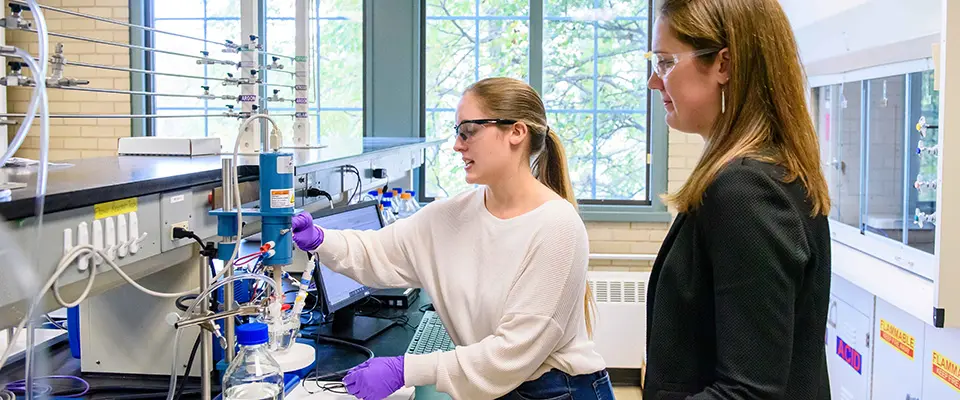
Chemical engineers tackle problems ranging from the molecular level to the planetary scale (and beyond). The skillset you'll build as a chemical engineer will position you to be able to solve a wide variety of problems across numerous industries, such as renewable energy, biomanufacturing, clean water, plastics recycling, and human health. Chemical engineers develop products that better our lives, whether they are conducting research in synthetic biology in the lab or rethinking large-scale industrial processes.
In Northwestern’s highly-ranking bachelor of science in chemical engineering program, you’ll learn from world-renowned faculty who are researching across traditional boundaries and are committed to excellence in teaching. Participate in hands-on research within and beyond the classroom, join a supportive community of students, and engage in career development programs. Our program emphasizes both technical skills and critical thinking, preparing graduates who are adept at innovating new processes, developing cutting-edge chemical products, and managing technical teams.
Study with world-class faculty members committed to excellence in teaching
by U.S. News & World Report

Our faculty boasts numerous National Science Foundation PYI/NYI/CAREER Award recipients, Packard Science and Engineering Fellows, and National Academy of Engineering members. Several have also received top teaching awards at the university.
by U.S. News & World Report

Lounds Foster oversees the agile, interconnected global supply chain necessary for propelling product development and industrializing nascent technology platforms to deliver innovative treatments to patients faster.

Lisse and her colleagues in technical development at Moderna help define the manufacturing processes that go into therapeutics items like the COVID-19 vaccine, which is crucial to help get the inoculations into people’s arms across the globe.

Hinton turned his chemical engineering studies into a multi-decade investment career, leveraging his academic background to gain an advantage in conducting fundamental research on companies and their business operations.
The basics at-a-glance
The bachelor of science in chemical engineering is a unique major that exists at the intersection of science and engineering. Building on a foundation of chemistry, biology, physics, and mathematics, our ABET-accredited program expands student expertise to thermodynamics, transport processes, and chemical kinetics.
Students must complete 48 courses, including required courses in mathematics, engineering, and science; core chemical engineering major courses; and five technical electives that may be used to create an individualized area of specialization within the major.
Built on two course sequences, Engineering Foundations and Design Thinking and Communication (DTC), our undergraduate core curriculum gives students a foundation in data science, probabilistic reasoning, programming, and human-centered design. Students begin putting what they know to work immediately on real design problems from community partners.
McCormick’s Combined Bachelor’s/Master’s Program allows undergraduates to pursue a bachelor’s degree (BS/BA) and master’s degree (MS) simultaneously, shortening the time required to earn a master’s degree.
Supplement your degree with programs that prepare you for the next step in your education and career.
Students in the chemical engineering program can pursue complementary certificates and minors.
This minor provides specific training for students to enter and contribute to growing fields in the bioprocess industries. It also provides in-depth preparation for future graduate study.
The Cooperative Engineering Education Program allows you to receive up to 18 months of engineering experience in industry while you pursue a degree in a highly-ranked program.
Hands-on experience in modern laboratories
Gain in-depth knowledge in your particular field of interest and prepare yourself for graduate study or post-graduate work.
Beyond the classroom
Enhance your education even further through our many opportunities to network and broaden your worldview.
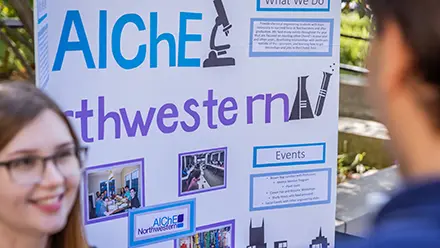
Join the student chapter of the American Institute for Chemical Engineers or find your community among the one of the many McCormick student organizations.
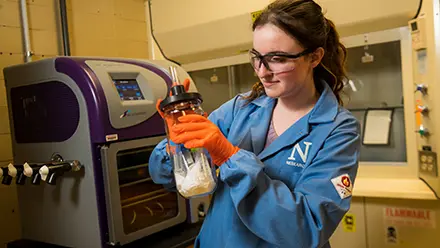
More than half of chemical engineering students engage in undergraduate research, working directly with faculty to define new frontiers of synthetic biology, biotechnology, bioprocessing, and energy.
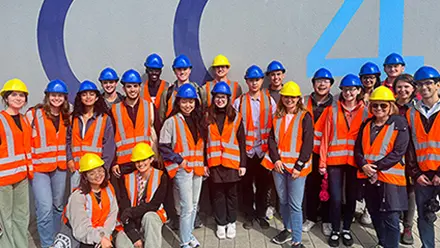
Northwestern encourages students in all of its undergraduate schools to study abroad. McCormick Global Initiatives offers a weeklong Global Engineering Trek that exposes students to real-world advances in water management, hi-tech innovation, and sustainability in energy and the environment.
Where do we go from here?
The undergraduate program prepares students for graduate study or practicing engineering. With a chemical engineering degree, students pursue careers in many industries, including the pharmaceuticals, food, chemicals, energy, sustainability, consumer products, and consulting industries. Graduates are also well prepared to apply their broad training for careers in entrepreneurship, medicine, law, government, and education.
While at Northwestern, our students engage in professional development opportunities that build leadership, communication, and real-world problem-solving skills. They have access to internships and extensive career placement resources via both Northwestern Engineering Career Development and Northwestern Career Advancement.
Where our alumni work in industry








Where our alumni attend graduate school




We encourage you to visit our campus and learn about Northwestern Engineering firsthand.