
The Problem
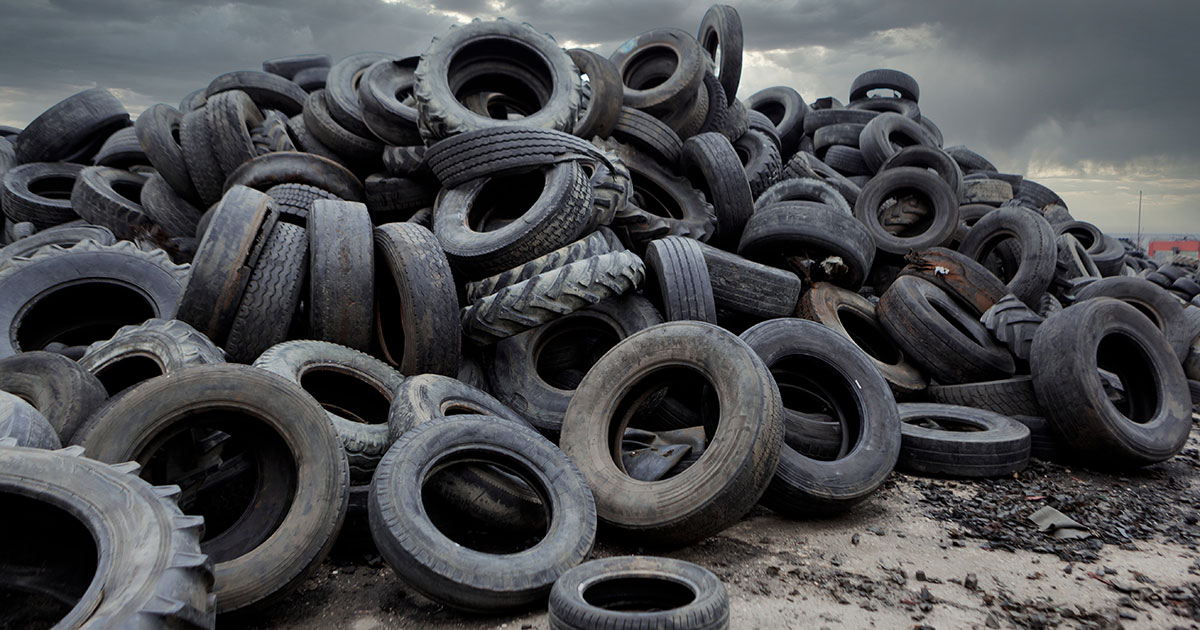
Conventional crosslinked polymers found in car tires, rubber bands, and other everyday items are durable, but their permanent crosslinks prevent them from being recycled.

Conventional crosslinked polymers found in car tires, rubber bands, and other everyday items are durable, but their permanent crosslinks prevent them from being recycled.
Researchers developed crosslinks that remain strong during use but can break and reform during reprocessing, allowing the material to be recycled multiple times.
The approach could make widely used crosslinked polymers recyclable using improved industrial processes.
Professor John Torkelson; PhD graduates Boran Chen (PhD ’24), Logan Fenimore (PhD ’25), Yen-Wen Huang (PhD ’26), and Mathew Suazo (PhD ’26); Dow researchers Evelyn Auyeung (PhD ’14), Stephanie Barbon, Hayley Brown, and Colin Li Pi Shan.
Northwestern Engineering’s John Torkelson and eight collaborators from Northwestern University and the Dow Chemical Company have been selected to receive the 2027 Cooperative Research Award in Polymer Science and Engineering from the American Chemical Society’s (ACS) Division of Polymeric Materials: Science and Engineering (PMSE). An award symposium in their honor will be held at the Spring 2027 National ACS Meeting in New Orleans. The award recognizes outstanding cooperative research among industrial, academic, and national laboratory scientists.

Along with Torkelson, Walter P. Murphy Professor of Chemical and Biological Engineering and Materials Science and Engineering at the McCormick School of Engineering, honorees include four researchers who conducted the work as PhD students in his group: Boran Chen (PhD ’24), Logan Fenimore (PhD ’25), Yen-Wen Huang (PhD ’26), and Mathew Suazo (PhD ’26). In addition, recipients include four collaborators from Dow: Evelyn Auyeung (PhD ‘14), Stephanie Barbon, Hayley Brown, and Colin Li Pi Shan.
The collaboration, supported through Dow’s University Partnership Initiative, has spanned nearly seven years to address a persistent problem in polymer recycling: how to give crosslinked polymers the durability that makes them useful without making them permanently unrecyclable.
For Torkelson, who joined Northwestern in 1983, the recognition also reflects a research direction he has pursued for decades.
“Sometimes the most important thing to do is to work on things that people think can’t be done,” said Torkelson, an expert in polymer science and engineering, particularly sustainable and recyclable polymers, polymer processing, and polymer nanotechnology, who has been energized by the success of the partnership.
The project began with skepticism. The team’s first paper demonstrating its reprocessable polyethylene networks was rejected. The team then submitted the manuscript to another journal, where it received strong reviews and was later recognized as one of the journal’s most popular papers of 2022. That paper became the foundation for much of the research now being recognized by the ACS PMSE award and pursued toward commercial application.
The research has since produced more than 20 publications and multiple patent filings. Torkelson sees its development from a small-scale university experiment to commercialization research as an example of what sustained relationships between universities and companies can accomplish.
Crosslinked polymers are everywhere, from rubber tires and rubber bands to foam mattresses. Crosslinks tie long polymer chains together, creating some of the most robust materials.
That durability, however, creates a recycling problem. Unlike thermoplastics, whose molecular chains can move past one another when heated, conventionally crosslinked materials cannot return to a flowing melt state that allows them to be reshaped.
“Once it’s made, you can never take a rubber band back into a melt state, Torkelson said.
His group developed a different approach. They created crosslinks that remain robust under normal use conditions but become dynamic at the elevated temperatures used during reprocessing. At those temperatures, the bonds forming the crosslinks can dissociate, allowing the material to be reshaped. As the material cools, the bonds reform.
The approach has been demonstrated with polyethylene and polypropylene, which together account for more than half of the roughly 1 trillion pounds of polymers and plastics produced globally each year. Currently, less than 10 percent of that total is recycled, Torkelson said.
The new method is designed as a relatively simple modification of an existing industrial process. Permanently crosslinked polyethylene is already manufactured by adding an initiator to polyethylene. Torkelson’s approach adds a small amount of a dynamic crosslinker to that process.
“Industry doesn’t have to develop a whole new process to accommodate this,” Torkelson said. “We can modify the existing process.”
That alignment can eliminate the need for new machinery and reduce the amount of process development required before adoption. Torkelson said the approach might require adjustments to some processing conditions, but it remains a relatively small variation on technology already used commercially.
The research could have implications beyond recycling. In recently published work, Huang and Torkelson found that converting polyethylene into the group’s crosslinked systems also made the material more resistant to wear. In tests, the materials exhibited more than a one-third reduction in wear, measured through volume or mass loss, compared with the polyethylene from which they were derived.
Because everyday wear of plastics can produce microplastics, Torkelson said the increased durability raises another possibility for the research.
“The crosslinks just lead to more durable materials that will actually wear less,” he said. “This even has an implication for potentially mitigating microplastic formation.”
Much of the project’s development has depended on the complementary capabilities of Northwestern and Dow.
At Northwestern, Torkelson’s group develops ideas, studies their underlying science, and demonstrates them at laboratory scale. Dow brought expertise and facilities needed to test whether those concepts could move toward larger-scale manufacturing and commercial applications.
“This was a case where they have real expertise in terms of large-scale processing, and we do everything at the university at small scale,” Torkelson said. “I’ve learned a lot from Dow. They have learned a lot from us.”
What began as a three-year Dow project supporting one graduate student expanded as the results accumulated. Fenimore, who had received a National Science Foundation fellowship, also joined the effort. Torkelson said Dow typically supports university projects for about three years before moving to new research questions, but the polymer work continued beyond that initial period with funding for two graduate students.
This was a case where they have real expertise in terms of large-scale processing, and we do everything at the university at small scale. I’ve learned a lot from Dow. They have learned a lot from us.
Dow has since conducted commercialization research based on the Northwestern technology at facilities in Lake Jackson, Texas, and Shanghai, China.
One area Dow has explored is molded footwear. Such products offered a relatively small consumer application through which the company could test the technology and its recyclability. Torkelson said Dow researchers demonstrated that a used crosslinked product could be cut into pieces, reprocessed, and used to make a new product. Waste material created during injection molding could similarly be fed back into the manufacturing process rather than discarded.
The partnership also provided an education that extended beyond Torkelson’s laboratory.
Chen, Fenimore, Huang, and Suazo carried out the bulk of the university research, Torkelson said, while gaining exposure to industrial research and the process of moving a scientific idea toward application.
The 2027 honor marks the first time the Cooperative Research Award has recognized the graduate students who performed much of the university research in addition to faculty and industrial researchers. For Torkelson, their inclusion in the Cooperative Research Award is particularly meaningful.
The four researchers have since moved into industry and academic research. Huang joined Dow, Suazo joined AOC Formulations, and two are pursuing postdoctoral research, including Fenimore at the National Institute of Standards and Technology and Chen at the University of Illinois Urbana-Champaign.
While Torkelson cautioned that not every university-industry research project will produce the same results, he said this collaboration has proven mutually beneficial for a relatively modest industrial investment.