Using AI to 'Create Tangible Impact'
Vishal Shrivastava (MSAI '23) did not grow up around computers.
In his hometown of Rewa in India, owning one was seen as a luxury. In his middle school, he got 40 minutes every week to type on his classroom's desktop computer.
It wasn't until he was in high school that he became truly interested in them — and their potential. Vishal participated in a state-organized science and technology field trip to several Bangalore research institutions, including the Centre for Mathematical Modelling and Computer Simulation, where there was a supercomputing facility.
"I barely understood the work they were doing there," Vishal said, "but the whole environment got me fascinated."
Vishal became engrossed, plowing through different books about computers and their evolution. He earned his bachelor of engineering in computer science from India's LNCT Group of Colleges, but while his classmates focused on web development and coding competitions, Vishal's passion became artificial intelligence.
"To me, AI has never been artificial," he said. "It's a continuation of natural intelligence, an evolution of our own ability to create and understand systems that think. The curiosity about how we turned rocks into thinking machines has kept me captivated ever since."
That captivation is what led him to Northwestern Engineering's Master of Science in Artificial Intelligence (MSAI) program. He knew of the University's reputation, but what appealed to him about MSAI was the program's cohort-based structure.
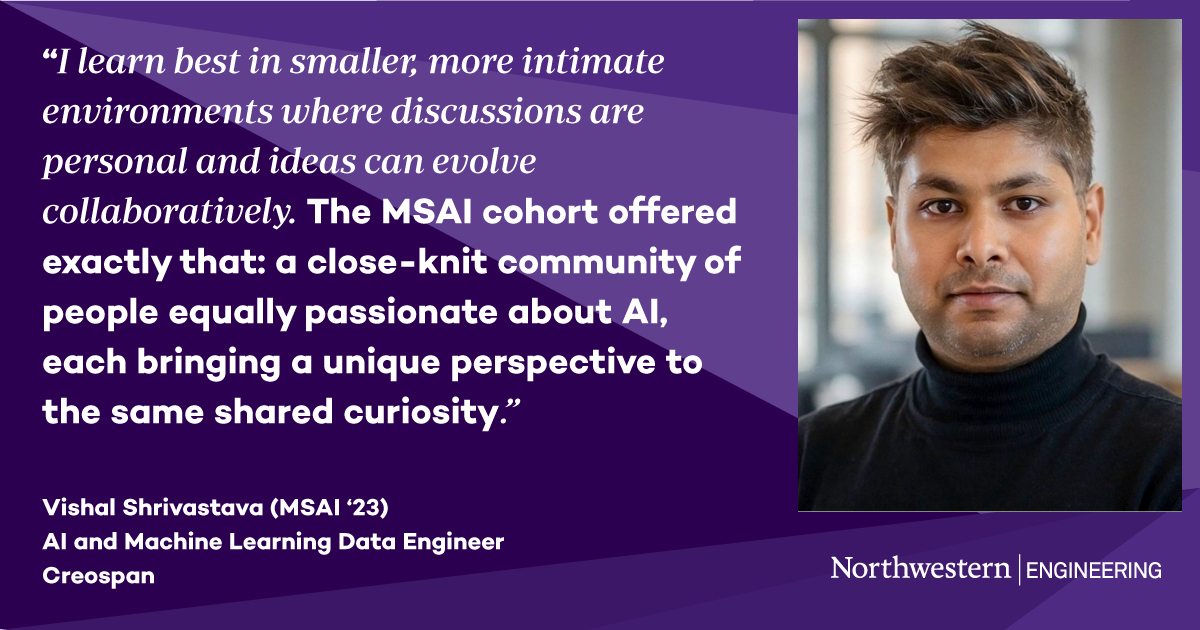
"I learn best in smaller, more intimate environments where discussions are personal and ideas can evolve collaboratively," Vishal said. "The MSAI cohort offered exactly that: a close-knit community of people equally passionate about AI, each bringing a unique perspective to the same shared curiosity."
Today, that curiosity guides Vishal in his work as an AI and machine learning data engineer at technology consulting and engineering firm Creospan. His role on the data and AI team places him at the intersection of research and engineering — allowing him to combine research and development with production-grade implementation to design AI-enabled solutions for clients.
"What excites me most is operating at the sweet spot between advancing the frontiers of AI and using it to build real-world systems that create tangible impact," he said. "Each project offers a window into how AI can be meaningfully embedded within real enterprise processes, not as a buzzword, but as a core enabler of efficiency, intelligence, and transformation."
For Vishal, that transformation effort extends beyond Creospan. While in MSAI, he collaborated with Northwestern's Pediatric Speech Technologies and Acoustics Research (PedzSTAR) Lab to classify speech disorders using audio data. After graduating he joined the lab as a volunteer research assistant focusing on automatic speech recognition (ASR).
"A key challenge we're addressing is that state-of-the-art ASR models struggle to generalize to children's speech—their acoustic and linguistic patterns differ significantly from adult speech, leading to poor recognition accuracy," Vishal said. "We're also tackling the lack of fairness and inclusivity in speech datasets, developing methods that reduce demographic bias across age, gender, and speech disorders while maintaining high performance."
In both of his roles, Vishal routinely finds himself relying on lessons learned during his time in MSAI. The program helped him understand how to collaborate across disciplines. It helped him learn how to translate academic concepts into productive systems.
Perhaps most importantly, MSAI taught him the importance of understanding the problem at hand before attempting to create a solution.
"I start every project by interrogating the problem space before writing a single line of code," Vishal said. "That discipline ensures the systems I design address real business or user pain points rather than convenient technical stand-ins."