Keeping Devices Running Smoothly
Monish Bangalore Vijay Kumar (MSAI ’26) built an AI tool that monitors hardware stress and recommends steps to keep devices running safely and smoothly.
The sound is subtle—a persistent fan whirring—but the impact can be devastating.
When a computer's hardware fails, it can make the frame rate stutter, the screen freeze, or, in the worst-case scenario, the device fail altogether.
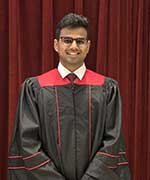
Monish Bangalore Vijay Kumar (MSAI '26) created a solution for the problem. He was part of a three-person team in The Practicum in Intelligent Systems course that built a Large Language Model (LLM) that users can easily interact with to diagnose the cause of poor computer performance.
Its name is EdgePilot.
“In most settings, answering questions like ‘What is slowing down my job?’ requires manually inspecting dashboards, logs, and monitoring tools. That process takes both time and deep expertise,” said Monish, a student in Northwestern Engineering's Master of Science in Artificial Intelligence (MSAI) program. “EdgePilot interprets live computer processing units, graphics processing units, memory, disk, network, and power data and provides actionable recommendations.”
EdgePilot can monitor a system and make recommendations about what background operations to stop—and in what order—to avoid the problem in the first place.
But EdgePilot’s application goes far beyond gaming computers. It can be used on machines ranging from high-performance, heavily taxed research computers to an average, everyday laptop used for work or school.
“Students running heavy workloads can quickly diagnose performance issues, avoid overheating or battery drain, and make smarter scheduling decisions,” Monish said. “With alerts enabled, they can be notified when thresholds are exceeded or tasks are completed, even when away from their device.”
EdgePilot’s creation was the result of an innovative class that brings students together from a variety of Northwestern programs. The Practicum course includes students from MSAI, Northwestern Engineering's Master of Science in Computer Science (MSCS) program, and undergraduate third- and fourth-year students.
The 10-week class pairs small groups of students with researchers from across Northwestern to help clarify their technology needs and build systems that meet them.
Monish's team was assigned to Yongho Kim from Northwestern – Argonne Institute for Scientific and Engineering Excellence (NAISE). The lab was established in 2013 and aims to drive collaborative breakthroughs in fields ranging from energy and materials to data science and national security.
Working with NAISE on the Practicum project was exactly the type of assignment that drew Monish to the MSAI program.
“MSAI appealed to me because of its applied orientation,” he said. “I wanted to study AI in the context of real systems and real constraints, not just theoretical models. The opportunity to work with external clients and build something production-oriented was a major draw.”
That is just what he did with EdgePilot.
Instead of having to interpret vague and complicated dashboards, users can query the LLM in the same natural way they interact with ChatGPT, Copilot, or other AI models. Questions to help a user diagnose or avoid a system logjam include:
- Can I run this job now?
- What is bottlenecking my system?
- When should I schedule these GPU tasks?
“This project reinforced how difficult it is for users to make optimal decisions using dashboards alone,” Monish said. “EdgePilot preserves rigor while improving accessibility.”
Put plainly, it can help keep your computer running smoothly and safely, whether you are a student, researcher, instructor—or gamer.
Monish said what he learned from Practicum and the collaborative effort with students from other programs will stay with him during the rest of his MSAI experience—and beyond.
“This project reinforced how important it is to build AI systems thoughtfully and responsibly,” he said. “It is not just about what AI can do, but where it genuinely adds value.”