An Always-Available Teaching Assistant
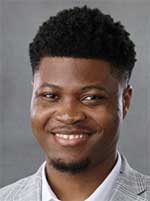
Sam Setsofia (MSAI ’25) helped build an AI education aide that provides students with consistent, instructor-aligned support anytime they need it.
Sam Setsofia (MSAI ’25) has a response to the seismic shift shaking up higher education since the rapid adoption and availability of AI.
He was part of a group in The Practicum in Intelligent Systems course that created TA Buddy, an always-available AI extension of college professors and their teaching assistants to guide students toward correct information—not simply provide it at will.
The Practicum course brings together students from a variety of Northwestern programs, including Northwestern Engineering's Master of Science in Artificial Intelligence (MSAI) program, Northwestern Engineering's Master of Science in Computer Science (MSCS) program, and undergraduate third- and fourth-year students. The students form small groups and partner with a Northwestern researcher to help clarify their technology requirements and build systems that meet those needs.
Sam’s small group teamed with Carolyn Tang Kmet, an associate professor in the Medill School of Journalism, Media, Integrated Marketing Communications.
“What she wanted was for students to have meaningful help available even after class hours, something that extended her presence and her pedagogy without requiring her to be physically there every time a student had a question,” Sam said. “We had a real user, a real problem, and permission to go deep to solve it.”
The early weeks of the course were spent gaining a full understanding of the pain points for both stakeholders—Kmet and her students. Sam and his teammates drew on conversations and workshops facilitated with more than 50 Northwestern faculty members to gain a detailed grasp of the challenge.
He said one key to the team’s ultimate success was how they approached the task.
“We weren't trying to solve AI-in-education as a concept,” he said. “We were trying to solve it for this instructor, these students, this course. That focus is exactly what I think an applied practicum should offer, and our team felt the energy of that from the start.”
That energy led to TA Buddy, which provides anytime assistance to students aligned with what a professor teaches and how she teaches it. The AI-driven helper incorporates actual classroom material and is designed to emulate an effective human teaching assistant who deeply understands the professor’s expertise.
Instead of simply returning answers to queries, TA Buddy guides students to discover the course’s core ideas for themselves. TA Buddy breaks problems down into manageable steps, ensuring students understand before moving forward. It also features a motivation enhancer agent that reinforces learning goals, encourages effort, and keeps students accountable.
On the flip side, professors can see what questions students are asking to get a better feel for what teaching is landing and what areas might need more in-class focus.
“What makes it distinct is that it doesn't replace the instructor, it extends the instructor,” Sam said. “Students get help grounded in what their instructor actually teaches, instructors get visibility into how students are engaging with the material, and the AI is guided by real educational methodology and not just the ability to generate plausible-sounding text.”
That, Sam said, is education reimagined. And it’s exactly what he hoped the MSAI program would do for him.
Sam came to the United States from Ghana, where he earned a bachelor’s degree in biomedical engineering from the University of Ghana. While in the school's library, he read an article about AI’s potential in healthcare.
“Something shifted in me. I started reading everything I could find about AI,” he said. “That's what brought me to MSAI. I wasn't looking for a credential. I was looking for the foundation I had never been given.”
That is exactly what he found.
"The hardest problems in AI are rarely the models," Sam said. "They're the design layer, how the system behaves when it's uncertain, how you build trust with skeptical users, how you make something technically capable also feel genuinely useful. That gap between what AI can do and what it should do in a given context is where most of the real work lives."