The Healer’s Assistant
Shivangi Sharma (MSAI ‘22) and her company MedMitra AI are part of a technological revolution taking place in India’s hospitals.
The clock struck midnight in a hospital in Mumbai, India, and yet another exhausted medical resident remained hunched over a desk, sifting through medical files and a random assortment of data to help chart a patient’s progress.
This scene, all too familiar in India’s crowded hospitals, sparked an idea that aims to change the face of healthcare in the world’s most populous country.
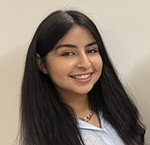 Shivangi Sharma (MSAI ‘22) is founder and chief technology officer of MedMitra AI, a healthtech platform specializing in autonomous AI agents that assist doctors in making faster, more accurate decisions.
She vividly remembers the moment that set her on her current path.
“My co-founder, Dr. Anushka Sharma, would often message me after her shift, frustrated that she had to sift through so many files manually to find the relevant information about any given patient,” Sharma said. "Those frustrations, repeated night after night, convinced us that clinicians needed an AI teammate.”
MedMitra AI’s goal is to be that teammate and offer a lifeline for India's overworked doctors, providing AI-powered tools that streamline everything from patient consultations to complex diagnoses. In a country where physicians often see hundreds of patients daily, every saved minute counts.
In the United States, 66 percent of physicians reported using AI in 2024, up from 38 percent just a year earlier, according to the American Medical Association. That number stood at just 12 percent in India, underscoring the company's opportunity.
MedMitra AI's impact is already evident. At a 300-bed tertiary hospital, the company’s discharge-summary generator trimmed the average completion time from roughly four hours to under an hour, Sharma said. In a busy district hospital handling about 450 outpatients daily, doctors now finish documentation before lunch, freeing up two extra consultation slots per clinician.
The goal of the company is to give doctors back their most precious resource: time — time to connect with patients, to think critically, and sometimes, just to catch their breath in the cauldron of a high-pressure environment.
Sharma said her journey to founding MedMitra AI was shaped by her time in Northwestern Engineering's Master of Science in Artificial Intelligence (MSAI) program. Its blend of rigorous theory and real-world application proved invaluable, she said.
“MSAI drilled into me that a pretty curve on a graph isn’t the same as a safe tool at the bedside,” Sharma said. “One project can look flawless, yet a single missed pneumonia on an edge-case X-ray would mean a real patient going home untreated.”
This lesson now guides MedMitra’s development process. Every new feature undergoes not just statistical validation, but also a “shadow week” where doctors provide feedback on its actual utility.
Today, MedMitra supports more than 150 doctors across five hospitals in major Indian cities. But Sharma’s vision extends far beyond those numbers. She sees AI not as a replacement for doctors, but as a powerful tool to augment their capabilities.
“Healthcare generates oceans of heterogeneous data yet still relies on fragmented human memory for synthesis,” Sharma said. “AI excels at pattern recognition across modalities and at real-time triage.”
As AI continues to transform healthcare globally, MedMitra AI could end up at the forefront in India. With its tailored approach to the unique challenges of the Indian healthcare system – from multiple languages to intermittent connectivity – the company is poised to make a significant impact.
Sharma's journey from MSAI student to AI innovator showcases the program’s emphasis on combining technical expertise with a deep understanding of real-world problems.
As she looks to the future, her vision is clear.
“I believe the next decade of medicine will be defined not by AI replacing doctors but by clinicians who wield AI outperforming those who don't,” Sharma said. “Northwestern gave me the toolkit to help build that future, and I'm grateful.”