The Cloud Classroom
MSAI and Microsoft collaborate for a special topics course called AI Platforms that teaches students industry-ready skills with generative AI in the cloud.
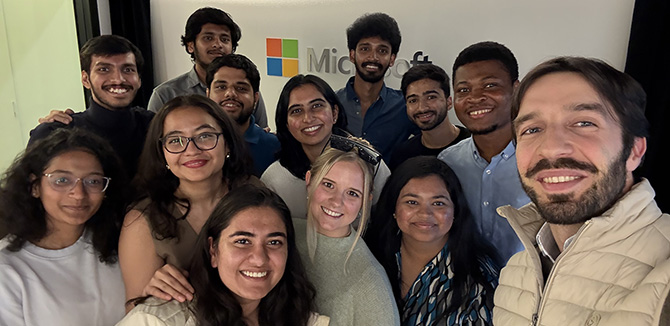
Students in Northwestern Engineering's Master of Science in Artificial Intelligence (MSAI) program recently got a unique experience to learn practical cloud skills related to generative AI while experimenting with Microsoft Azure.
Three Microsoft employees recently taught the special topics MSAI course called AI Platforms. The goal was to help students understand the behind-the-scenes skills necessary to develop and mass deploy computing solutions.
“In school, students often get a clearly defined project and a set of steps to follow. In our class, we flipped that script,” said Julia Heseltine, senior manager of global AI go-to-market strategy at Microsoft. Heseltine co-taught the course with Microsoft colleagues Pablo Salvador López and Arvind Periyasamy. “We handed them an ambiguous challenge, a toolbox full of possible technologies, and asked: ‘How will you design something that works?’”
The course proved to be anything but academic. It focused on business-world realities faced by today’s tech leaders. Leaning on Microsoft’s Azure cloud platform, students were challenged to work with a tech stack used in thousands of businesses in a wide array of industries across the globe.
In doing so, it taught students skills immediately translatable to their post-MSAI lives.
“Employers aren’t just looking for people who can recite cloud terminology. They want people who can confidently tackle a business problem, design an effective solution, and think about cost, scalability, and flexibility,” said Periyasamy, director of AI and analytics for health and life science at Microsoft. “By experimenting, making choices, and asking ‘What if?’ at every step, these students became the kind of adaptable, innovative thinkers the industry really needs.”
Qixuan Wang (MSAI ‘25) was one of those students. He said the course was his first exposure to Azure.
“By taking that course, it’s like opening a window for me,” he said. “It helped me explore all the functionalities in Azure and allowed me to do hands-on projects using it.”
That hands-on element was key to accomplishing the goals the trio of instructors set for the class.
For Salvador López, principal AI applications development architect at Microsoft, those goals were informed by his own early experiences.
“What lit me up about this course was the chance to give students exactly what I once craved – a peek behind the curtain of real production systems,” he said. “After years helping Microsoft’s largest customers deploy AI at scale, I’ve collected those scar-tissue lessons, and sharing them felt like handing students a fast-forward button on their careers.”
The instructors said they were impressed by the MSAI students. Periyasamy said they learned solution architecture quickly, asked sharp and thoughtful questions, and pushed to find alternative solutions that factored in cost and scalability.
But that wasn’t the learning limit.
“What makes it even more rewarding is that it’s truly a two-way street,” Heseltine said. “I learned just as much from them as they did from me.”
Editor’s note: The views and opinions expressed here are solely those of Julia Heseltine, Pablo Salvador López, and Arvind Periyasamy, and do not necessarily reflect the official policy, position, or endorsement of Microsoft or any of its affiliates. Any content shared is intended for informational purposes only and should not be interpreted as professional advice or guidance from Microsoft.