Targeting Success
Sagnik Sarkar (MSAI ‘23) is applying lessons from the MSAI program to create AI systems that improve cancer treatment outcomes
Lung tumors don’t sit still. They rise and fall with every breath, challenging doctors to deliver precise radiation. For Sagnik Sarkar (MSAI ’23), the moment he realized AI could solve this problem came while working with real patient data during his MSAI practicum.
Sarkar and his team developed an AI model that wasn’t just analyzing static images, it was predicting patient outcomes by tracking lung tumors during radiation therapy delivery as they moved sometimes infinitesimally with each breath. A new technology that could transform radiation therapy for thousands of patients had emerged.
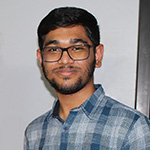 That potentially revolutionary moment occurred in Mohamed Abazeed's radiation oncology lab at Northwestern’s Feinberg School of Medicine, where Sarkar was working on his practicum project for Northwestern Engineering’s Master of Science in Artificial Intelligence (MSAI) program.
“Working with actual clinical data was particularly transformative,” Sarkar said. “Being able to test models I developed on real healthcare data and seeing their potential impact showed me that research could create tangible solutions for real-world problems, not just academic publications.”
Now a senior research technologist at Feinberg, Sarkar leads development of intelligent systems that address critical problems in radiotherapy planning and delivery. His work spans computer vision applications for analyzing CT scans and microscopic images, as well as natural language processing for tasks including report summarization and patient conversations.
The journey from MSAI student to senior researcher happened remarkably quickly.
Sarkar joined the lab full-time as a research technologist after graduating in winter 2023. He was promoted to senior research technologist less than one year later. His responsibilities have expanded from handling individual projects to managing multiple concurrent research initiatives across different parts of the radiotherapy workflow.
The centerpiece of Sarkar’s work involves solving one of radiation therapy’s most challenging problems: targeting moving tumors. Unlike most tumors that remain stationary, lung tumors rise, fall, and slide with each breath, creating a moving target for radiation beams.
“If the beam misses the tumor due to this movement, you end up irradiating critical healthy tissue like the heart, spinal cord, or healthy lung tissue while failing to deliver enough radiation to treat the cancer,” Sarkar said. “With modern radiation methods being incredibly precise and able to deliver high doses quickly, getting these boundaries exactly right is crucial for treatment success.”
Sarkar's team has developed iSeg, an AI-powered segmentation tool that tracks lung tumors through all breathing cycles and creates precise boundaries around them. The technology encompasses the entire tumor without including surrounding healthy tissue.
The research has yielded a particularly significant discovery: the correlation between areas physicians missed during tumor segmentation and tumor recurrence, suggesting treatment failures could be related to human error.
“What excites me most is working on projects that have direct, measurable impact on patient outcomes,” Sarkar said. “Our model’s performance could potentially improve treatment outcomes while speeding up planning and freeing physicians to focus on more complex decision-making tasks.”
The MSAI program proved instrumental in preparing Sarkar for this work. The program’s emphasis on collaboration across Northwestern's diverse schools and departments aligned perfectly with his belief that AI’s true potential emerges through partnerships with fields ranging from healthcare to astronomy and law.
“AI by itself is not fruitful,” Sarkar said. “It is the collaborations between departments that bring AI to life and help tackle pressing needs across different domains. This interdisciplinary approach is exactly how truly impactful projects come to be.”
Beyond technical skills, the MSAI program prepared Sarkar for leadership responsibilities. He now mentors team members, guides project strategy, and ensures research translates into clinically viable solutions. His role includes supporting other lab members, interns, and current MSAI practicum students, creating a full-circle mentoring relationship.
The potential impact of Sarkar’s work extends far beyond individual patients. The team is working toward clinical trials and eventually building a platform for widespread adoption to bring this technology to every cancer care center.
“Healthcare touches all of humankind, and the need and potential impact for AI are tremendous,” Sarkar said. “Being able to contribute to this transformation through rigorous, impactful research while continuing to learn and grow in such a collaborative environment is incredibly fulfilling.”