Taming the Research Tsunami
A trio of MSAI students used their practicum project to create an AI system capable of identifying contradictions and streamlining analysis among hundreds of neuroscience papers.
A trio of students in Northwestern Engineering's Master of Science in Artificial Intelligence (MSAI) program hope their recent project helps researchers stay afloat amidst the growing deluge of scientific papers flooding the field of neuroscience.
The students – Shruti Lakshminarayanan (MSAI '25), Xiao Qin (MSAI '25), and Asim Wahedna (MSAI '25) – focused their MSAI practicum project on more than 200 research papers spanning diverse neuroscience topics. The students' goal was to develop an AI-powered system that could read and understand the swell of research papers.
“Time savings was a major concern, but beyond that, the client emphasized the challenge of identifying and validating contradictory findings across hundreds of studies,” Wahedna said. “Automating this process meant not only improving efficiency, but also significantly reducing the risk of oversight and human error.”
This comes at a time when global research output continues to explode in science and engineering.
Since 1900, the number of published scientific articles has doubled roughly every 10 to 15 years, according to the Science Citation Index. The rise of the internet and its endless publishing possibilities has only accelerated this output.
But the flood of information has made researchers’ jobs more difficult. Keeping up on the latest research has become more challenging, and the number of papers later contradicted by new data is growing.
That makes the success of the work done by Lakshminarayanan, Qin, and Wahedna necessary and important to progress in the AI age.
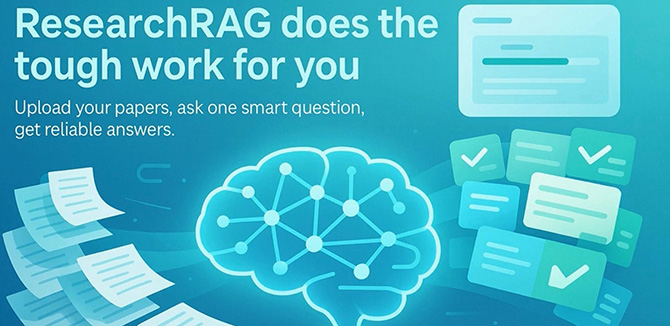
The students developed a retrieval-augmented generation (RAG) system, a hybrid AI architecture that enhances large language models by retrieving relevant information from databases or documents to generate a response to a user query.
“We quickly recognized that RAG modeling was the ideal approach,” Wahedna said. “We were excited by the challenge and motivated to apply our skills to build a solution that would deliver real value to our client.”
Their initial fear was that the biggest challenge would be creating a model that could handle such a large volume of data.
The challenge was something else.
“We soon realized that cost would be a limiting factor,” Wahedna said. “Striking the right balance between performance and affordability required extensive experimentation and careful model selection, which added a layer of complexity we hadn’t fully anticipated.”
The cost curveball ultimately proved to be a minor hurdle. The students built their RAG model within budget by leaning heavily on open-source tools and free-to-use models such as DeepSeek and Gemini for the foundation.
By the end of the 10-week practicum – a third-quarter project in the MSAI program that prepares students for a summer internship or work in a Northwestern lab – the trio presented a customizable solution with a user-friendly interface where researchers can generate chat assistants, fine-tune their parameters, and initiate interactive chat sessions to ask targeted questions. They also tied their model to external sources, including Google Scholar and arXiv, to expand its reach beyond the research papers they were provided at the outset of the project.
Throughout the project, the students leaned heavily on their MSAI coursework to guide their progress. A half-credit workshop on LLM engineering, taught by a team from Microsoft, proved incredibly valuable, as did core course lessons on natural language processing infrastructure.
The practicum itself prepared the students for life after the MSAI program, they said.
“While the MSAI program provides a strong foundation in technical and conceptual knowledge, applying those skills to build actual products under real constraints and with real stakeholders requires a different level of problem solving,” Wahedna said. "The synergy between these academic experiences and the practicum allowed us to build with confidence and translate theory into impact.”