Precision Partnership
A groundbreaking cancer treatment project sprung from a collaboration between Northwestern Engineering’s MSAI program and Northwestern’s Feinberg School of Medicine.
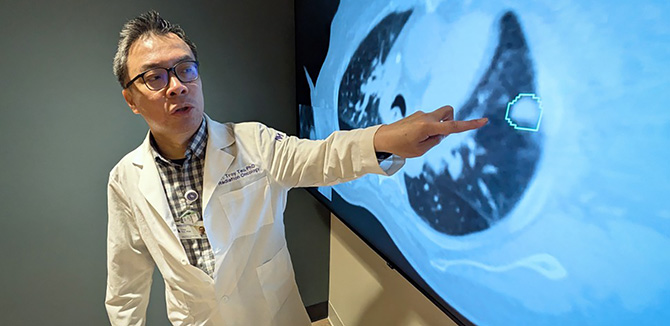
The correlation was striking. Reams of patient data showed that areas physicians missed while attempting to precisely define a cancerous tumor were linked to recurrence and an increased likelihood of death.
Sagnik Sarkar (MSAI '23), Troy Teo, and Mohamed Abazeed from Northwestern’s Feinberg School of Medicine discovered their new AI model could overcome this human fallibility to catch the oversight.
That groundbreaking research, published in NPJ Precision Oncology, emerged from the first partnership for a practicum project between Northwestern Engineering’s Master of Science in Artificial Intelligence (MSAI) program and Feinberg.
Led by Sarkar and mentored by Teo, a Feinberg radiation oncology instructor, the collaboration exemplifies how academic programs can be most effective.
“These practicum experiences are valuable in preparing students for success after graduation because they bridge the gap between theoretical learning and real-world application,” Teo said. “This exposure cultivates not only technical proficiency but also critical soft skills like communication, problem-solving, and adaptability, which are essential for thriving in professional environments.”
The project's ambitious goal was to use AI to segment lung tumors and predict radiotherapy treatment outcomes based on increased accuracy. Unlike previous AI tools that rely on static images, their iSeg model became the first 3D deep learning tool proven to segment tumors as they move during respiration, allowing radiation to be targeted at cancer cells more precisely to spare nearby healthy cells.
The research has garnered significant attention across medical and technological communities. The tool’s ability to flag missed regions linked to worse patient outcomes suggests it could catch high-risk areas that often go unnoticed.
For Teo, who has sponsored MSAI practicum projects for three years and worked with five different teams, the collaboration demonstrates the unique value MSAI students bring to medical research.
“MSAI students are equipped with the necessary technical background that contribute and complement our research work,” Teo said. “They tackle actual problems with tangible datasets, work within interdisciplinary teams, and navigate the challenges of scaling models to production settings.”
The practicum experience has proven transformative for participating students, including Sarkar, who now works in Teo’s department.
“The students have adapted to the research environment and contributed to numerous publications and conference presentations,” Teo said. “I’ve seen firsthand how these experiences accelerate students’ readiness to contribute meaningfully to industry or academic research roles immediately after graduation.”
Teo's unique background combines undergraduate studies in electrical engineering and computer science with a PhD in applying AI to radiation oncology challenges, as well as clinical training through a medical physics residency. This blend of technical and clinical expertise molds his mentorship approach and helps students understand how to apply AI tools in complex, high-stakes healthcare situations.
The iSeg project is just one example. Its publication in a prestigious journal and potential for clinical deployment within years demonstrates how academic partnerships can accelerate innovation while providing students with valuable research experiences.
The MSAI practicum itself can be a crucial differentiator for students entering competitive job markets. The hands-on experience with real-world applications combined with interdisciplinary teamwork and mentorship prepares graduates well for work post graduation.
“These experiences leave them much better prepared for the multifaceted demands of industry or further research,” Teo said. “It has been rewarding to see many of them go on to make meaningful contributions in AI-driven healthcare and beyond.”